

Dewey Wu General Manager & senior mechanical engineer at EPOC CRAFTER, 15 years in design engineering, quality, and metallurgy. Hands-on across CNC machining, metalwork, sheet metal, and prototyping (subtractive + 3D printing).
Five types of sheet metal cover most fabricated part specifications: 5052-H32 aluminum, 6061-T6 aluminum, 304 stainless steel, 1018 cold rolled steel, and galvanized steel. Property data for these grades traces to ASTM B209/B209M-21a (aluminum), ASTM A240/A240M-25 (stainless), and ASTM A1008/A1008M-26 (carbon steel sheet).
5052-H32 bends around a 2t diameter per ASTM B209. 6061-T6 requires 3t to 5t and cracks at tighter radii without annealing. Choosing 6061 where 5052 meets the load requirement adds 15 to 25% scrap on multi-bend enclosures.
This guide compares all five materials through a Five-Property Selection Matrix covering yield strength, formability, corrosion resistance, weldability, and cost. Each section gives ASTM-traced data, minimum bend radii, and a “when to use / when to avoid” decision boundary so you can lock the material choice during your DFM review before the drawing goes to production.
1. Five-Property Selection Matrix at a Glance
5052-H32 leads in formability and corrosion resistance. 6061-T6 delivers the highest aluminum yield strength but restricts bend geometry. 304 stainless provides 515 MPa minimum tensile strength and the best corrosion protection. 1018 costs the least and bends flat-on-itself. Galvanized steel matches 1018 formability with added zinc protection.
Table 1. Five-Property Selection Matrix
| Yield Strength | 160 MPa min (ASTM B209) | 240 MPa min (ASTM B209) | 205 MPa min (ASTM A240) | ~305 MPa typical* | ~305 MPa typical* |
| Tensile Strength | 215 MPa min (ASTM B209) | 290 MPa min (ASTM B209) | 515 MPa min (ASTM A240) | ~370 MPa typical* | ~370 MPa typical* |
| ASTM Bend Requirement | 2t diameter, 180° | 3t to 5t diameter, 180° | Not required (A240) | Flat-on-itself (A1008 CS/DS) | Flat-on-itself |
| Corrosion Resistance | Good, no coating needed | Moderate, needs anodize or chromate | Excellent, self-passivating | Poor, rusts without coating | Good, zinc layer G60 or G90 |
| Weldability | Good (MIG/TIG) | Good, loses T6 temper in HAZ | Good (TIG/MIG), work-hardens in HAZ | Excellent (MIG/TIG/spot weld) | Fair, zinc fumes need ventilation |
| Relative Cost per kg | Medium | Medium-high | High | Low | Low-medium |
| Specify When | Complex bent enclosures, marine parts | Structural brackets, machined + formed parts | Food, medical, chemical equipment | Cost-driven brackets, painted parts | Outdoor enclosures, HVAC, general structures |
* 1018 and galvanized steel values are typical ranges per ASTM A1008/A1008M-26 Table 3 (nonmandatory). Verify against mill test reports for your specific order.
Engineering Note
The core trade-off is yield strength versus bend diameter factor. 6061-T6 gives 50% more yield than 5052-H32 (240 vs 160 MPa), but the ASTM bend factor jumps from 2t to 3t minimum. On 2 mm sheet, minimum inside radius goes from 2 mm (5052) to 3 mm (6061). If design loads stay below 160 MPa and the part requires complex bend geometry, 5052-H32 removes cracking risk and eliminates the annealing step 6061 needs for tight radii.
EPOC CRAFTER’s sheet metal fabrication services cover all five materials in this matrix, from single prototypes to 5,000-piece production runs.
2. 5052-H32 Aluminum: The Forming Workhorse
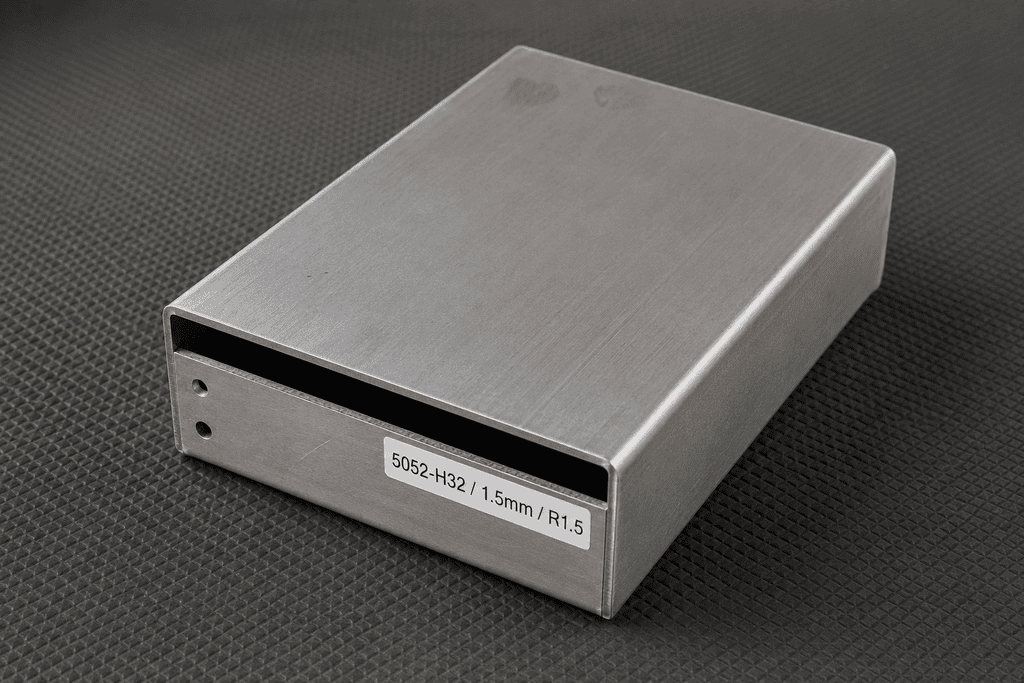
5052-H32 is the default aluminum alloy for sheet metal parts that require multiple bends, drawn features, or complex enclosure geometry. Its ASTM B209 bend diameter factor of 2t at 180° makes it the most formable structural aluminum grade in common production use.
2.1 Mechanical Properties
ASTM B209/B209M-21a specifies these minimum values for 5052-H32 sheet (thickness 0.20 to 6.30 mm):
Table 2. 5052-H32 Mechanical Properties per ASTM B209
| Yield Strength (0.2% offset) | 160 MPa min | All thicknesses 0.20 to 6.30 mm |
| Tensile Strength | 215 MPa min (265 MPa max) | All thicknesses 0.20 to 6.30 mm |
| Elongation (50 mm gauge) | 4% min (0.40 to 0.63 mm) / 5% min (0.64 to 1.20 mm) / 7% min (1.21 to 6.30 mm) | Varies by thickness |
| Bend Diameter Factor (N) | 2 | 180° bend, ≤6.30 mm |
5052 contains 2.2 to 2.8% Mg with no copper. The absence of copper separates its corrosion resistance from 6061: saltwater attacks copper-bearing alloys faster. For marine housings and fuel tank panels, 5052-H32 resists pitting without coating.
2.2 When to Use 5052-H32
Specify 5052-H32 when your part has three or more bends, when minimum inside radius drops below 3t, or when the service environment involves moisture, salt spray, or mild chemical contact. A bracket with four 90° bends at 1.5t inside radius fabricates cleanly in 1.5 mm 5052-H32 with no springback compensation beyond standard V-die practice.
2.3 When to Avoid 5052-H32
Avoid 5052-H32 when the part requires yield strength above 160 MPa under static load, when post-forming CNC machining needs a stiffer substrate (5052 gums cutting tools compared to 6061-T6), or when the part goes to Type III hard anodize. 5052 anodizes with less color consistency than 6061 due to its magnesium content, producing a yellowish tint on dark colors that may not meet cosmetic specifications.
Engineering Note
5052-H32 elongation ranges from 4% at thin gauges (0.40 to 0.63 mm) to 7% at thicker sections (1.21 to 6.30 mm) per ASTM B209 Table 3 SI. Thin-gauge enclosures under 0.50 mm sometimes crack at sharp transitions even within the 2t bend limit. On production runs below 0.50 mm, EPOC CRAFTER runs first-article bend coupons before committing full sheets to the press brake.
3. 6061-T6 Aluminum: Strength over Formability
6061-T6 delivers 50% higher yield strength than 5052-H32 (240 vs 160 MPa per ASTM B209) but trades formability for that gain. Parts needing both high strength and tight bends often require an O-temper bend followed by T6 heat treatment, adding one process step and 3 to 5 days of lead time.
3.1 Mechanical Properties
ASTM B209/B209M-21a specifies these minimum values for 6061-T6 sheet (thickness 0.20 to 6.30 mm):
Table 3. 6061-T6 Mechanical Properties per ASTM B209
| Yield Strength (0.2% offset) | 240 MPa min | Sheet 0.20 to 6.30 mm |
| Tensile Strength | 290 MPa min | Sheet 0.20 to 6.30 mm |
| Elongation (50 mm gauge) | 4% min (0.15 to 0.20 mm) / 8% min (0.50 to 1.20 mm) / 10% min (1.21 to 6.30 mm) | Varies by thickness |
| Bend Diameter Factor (N) | 3 (≤0.81 mm) / 4 (0.81 to 6.30 mm) / 5 (>6.30 mm) | 180° bend, per Table 4 |
6061 contains 0.8 to 1.2% Mg, 0.40 to 0.80% Si, and 0.15 to 0.40% Cu. Copper and silicon enable precipitation hardening to T6 but reduce formability and corrosion resistance versus 5052.
3.2 The Bend Radius Gap
The practical gap between 5052 and 6061 grows with sheet thickness. On a 2 mm sheet, the minimum inside bend radius per ASTM is 2 mm for 5052-H32 (N=2, R = Nt/2 = 2) versus 4 mm for 6061-T6 (N=4, R = 4). On a 3 mm sheet, the gap widens to 3 mm for 5052 versus 6 mm for 6061.
For tight bends in 6061, you have three options: switch to 5052 if loads allow (capping yield at 160 MPa), bend in O temper then age to T6 (adding 3 to 5 days and $2 to $5/kg), or widen the inside radius to meet the bend factor.
For a deeper look at bend calculations across all five materials, see the bend radius and K-factor guide in this series.
3.3 When to Use 6061-T6
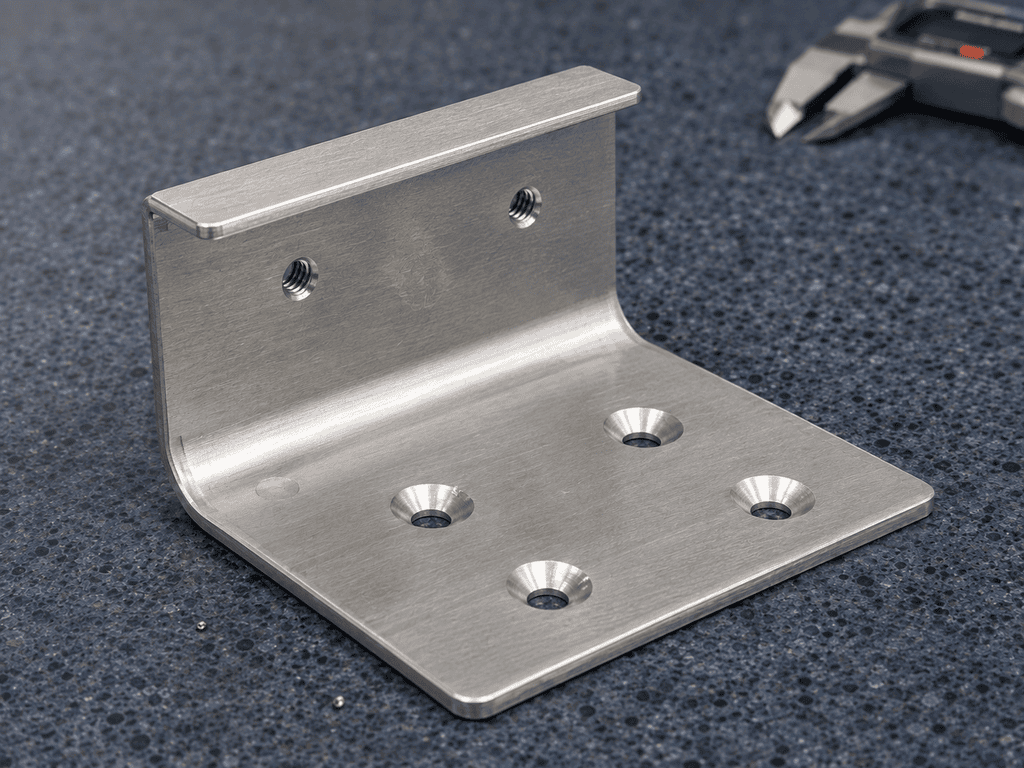
Specify 6061-T6 when the part needs yield strength above 200 MPa, when post-forming CNC machining (drilling, tapping, pocketing) is part of the workflow, or when the part requires Type II or Type III anodize with consistent color. Structural brackets, heatsinks with machined fin features, and electronic enclosures that double as heatsinks are typical 6061-T6 sheet metal applications.
3.4 When to Avoid 6061-T6
Avoid 6061-T6 for parts with inside bend radii below 3t, for saltwater or chemical service without post-process coating, and for deep-drawn or stretch-formed geometry. 6061-T6 elongation (4 to 10% depending on thickness) is lower than 5052-H32 at equivalent thickness, and stretch forming exceeds that limit in most geometries.
According to Dewey Wu, General Manager & senior mechanical engineer at EPOC CRAFTER: “On multi-bend 6061-T6 enclosures, we see a 20 to 30% first-article rejection rate when the drawing specifies radii below 3t. Switching to 5052-H32 or adding an O-temper pre-bend step drops that rejection rate to under 3%. The added heat-treat cost on a 200-piece run is about $400 total, which is less than one rejected batch of laser-cut blanks.”
Engineering Note
ASTM B209 Table 5 covers 6061-T6 only to 6.30 mm. Above that, T62 or T651 temper rows apply. Verify temper on your mill test report.
4. 304 Stainless Steel: Corrosion Resistance with a Work-Hardening Trade-off
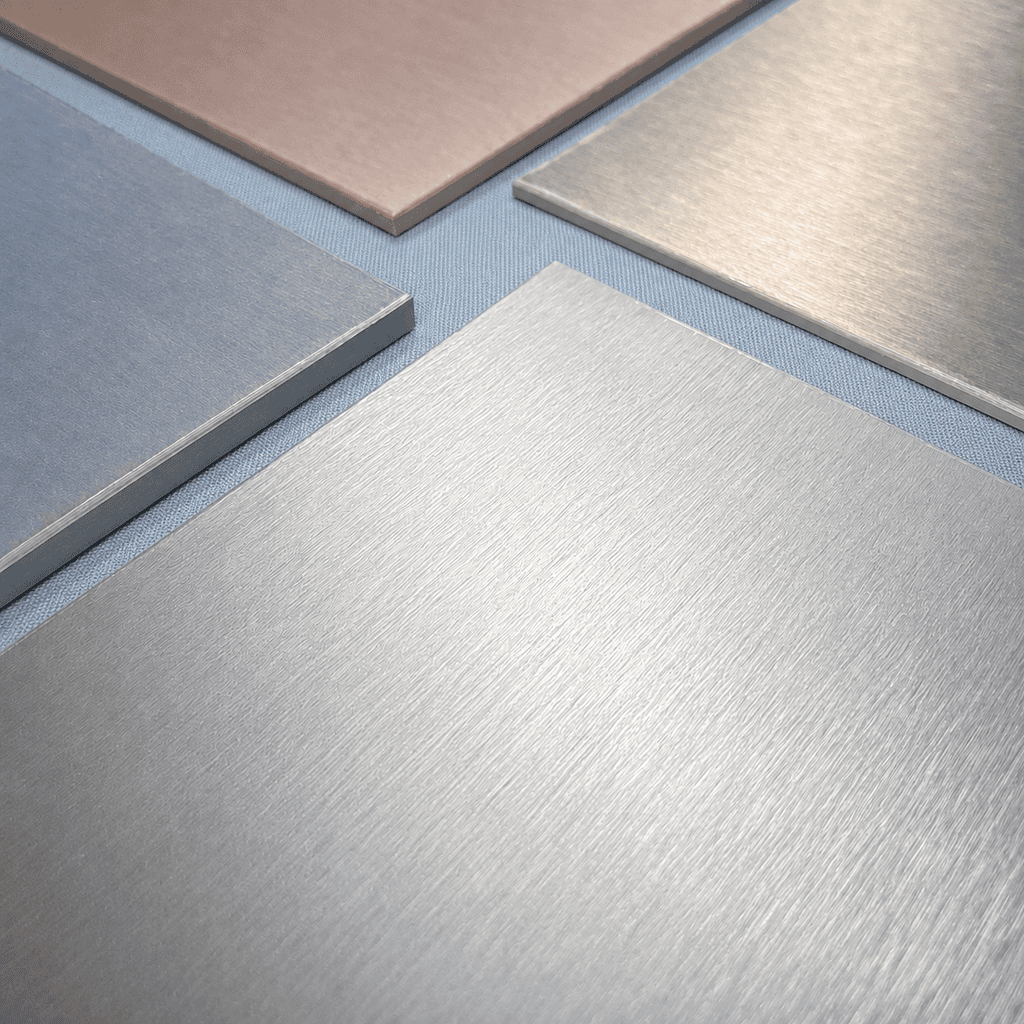
304 stainless steel (UNS S30400) provides the highest tensile strength and best corrosion resistance in this five-material group. ASTM A240/A240M-25 sets minimum tensile strength at 515 MPa and yield at 205 MPa, more than double the tensile values of 5052-H32 aluminum. The trade-off is work-hardening: every forming operation increases hardness in the deformed zone, raising springback and shortening punch and die life.
4.1 Mechanical Properties
Table 4. 304 Stainless Steel Mechanical Properties per ASTM A240/A240M-25
| Yield Strength (0.2% offset) | 205 MPa min | All product forms (plate, sheet, strip) |
| Tensile Strength | 515 MPa min | All product forms |
| Elongation (50 mm gauge) | 40% min | All product forms |
| Hardness | 92 HRB max | Rockwell B scale |
| Bend Test | Not required | A240 Table 2, Footnote D: austenitic grades exempt |
304 is an 18Cr-8Ni austenitic grade (carbon ≤0.08%). The chromium passive layer resists atmospheric corrosion, mild acids, and moderate chlorides without post-process coating.
4.2 Work-Hardening Behavior in Forming
304’s 40% minimum elongation looks generous on paper, but the austenitic structure strain-hardens rapidly during bending. A single 90° bend on 1.5 mm 304 sheet can raise local hardness from 88 HRB to over 30 HRC in the bend zone. Springback on 304 runs 3 to 5° more than on 1018 cold rolled steel at the same bend angle and inside radius.
ASTM A240 does not specify a bend test for 304 (Table 2 Footnote D exempts austenitic grades). Production practice on 304 sheet 0.5 to 3.0 mm uses 0.5t to 1t minimum inside radius. Overbend by 3 to 5° for 90° bends to compensate springback.
4.3 When to Use 304
Specify 304 when the part requires corrosion resistance without coating (food equipment, medical enclosures, chemical splash guards), when tensile loads exceed aluminum capacity, or when operating temperature reaches 800°C intermittent service.
4.4 When to Avoid 304
Avoid 304 when weight matters (8.0 vs 2.68 g/cm³ for aluminum), when material cost is primary (304 runs 3 to 4x the price of 1018 CRS), or when the part requires deep draws. 304 work-hardening creates uneven wall thinning in deep-drawn geometries.
Engineering Note
304 dimensional tolerances (thickness, flatness) are governed by ASTM A480/A480M, not A240. Reference A480/A480M on your drawing for thickness tolerance.
5. 1018 Cold Rolled Steel: Low Cost, Good Formability, No Corrosion Protection
1018 cold rolled steel is the lowest-cost, most formable option in this matrix. ASTM A1008/A1008M-26 governs cold rolled carbon steel sheet. 1018 enters A1008 through A568/A568M chemistry grade, ordered as CS Type B or DS Type B with a 1018 call-out.
5.1 Mechanical Properties
Table 5. 1018 Cold Rolled Steel Typical Properties per ASTM A1008/A1008M-26
| Yield Strength | ~305 MPa typical | A1008 Table 3 (nonmandatory range for CS/DS) |
| Tensile Strength | ~370 MPa typical | A1008 Table 3 (nonmandatory range for CS/DS) |
| Elongation (50 mm gauge) | ~32% typical | CS/DS, varies by thickness |
| Bend Test | Flat-on-itself, 180° | A1008 §8.1.2 for CS/DS/DDS/EDDS |
| Hardness | ~55 HRB typical | A1008 Appendix X3 (nonmandatory) |
A1008 Table 3 values for CS/DS are nonmandatory typical ranges, not guaranteed minimums. For certified minimums, specify a Structural Steel (SS) grade under A1008 or request mill certification.
5.2 Formability
1018 cold rolled steel bends flat-on-itself at 180° per A1008, the most generous bend requirement in this material group. No minimum radius factor applies to CS/DS grades. Combined with ~32% elongation, 1018 handles tight-radius bends, offsets, hems, and joggle bends that would crack 6061-T6 or strain-harden 304 excessively.
Thickness tolerance follows ASTM A568/A568M (not A1008 itself), using a minimum-thickness system. For 1.5 mm sheet at widths up to 1220 mm, tolerance is approximately 0.12 mm under nominal. Confirm with your supplier whether your drawing uses minimum-thickness or bilateral convention.
5.3 When to Use 1018 CRS
Specify 1018 when cost drives the decision, when the part will be painted or powder coated (hiding the bare steel surface), when complex bend geometry demands maximum formability, or when the part needs post-form welding with no special atmosphere or filler requirements. Brackets, internal chassis, mounting plates, and painted enclosures are standard 1018 applications.
5.4 When to Avoid 1018 CRS
Avoid 1018 when any surface will be exposed to moisture or outdoor atmosphere without coating. Bare 1018 begins surface rusting within hours of exposure in humid environments. Also avoid 1018 when weight reduction matters (density 7.85 g/cm³, nearly 3x aluminum) or when the part specification requires corrosion resistance without reliance on a coating system.
Engineering Note
Ordering “1018 cold rolled sheet” without referencing A1008 and a specific base type (CS, DS, DDS) leaves the mill to choose the product category. CS Type B permits a broad carbon range that overlaps 1018 chemistry but does not guarantee 1018 composition. If exact 1018 chemistry matters for downstream heat treatment or case hardening, add a chemistry grade call-out per A568/A568M on your purchase order. For hole spacing and tolerance rules that apply to each material type, see our tolerances guide.
6. Galvanized Steel: 1018 with Built-in Corrosion Barrier
Galvanized steel is carbon steel sheet (typically the same CS or DS base as 1018) with a hot-dip zinc coating applied per ASTM A653/A653M. The zinc layer provides sacrificial corrosion protection: even where the coating is scratched or cut, zinc corrodes preferentially and protects the exposed steel. G60 coating (180 g/m² total both sides) and G90 coating (275 g/m² total both sides) are the two most common weights for sheet metal fabrication.
6.1 Coating Weight and Thickness
Table 6. Common Galvanized Coating Designations
| G60 | 180 g/m² | ~10.5 μm | Indoor enclosures, light outdoor |
| G90 | 275 g/m² | ~16 μm | Outdoor enclosures, HVAC, structural |
G60 suits parts that will receive powder coat or paint over the zinc. G90 provides standalone outdoor corrosion resistance rated at 15 to 25 years in mild atmospheric exposure. Heavier coatings (G115, G140) exist but increase the risk of coating flaking during tight-radius bends.
6.2 Forming and Welding Considerations
Galvanized steel bends with the same flat-on-itself capability as bare 1018. The zinc coating does not significantly affect formability at standard bend radii. At inside radii below 1t, the coating may crack and flake on the outer surface of the bend, exposing bare steel at the bend apex. For tight bends, G60 coating survives better than G90 because the thinner zinc layer is more ductile.
Welding galvanized steel produces zinc oxide fumes requiring local exhaust ventilation (OSHA PEL: 5 mg/m³). Weld spatter increases versus bare steel, and the HAZ loses its zinc layer. Touch-up welded joints with zinc-rich primer.
Laser and plasma cutting galvanized sheet also generate zinc fumes; adjust assist gas and speed to control dross.
6.3 When to Use Galvanized Steel
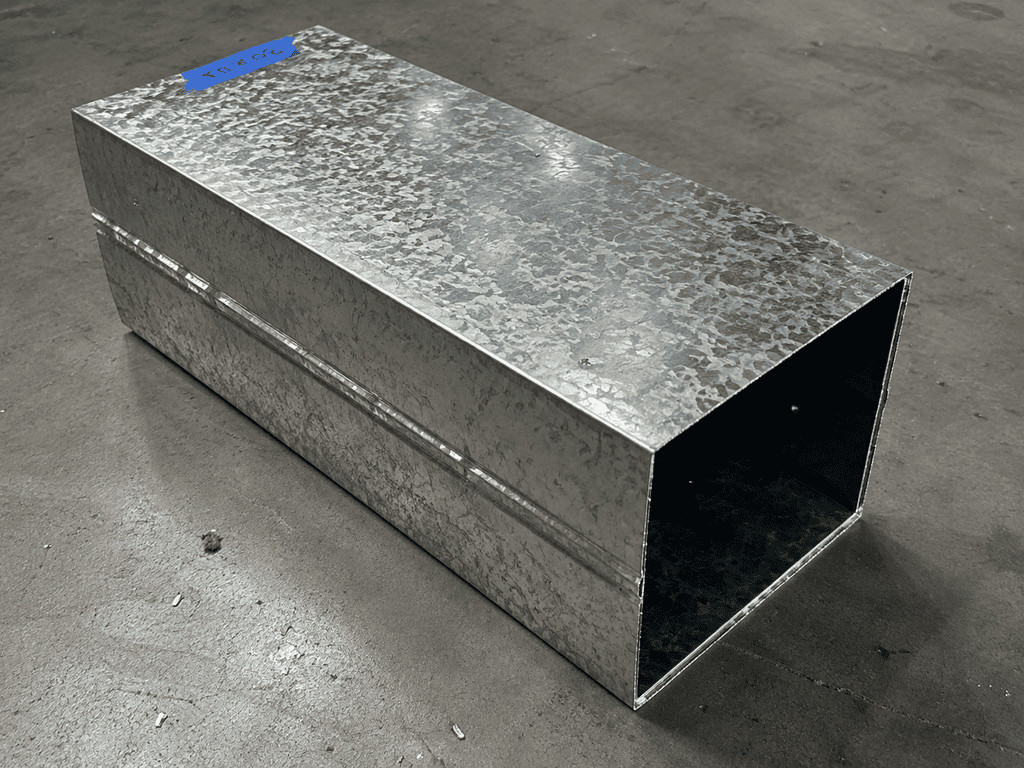
Specify galvanized when the part needs outdoor corrosion protection without paint, when HVAC ductwork requires a standard sheet metal material , or when budget rules out stainless but bare 1018 cannot survive the environment.
6.4 When to Avoid Galvanized Steel
Avoid galvanized when exposed to strong acids (pH below 6) or strong alkalis (pH above 12.5). Avoid contact with dissimilar metals (copper, brass) in moisture. Not permitted for food-contact or medical applications due to zinc leaching.
For design rules that apply regardless of which material you select, see the sheet metal design guidelines in this series.
Engineering Note
Galvanized sheet adds zinc on both sides. G90 on 1.5 mm nominal sheet measures approximately 1.53 mm total caliper. Account for coating thickness in your tolerance stack. Increase punch clearance by approximately 5% over bare steel settings to prevent zinc buildup.
7. How to Choose: Applying the Five-Property Selection Matrix
The Five-Property Selection Matrix reduces selection to five sequential questions. Each answer eliminates at least one candidate.
7.1 Decision Sequence
Table 7. Five-Property Selection Matrix Decision Sequence
| 1. Load | Does the part carry loads above 200 MPa yield? | 6061-T6 or 304 SS | 5052, 1018, galvanized |
| 2. Environment | Will the part contact moisture, salt, chemicals, or outdoor atmosphere without paint? | 5052, 304, or galvanized | 1018 (bare) |
| 3. Forming | Does the geometry require inside bend radius below 3t or more than three bends? | 5052, 1018, or galvanized | 6061-T6 (unless O-temper path accepted) |
| 4. Joining | Will the part be MIG/TIG welded in corrosive service? | 304L or 5052 | 6061-T6 (HAZ loses temper), galvanized (zinc fume, coating loss) |
| 5. Budget | Is per-part material cost the primary constraint? | 1018 or galvanized | 304 (3-4x), 6061 (1.5-2x), 5052 (1.3-1.5x vs 1018) |
7.2 Typical Application Mapping
Table 8. Application Scenarios and Recommended Materials
| Multi-bend electronics enclosure, indoor use | 5052-H32 | 2t bend factor, no coating needed indoors |
| Structural bracket with CNC-machined mounting features | 6061-T6 | 240 MPa yield, machines cleanly |
| Food processing equipment panel | 304 | Self-passivating, FDA/NSF compatible, washdown resistant |
| Painted internal chassis or mounting plate | 1018 CRS | Lowest cost, flat-on-itself bending, easy to weld |
| Outdoor electrical enclosure, no paint system | Galvanized (G90) | Zinc sacrificial protection, 15-25 year atmospheric life |
| Marine housing with complex bends | 5052-H32 | Saltwater corrosion resistance + tight bend capability |
| Heatsink enclosure with machined fins | 6061-T6 | Thermal conductivity 167 W/m·K, machines without gumming |
| HVAC duct or cable tray | Galvanized (G60/G90) | Industry standard, cost-effective corrosion protection |
Not every project fits one material. A bracket needing 240 MPa yield and 2t bend radius conflicts between Steps 1 and 3. Resolution: bend in O temper, age to T6, accept $2 to $5/kg heat-treat cost and 3 to 5 days. EPOC CRAFTER’s rapid prototyping includes this path.
According to Dewey Wu, General Manager & senior mechanical engineer at EPOC CRAFTER: “About 60% of our sheet metal RFQs can be answered with 5052-H32 or 1018 CRS. The other 40% split between 304 for corrosion-critical parts and 6061-T6 for structural parts that also need machined features. Galvanized is almost always customer-specified rather than engineer-recommended, because most engineers default to 1018 plus powder coat. When the customer’s end environment is outdoor and the paint budget is zero, galvanized wins on total cost of ownership.”
Full material property data available in EPOC CRAFTER’s materials library.
8. Frequently Asked Questions
8.1 Can you bend 6061-T6 sheet metal without cracking?
6061-T6 bends without cracking when inside radius meets the ASTM B209 bend factor: 3t for sheet under 0.81 mm, 4t for 0.81 to 6.30 mm, 5t above 6.30 mm. For tighter radii, bend in O temper then age-harden to T6. The O-temper factor drops to 2t or less. Added cost is 3 to 5 business days and $2 to $5/kg. EPOC CRAFTER runs this process on batches from 50 to 5,000 pieces.
8.2 What is the difference between 5052 and 6061 aluminum for sheet metal?
5052-H32 and 6061-T6 differ in three areas. Yield: 6061-T6 delivers 240 MPa versus 160 MPa for 5052 per ASTM B209, a 50% advantage. Formability: 5052 bends at 2t versus 3t to 5t for 6061. Corrosion: 5052 has no copper and resists saltwater without coating; 6061’s copper makes it vulnerable in marine service. Choose 5052 when bends and corrosion dominate, 6061 when load and machining dominate.
8.3 Does 304 stainless steel work harden during bending?
304 work-hardens during bending. A 90° bend on 1.5 mm sheet raises hardness from 88 HRB to over 30 HRC. Springback increases 3 to 5° versus 1018. Overbend by 3 to 5° to compensate. Plan drilling and tapping in flat areas before forming. ASTM A240 does not require a bend test for 304 (Footnote D exempts austenitic grades). Production practice uses 0.5t to 1t inside radius on 0.5 to 3.0 mm sheet.
8.4 Is 1018 steel the same as mild steel?
1018 is a specific SAE/AISI grade (0.15 to 0.20% C, 0.60 to 0.90% Mn). “Mild steel” broadly covers low-carbon steels below 0.25% C. Under ASTM A1008, 1018 enters through A568/A568M chemistry grade as CS Type B or DS Type B. If your drawing says “mild steel” without a grade, the mill may supply any low-carbon grade fitting the CS spec.
8.5 When should you choose galvanized steel over bare 1018?
Choose galvanized when surfaces face outdoor atmosphere, moisture, or water contact without paint. G90 coating (275 g/m², ~16 μm per side) provides 15 to 25 years atmospheric protection. Bare 1018 rusts within hours in humid conditions. The galvanized premium is 10 to 20% per kg, far less than a full blast-prime-topcoat system. If the part will be painted anyway, bare 1018 is more cost-effective.
8.6 What is the cheapest sheet metal material for prototyping?
1018 cold rolled steel is the cheapest per-kg and most widely stocked at service centers. For 1 to 20 prototypes, 1018 is available next-day in 0.5 to 3.0 mm gauges. Prototyping in 1018 validates bend geometry and fit-up even if production uses a different material. Adjust bend allowance when transitioning, as springback differs across grades. EPOC CRAFTER’s low-volume production supports single-piece prototyping in all five materials.
Related Resources
Related Article: Sheet Metal Design Guidelines. DFM rules covering bend relief, corner relief, minimum flange width, and hole-to-edge spacing regardless of material choice.
Related Article: Bend Radius and K-Factor Guide. K-factor charts, flat pattern formulas, and material-specific bend allowance tables explaining why 6061 needs a larger bend radius than 5052.
Related Article: Sheet Metal Tolerances and Features. Feature rules and ISO 2768-based tolerance charts for punched holes, formed features, and bent dimensions across all five material types.
Ready to Quote Your CNC Prototype?
Upload your STEP file and get a DFM review + quote within 12 hours.
No tooling cost. Minimum 1 part.