

Dewey Wu General Manager & senior mechanical engineer at EPOC CRAFTER, 15 years in design engineering, quality, and metallurgy. Hands-on across CNC machining, metalwork, sheet metal, and prototyping (subtractive + 3D printing).
Polyamide, commonly called nylon, is a family of engineering plastics rather than one fixed material. A useful part specification must identify more than the family name because PA6, PA66, PA12, glass filled nylon, modified grades, and different process routes can respond differently to moisture, sustained load, machining, and molding. This guide focuses on the decisions that control nylon dimensional stability: grade identity, nylon moisture absorption, nylon creep, manufacturing route, critical tolerances, and the condition used for final inspection.
1. What Is Polyamide, and What Is Nylon?
Nylon and polyamide describe the same broad polymer family, but neither term is a complete purchasing specification. ISO 16396-1:2022 classifies polyamide moulding and extrusion materials by polymer identity and can also carry information about fillers, reinforcement, processing, additives, and designatory properties. The standard explicitly warns that materials with the same designation are not guaranteed to give the same performance.
That distinction changes how you read a nylon material callout. These types of nylon are not interchangeable labels for one nylon plastic. PA6, PA66, PA11, and PA12 are different polymer identities. Copolymers and blends are separate definitions. A designation such as PA66-GF30 also adds reinforcement information, but it still may not define the commercial grade, service condition, or finished-part acceptance requirement. The existing nylon properties guide covers broader material data for CNC machined parts, allowing this page to focus on specifications and tolerance risks.
Engineering decision: write the actual PA family and reinforcement into the RFQ, then tie critical performance to an approved commercial grade or equivalent criteria. “Nylon” alone leaves too much open to supplier interpretation.
2. Nylon Moisture Absorption: Three Different Measurements
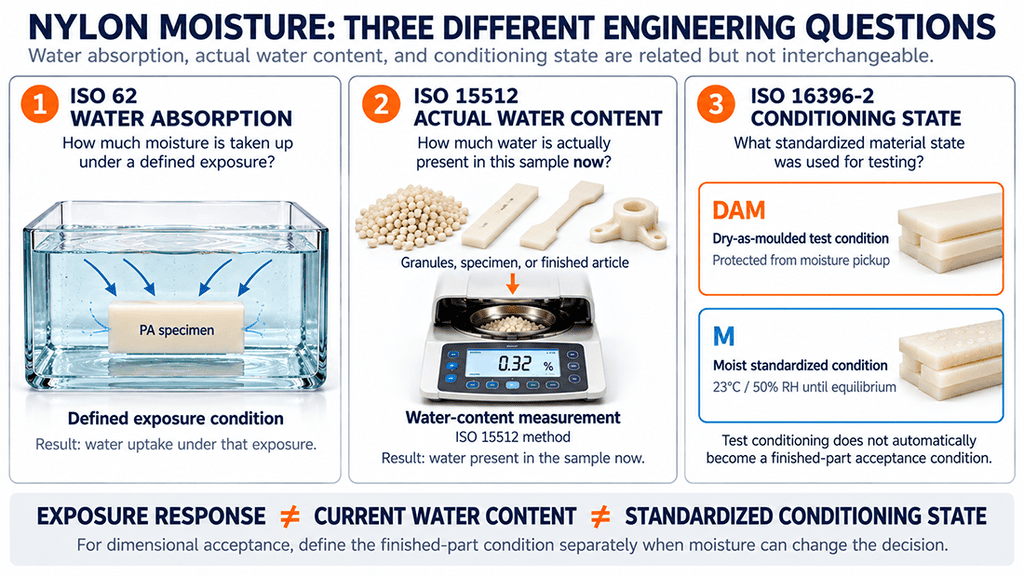
Moisture data become useful only when the measurement is named correctly. Three terms that are often mixed together answer different engineering questions.
| Term | Primary standard | What it tells you | What it does not tell you |
| Water absorption | ISO 62:2008 | How much water a defined specimen takes up under a specified exposure | The actual water content of your production part at inspection |
| Water content | ISO 15512:2019 | How much water is present in a plastic sample, including granules or finished articles | Absorption kinetics or equilibrium uptake under ISO 62 |
| DAM / moist conditioning | ISO 16396-2:2022 | A controlled specimen state used to make PA property tests comparable | A universal delivery or inspection condition for every finished nylon part |
ISO 16396-2 distinguishes dry-as-moulded, DAM, specimens from moist specimens. The technical summary specifies DAM handling at 23°C ± 2°C for at least 24 h, a moisture content not above 2 g/kg, and testing as soon as practicable after removal from the moisture-proof container. The moist state is conditioned at 23°C and 50% RH to equilibrium. Those are test specimen conditions, not automatic requirements for a machined or molded production part.
The procurement consequence is simple. Do not copy one “water absorption %” into a drawing and treat it as the part’s present moisture level or its dimensional growth. Grade, specimen geometry, exposure, conditioning, and test method must travel with the number.
3. Nylon Machining vs Nylon Injection Molding: Why Tolerances Move
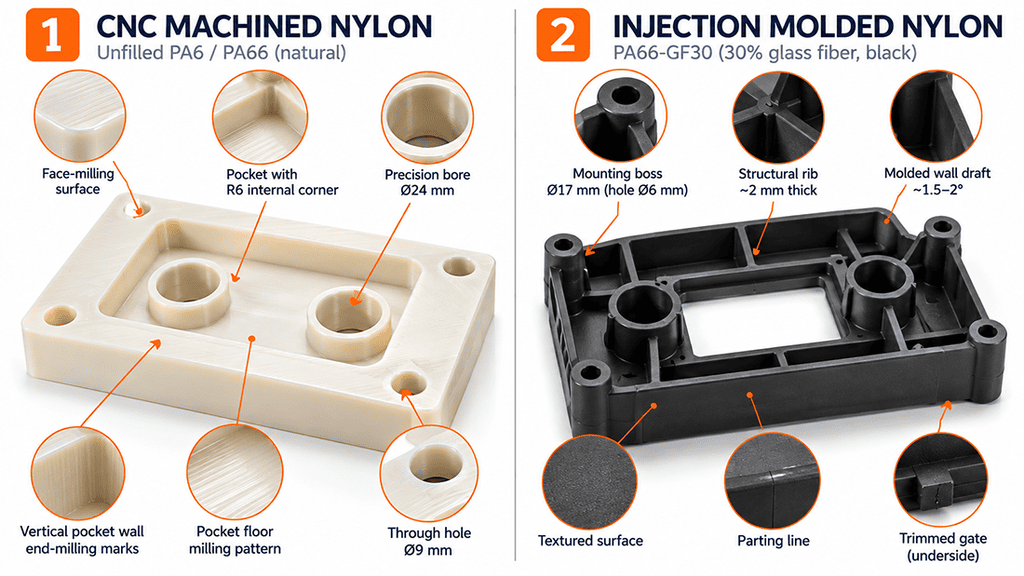
Nylon machining and nylon injection molding can start with the same polymer family but create different dimensional histories. The drawing therefore needs to control the route that actually produces the CTQ.
| Decision point | Nylon CNC machining | Nylon injection molding | Buyer action |
| Starting material | Rod, plate, sheet, tube, or other semi-finished stock | Commercial molding resin | Specify stock or resin grade and reinforcement |
| Moisture control | Stock condition and moisture pickup can matter before and after cutting | Resin moisture is a process variable before molding; post-mold conditioning can also matter | Define moisture or conditioning only where it changes function or inspection |
| Dimensional drivers | Stock stress history, asymmetric removal, cutting heat, workholding, time to inspection | Shrinkage, crystallization, flow and fiber orientation, packing, post-mold condition | Do not transfer a generic tolerance or shrinkage number between routes |
| Evidence | Machining sequence and final dimensional inspection | Resin/process records and molded-part inspection | Require evidence for the actual route and CTQ |
The manufacturing route should also determine which EPOC CRAFTER resource carries the next level of detail. CNC machining covers the subtractive route for nylon and other engineering plastics, while rapid injection molding covers molded production. The nylon mechanical properties guide provides tooling, machinability, and cutting parameter details without duplicating this article.
A tight dimension on a hygroscopic nylon part may need an inspection condition as well as a numerical tolerance. ISO 16396-2 defines specimen states for comparable material tests, but it does not require every finished CNC or molded part to be accepted at 23°C and 50% RH equilibrium. The project drawing or quality plan has to define the finished-part condition when moisture can change the acceptance decision.
Keep the material-state note separate from the geometric callout. CNC tolerances and GD&T standards define dimensional requirements, while moisture conditioning defines the state in which the nylon part is inspected.
4. Nylon Creep: Why Short-Term Strength Is Not Enough
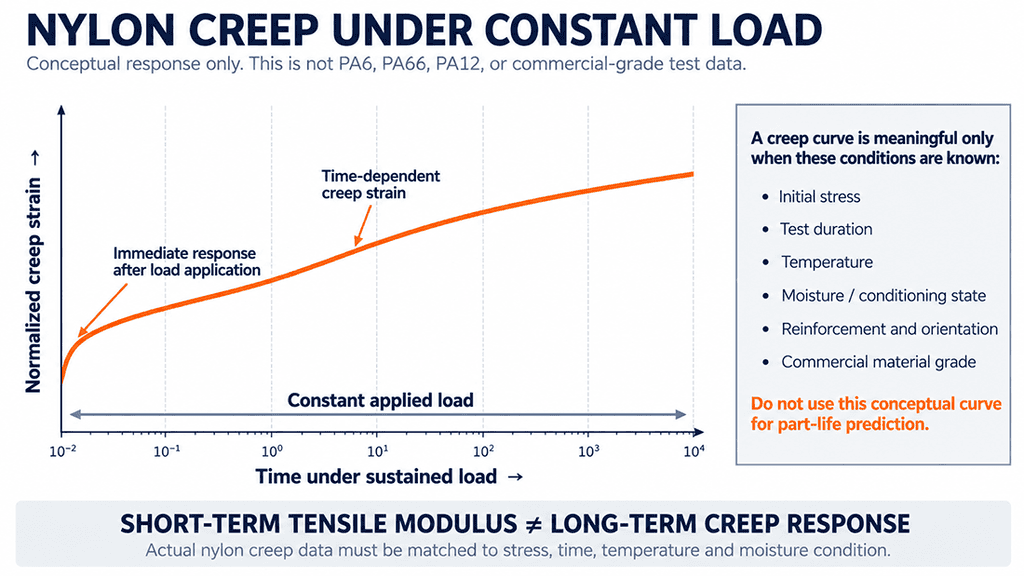
Nylon creep is time-dependent strain under sustained load. ISO 899-1:2017 specifies tensile creep testing for rigid and semi-rigid plastics, including unfilled, filled, and fiber-reinforced materials, under defined pretreatment, temperature, and humidity conditions. ISO confirms that the 2017 edition remains current.
The useful design input is not one “creep number.” A creep result needs the applied stress, elapsed time, temperature, conditioning state, humidity, material identity, and specimen orientation where reinforcement makes orientation relevant. A dry specimen that absorbs moisture during a long test can gain moisture-driven strain while it is also creeping. A wet specimen that loses water can contract. Those effects make uncontrolled comparisons misleading.
This matters in nylon bushings, nylon bearings, nylon gears, nylon spacers, nylon washers, and nylon fasteners whenever the function depends on retained geometry or contact load. ISO 899-1 supports the material behavior, but it does not calculate press-fit retention, thread life, bolt preload loss, a finished bore after 1,000 h, or a universal allowable creep strain. Those are part-level design questions.
Engineering decision: compare creep data only when stress, time, temperature, moisture condition, and grade are comparable. Short-term tensile strength or tensile modulus cannot stand in for long-term creep behavior.
5. PA6 vs PA66 vs PA12: Select the Grade by the Part Condition
PA6 vs PA66 is a real engineering decision, but one property should not decide it. The same applies to nylon 6 vs nylon 66, PA12, and reinforced grades. Start from the failure mode or CTQ, then compare commercial grade data measured under relevant conditions.
| Part condition | Evidence that should drive selection | Weak shortcut to avoid |
| Tight dimensional control | Grade-specific moisture response, stock or molding route, geometry, conditioning, inspection state | Choosing from a generic nylon dimensional stability claim |
| Sustained load | Creep data at relevant stress, time, temperature, and moisture condition | Choosing from short-term tensile strength alone |
| Reinforced structure | Actual glass-fiber content, orientation where relevant, creep, thermal response, process route | Assuming every glass filled nylon behaves alike |
| Machined feature | Stock grade and form, material removal, workholding, final inspection condition | Using injection-molding data as finished CNC capability |
| Molded feature | Resin grade, moisture control, shrinkage evidence, fiber orientation, molded-part inspection | Using a generic family shrinkage value |
The detailed PA6 vs PA66 vs PA12 comparison provides broader grade selection data. Once a grade is chosen, the drawing must still specify the manufacturing route and acceptance condition.
Molded nylon features require geometry-specific design validation. The injection molding DFM guide covers wall thickness, ribs, bosses, draft angles, and material-dependent molding considerations.
Scope boundary: nylon extrusion, nylon 3D printing, SLS nylon, and PA12 3D printing use different feedstock and process controls. They are not used here as evidence for machined or injection molded part tolerances.
6. What to Put on a Nylon Part RFQ or Drawing
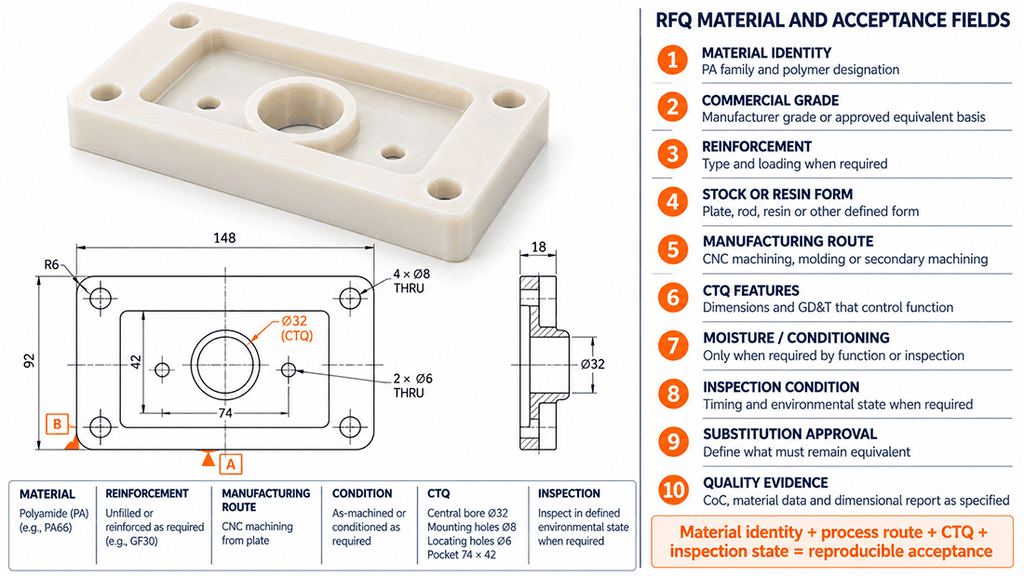
A practical nylon RFQ should control the variables that can change fit, function, substitution, or inspection. Low-risk covers may need only a clear material callout and dimensional requirements. A precision bearing element, loaded spacer, or moisture-sensitive housing needs more.
| RFQ / drawing field | What to state | Decision value |
| Polymer identity | PA6, PA66, PA12, PA11, defined copolymer or blend | Prevents “nylon” from becoming an uncontrolled family-level callout |
| Commercial grade | Manufacturer grade or approved equivalent criteria | Links the drawing to purchasable data and controls substitution |
| Reinforcement | Unfilled, GF, CF, mineral, plus required loading where relevant | Separates materials that ISO 16396-1 treats as different definitions |
| Manufacturing route | CNC machining, injection molding, or molding plus secondary machining | Identifies which process history controls the finished feature |
| CTQs | Explicit dimensions and GD&T where function requires them | Keeps tight requirements on functional features instead of every dimension |
| Moisture / conditioning | Only where function requires it, using a measurable procedure or state | Makes moisture-sensitive acceptance reproducible |
| Inspection condition | Timing, environment, or conditioning state where it can change acceptance | Prevents two correct measurements from being compared under different states |
| Long-term load | Load basis, duration, temperature, environment where creep matters | Lets the supplier review relevant creep evidence rather than a short-term property |
| Quality evidence | CoC, supplier TDS, material report, dimensional report, or other agreed record | Connects the RFQ requirement to verification |
Avoid “PA66-GF30 or equivalent” unless the equivalence rule is defined. ISO 16396-1 states that the same designation does not guarantee the same performance. An alternate grade should be reviewed against the properties and conditions that control the actual part, not against the family name alone.
7. FAQ
7.1 Does nylon absorb water after it becomes a finished part?
Yes. Finished nylon can absorb moisture from its environment. The engineering question is how much the selected grade takes up under the relevant exposure and how that state affects the part. ISO 62 covers water absorption behavior; ISO 15512 measures the actual water content in a sample. Do not use one as a substitute for the other.
7.2 Why can a machined nylon part measure differently after shipment?
A dimension can move when moisture state, temperature, stock stress, or time after machining changes. That does not prove every dimensional change is caused by moisture, so the investigation should compare the grade, original inspection condition, shipment environment, and measurement method before changing the drawing or process.
7.3 Why can nylon molding shrinkage differ from a datasheet value?
A published shrinkage value is not a finished-part guarantee. Commercial grade, geometry, gate and flow direction, packing, mold temperature, crystallization, reinforcement, moisture history, and measurement condition can all affect the observed result. Use grade-specific supplier data to start tool design, then validate the real cavity and part.
8. A Practical Approval Rule
Approve the material identity, commercial grade, manufacturing route, critical dimensions, and inspection condition together. Add a moisture requirement only when it changes function or acceptance. Review nylon creep separately when the part carries sustained load. That sequence keeps a generic nylon material name from becoming an unverified claim about finished-part performance.
Ready to Quote Your CNC Prototype?
Upload your STEP file and get a DFM review + quote within 12 hours.
No tooling cost. Minimum 1 part.