

Dewey Wu General Manager & senior mechanical engineer at EPOC CRAFTER, 15 years in design engineering, quality, and metallurgy. Hands-on across CNC machining, metalwork, sheet metal, and prototyping (subtractive + 3D printing).
Gray iron with a fully ferritic matrix turns at roughly 270 m/min for a 30-minute tool life. Give the same iron an acicular matrix at 263 HB and that speed falls to about 60 m/min (ASM Handbook Vol. 1/16, Table 2, p. 650, handbook test data). Cast iron is not one material, and neither is steel, so “cast iron vs steel” only becomes a real question once you fix the grade on both sides.
The short version for a sourcing or design call:
Pick gray iron when the part carries compression, needs vibration damping, and suits a cast near-net shape: machine bases, housings, gearbox and cylinder-block bodies. Damping is high and casting cost is low.
Choose ductile iron when the part sees tension, bending, impact, or internal pressure: pump and valve bodies, steering knuckles, brackets. ASTM A536 grade 65-45-12 holds a specified minimum 448 MPa tensile, 310 MPa yield, 12% elongation (ASTM A536-24, Table 1).
Go to carbon or alloy steel (1018, 1045, 4140) when you need weldability, high impact resistance, or heat-treated strength a casting cannot reach. Quenched-and-tempered 4140 runs from about 810 to 1965 MPa tensile depending on temper (ASM Handbook Vol. 1, Table 4, handbook typical values).
One decision sits before any of this and moves cost before you cut a single chip: an iron casting machines nothing like a wrought steel bar. Short chips instead of long ribbons, abrasive graphite dust, interrupted cuts in milling. That second half, how the casting actually machines, is covered below.
1. Gray iron vs ductile iron vs steel: what actually differs
The dividing line is where the carbon sits. Cast iron holds 2.5 to 4% carbon, and most of it drops out of solution as graphite because of 1 to 3% silicon (ASM Handbook Vol. 1). In gray iron that graphite grows as flakes. In ductile iron it grows as spheres. Steel keeps carbon below about 2% and forms no free graphite. That one structural difference drives everything else.
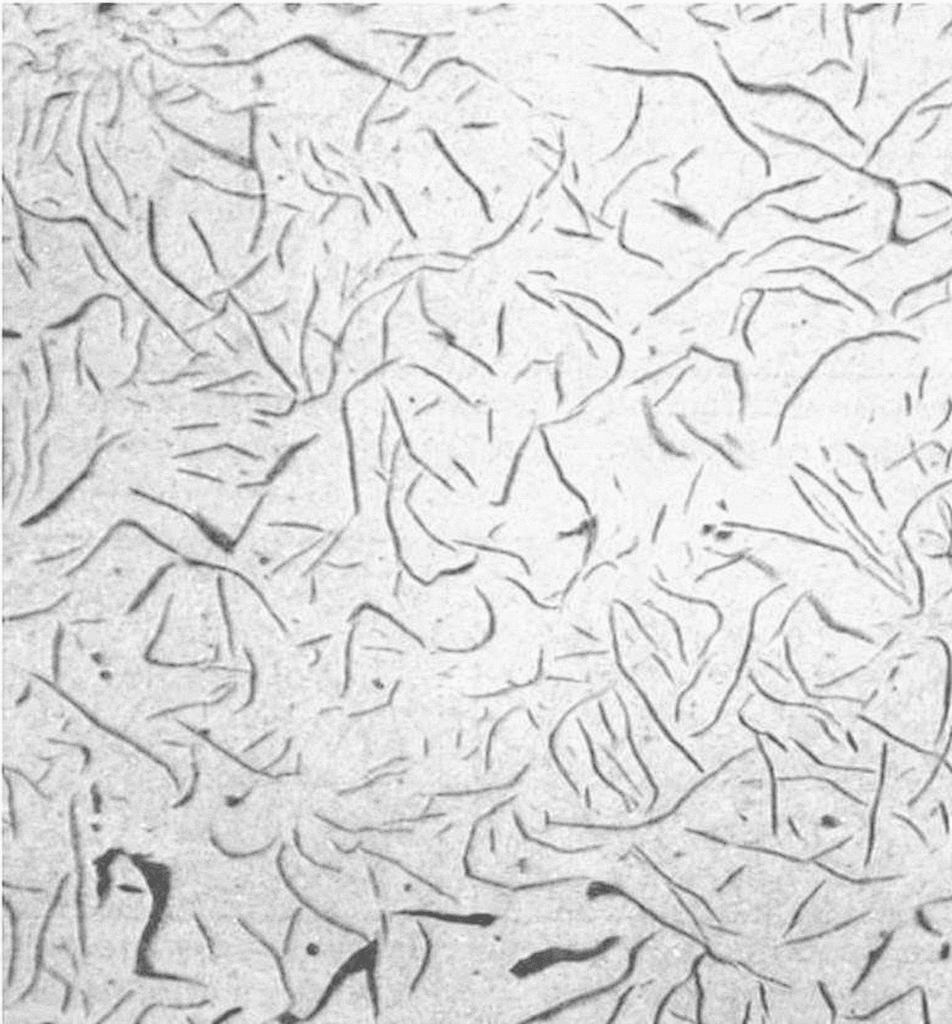
1.1 Flake graphite: damping and short chips, low tensile strength
Flake graphite breaks up the metal matrix. Under load the flakes act as internal cracks, so gray iron is brittle in tension. Fracture elongation sits around 0.6%, low enough that the handbook often does not report it (ASM Handbook Vol. 1). Compression is a different story. Gray iron compressive strength runs about three to four times its tensile strength (ASM Handbook Vol. 1, p. 55). Across ASTM A48 classes the handbook typical window is 152 to 431 MPa tensile against 572 to 1293 MPa compressive (ASM Handbook Vol. 1, Table 12).
The same flakes soak up vibration. On a resonance test, ASTM class 30 gray iron showed a logarithmic decay of 68.67 × 10⁻⁴ against 1.23 to 1.31 × 10⁻⁴ for SAE 1018 steel (ASM Handbook Vol. 1). Machine beds and compressor housings are poured from gray iron for exactly that reason: the material deadens chatter that a steel weldment passes straight into the cut.
Stiffness is lower than steel, and it is not a fixed number. Gray iron does not follow Hooke’s law, so its modulus is quoted as a secant value from the origin to one quarter of tensile strength: roughly 66 to 157 GPa across classes (ASM Handbook Vol. 1, Table 13). A class 30 part near 97 GPa deflects about twice as much as a steel part of the same section under the same tool load.
1.2 Spheroidal graphite: strength and elongation for loaded parts
Round nodules do far less damage to the matrix than flakes, so ductile iron carries real tensile strength and real elongation. ASTM A536 sets specified minimums by grade: 60-40-18 at 414 MPa tensile / 276 MPa yield / 18% elongation, climbing to 120-90-02 at 827 / 621 / 2% (ASTM A536-24, Table 1). The European standard EN 1563 runs the EN-GJS grades on the same logic. EN-GJS-500-7 holds a specified 500 MPa tensile / 320 MPa yield / 7% elongation for section thickness up to 30 mm (EN 1563:2018, Table 1).
Note the trade. Ductile iron damps far less than gray. The same resonance test that put gray class 30 at 68.67 × 10⁻⁴ put ductile iron at 8.316 × 10⁻⁴ (ASM Handbook Vol. 1). Choose ductile for load, gray for quiet.
1.3 When ductile iron earns its cost over gray
Ductile iron costs more to pour than gray and machines a little harder at the high-strength grades. It wins where a gray casting would crack: pressure-tight pump and valve bodies, parts under shock or fatigue, anything that has to bend before it breaks. Where the duty is non-pressure, low-impact, and cost-sensitive, gray iron with its better damping and easier cut is the cheaper right answer. Deciding which surfaces on that casting have to be machined clean, and which stay as-cast, is where the cast-part tolerances and machining stock come in, covered in the tolerance section below.
2. Cast iron vs carbon and alloy steel: 1018, 1045, 4140
Cast iron and steel bar get compared as if they were rivals for the same part. They usually are not. A casting reaches a near-net shape straight from the mold; a wrought steel bar arrives as stock you cut the whole shape out of. The material choice and the manufacturing route are tied together, so the comparison only means something once you name the steel grade.
Three grades cover most of what a shop cuts against cast iron.
1018 is low-carbon steel, 0.15 to 0.20% C, 0.60 to 0.90% Mn (ASTM A29/A29M-23, Table 1, specified heat-analysis range). Soft, weldable, easy to form. Hot-rolled, the handbook estimates about 400 MPa tensile, 220 MPa yield, 25% elongation, 116 HB (ASM Handbook Vol. 1, Table 9, estimated values). It bends before it breaks, the opposite of gray iron.
1045 is medium-carbon, 0.43 to 0.50% C, 0.60 to 0.90% Mn (ASTM A29/A29M-23, Table 1). Hot-rolled, roughly 570 MPa tensile, 310 MPa yield, 16% elongation, 163 HB (ASM Handbook Vol. 1, Table 9, estimated values). More strength and wear resistance than 1018, still weldable, still tough enough to take impact.
4140 is chromium-molybdenum alloy steel: 0.38 to 0.43% C, 0.75 to 1.00% Mn, 0.80 to 1.10% Cr, 0.15 to 0.25% Mo (ASTM A29/A29M-23, Table 2 and SAE J404, specified ranges). Its point is heat treatment. There is no single “4140 strength.”
That last point is where 4140 separates itself from any cast iron on this page. On a 13 mm bar oil-quenched from 845 °C, changing only the temper moves tensile strength across a wide band: 1965 MPa at 205 °C temper down to 810 MPa at 705 °C (ASM Handbook Vol. 1, Table 4, handbook typical values). Section size shifts it again. Same quench and 540 °C temper, a 25 mm bar reads about 1140 MPa tensile where a 50 mm bar reads about 920 MPa (ASM Handbook Vol. 1, Table 5, handbook typical values). A casting cannot be dialed across that range, and no gray or ductile grade reaches the top of it.
Put the three side by side, and keep the condition in the header, because a hot-rolled bar and a quenched-and-tempered bar are not the same claim:
| 1018 | hot-rolled | ~400 MPa | ~220 MPa | 25% | 116 HB | ASM Vol. 1, Table 9 (estimated) |
| 1045 | hot-rolled | ~570 MPa | ~310 MPa | 16% | 163 HB | ASM Vol. 1, Table 9 (estimated) |
| 4140 | oil-quenched 845 °C, tempered 540 °C, 13 mm | ~1150 MPa | ~1050 MPa | 17.5% | 341 HB | ASM Vol. 1, Table 4 (typical) |
| gray iron, class 30 | as-cast | ~214 MPa | n/a | ~0.6% | 210 HB | ASM Vol. 1, Table 12 (typical) |
| ductile 65-45-12 | per spec | ≥448 MPa | ≥310 MPa | 12% | n/a | ASTM A536-24, Table 1 (specified min) |
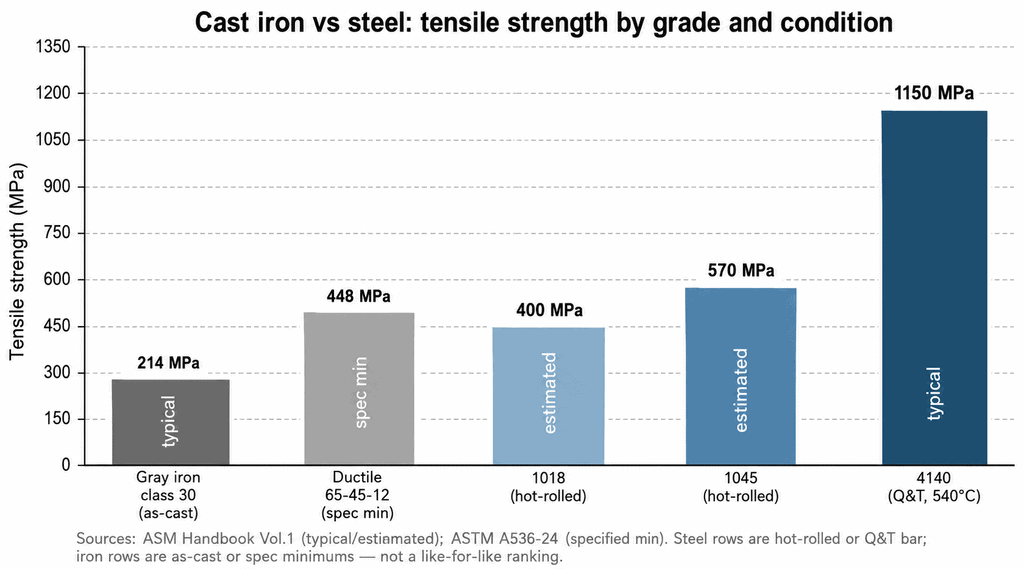
Read that as a capability map, not a fair one-to-one ranking. The steel rows are hot-rolled or heat-treated bar; the iron rows are as-cast or spec minimums. What it shows: heat-treated 4140 climbs into a strength range no cast iron reaches, gray iron owns the compression-and-damping corner no wrought bar matches, and ductile iron sits in the middle where you want both strength and a cast shape.
Two practical differences settle most calls.
Welding. Low-carbon steel welds with no structural penalty. Cast iron does not, because the high carbon drives quench cracking in the heat-affected zone. If the part gets welded into an assembly, that alone rules cast iron out, and the job moves toward a wrought grade or a welded sheet-metal assembly instead of a casting.
Why 4140 needs heat treatment at all. The chromium and molybdenum give it hardenability, so it can be quenched and tempered through-section instead of only at the skin. That is what buys the strength window above. The standard method for measuring that hardenability is the Jominy end-quench test, which relates hardness to distance from the quenched end (ASTM A255-20, §3.1, §7.1). ASTM A255 defines how to measure hardenability; it does not itself publish 4140 versus cast-iron hardenability values, so treat any such comparison as needing its own source.
3. Machinability: why gray iron cuts easier than the steel next to it
There is a paradox on the shop floor. Cast iron is hard, brittle, and full of carbon, which sounds like a nightmare to cut. In practice gray iron is one of the friendliest ferrous materials on a lathe, and it cuts more easily than mild steel.
The reason is the graphite. In gray iron the flakes create discontinuities in the metal matrix, and those discontinuities act as chip breakers; the graphite also lubricates the tool (ASM Handbook Vol. 16, p. 649). So instead of the long continuous ribbon a low-carbon steel throws off, gray iron makes small chips that break on their own at almost any cutting condition. In ductile iron the graphite is spheroidal rather than flaked, but the handbook states it plays the same chip-breaking and lubricating role (ASM Handbook Vol. 16, p. 651).
One caution on how far to push that. The handbook supports “flake graphite creates discontinuities that act as chip breakers.” It does not give a formula turning that into a fixed chip length, so this stays a mechanism, not a number.
What actually sets the usable cutting speed is the matrix around the graphite, and it tracks hardness. As the matrix shifts from ferrite toward pearlite, hardness rises and tool life drops (ASM Handbook Vol. 16, p. 648). The clearest data on this is a set of speeds tied to a 30-minute tool life:
| gray iron | 100% ferrite | 100 HB | 270 m/min |
| gray iron | coarse pearlite | 195 HB | 110 m/min |
| gray iron | acicular | 263 HB | 60 m/min |
| ductile iron | 100% ferrite | 170 HB | 250 m/min |
| ductile iron | 60% ferrite / 40% pearlite | 207 HB | 130 m/min |
| ductile iron | 20% ferrite / 80% pearlite | 265 HB | 75 m/min |
| ferritic malleable | temper carbon | 109 HB | 290 m/min |
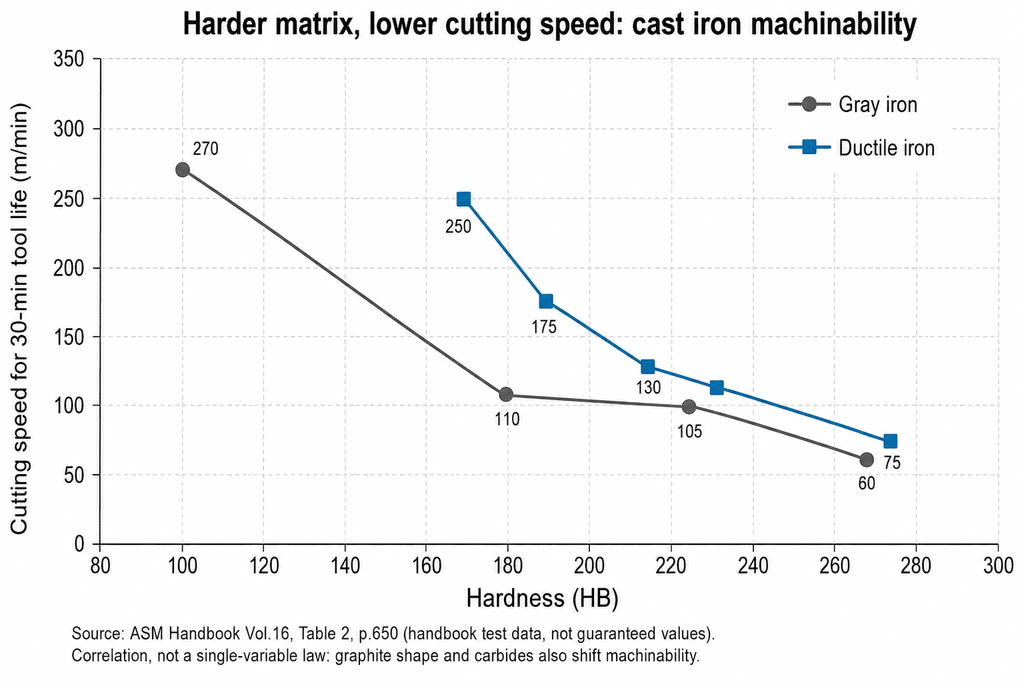
Read the pattern, not the exact figures: within one family, as ferrite falls and pearlite and hardness rise, the speed that holds the same 30-minute tool life drops sharply. It is a correlation from handbook testing, not a single-variable law, because graphite shape and carbides move machinability too.
Two comparisons worth keeping straight, because they get overstated.
Ductile vs gray at similar hardness. The handbook notes ductile iron can machine better than gray iron in some operations despite higher tensile strength at equal hardness. In one figure, at close-to-equal high hardness a gray iron at 263 HB tested at 45 m/min while a ductile iron at 265 HB tested at 60 m/min (ASM Handbook Vol. 16, Fig. 6, p. 650). That is a test point, not a blanket rule.
Malleable iron’s “25% better.” A frequently quoted general rule puts malleable iron machinability about 25% above free-cutting steel (ASM Handbook Vol. 16, p. 652). The handbook itself flags it as a general rule that fits many turning operations and does not necessarily hold for broaching and other cuts.
There is no single percentage machinability rating that covers gray, ductile, and malleable iron as one number. This chapter compares them through 30-minute tool-life speeds, specified-wear-volume tests, and graphs, each with a different endpoint, so mixing their speeds into one figure is wrong. The gray iron speeds in the table above come from a different test endpoint than the wear-volume speeds elsewhere in the same chapter and cannot be swapped.
4. Machining iron castings: tools, coolant, dust, and finish
A casting rarely leaves the mold ready to use. Sealing faces, bores, ports, and mounting surfaces get machined to size after casting, and that secondary work behaves differently from cutting a wrought bar. Four things decide how it goes.
4.1 Tool grades: ISO K, ceramic, CBN
Cast iron sits in application group K under ISO 513, the group for gray iron, spheroidal-graphite (ductile) iron, and malleable iron (ISO 513:2012, Table 5). Two points on that letter get missed often enough to cost inserts.
First, K is an application group, not a carbide grade or a chemistry. A K20 insert from one maker is not automatically equivalent to a K20 from another; the standard itself provides no grade comparison charts (ISO 513:2012, Clause 4). Within the K range, lower numbers (K01) sit toward higher wear resistance and higher speed, higher numbers (K40) toward higher toughness and higher feed (ISO 513:2012, Clause 3.2, Table 5 footnotes). The standard stops there. It does not map K01 to “finishing” or K40 to “roughing,” and it does not tie a K number to a specific speed, feed, or cast-iron grade, so those pairings are not standard claims.
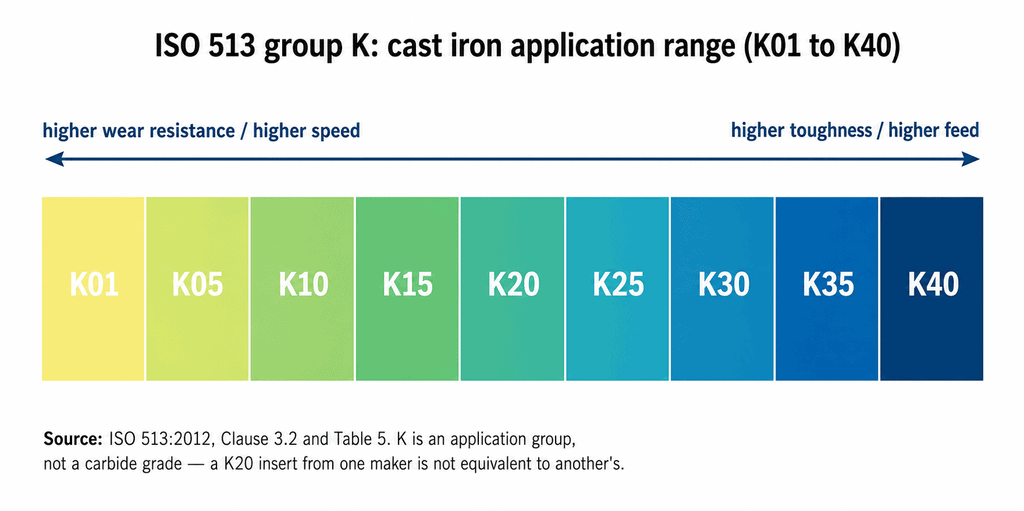
Second, hardened and chilled cast iron are not in group K. ISO 513 puts hardened cast iron materials and chilled cast iron in group H (ISO 513:2012, Table 5). “All cast iron is ISO K” is wrong for those two.
On material type, the handbook is direct about coated carbide for iron: coatings such as TiC, TiN, and Al₂O₃ are particularly effective for milling cast iron, and they lower flank wear and cratering, which lifts tool life (ASM Handbook Vol. 16, p. 656). For higher speeds, ceramics take over. On ferritic gray iron at 120 to 150 HB, cold-pressed alumina turns at 365 to 610 m/min depending on depth of cut; on pearlitic gray iron at 190 to 220 HB, hot-pressed Al₂O₃-TiC runs 215 to 460 m/min (ASM Handbook Vol. 16, Table 8, p. 654, handbook nominal values). Ceramic turning of iron has reached about 1500 m/min in high-volume work (ASM Handbook Vol. 16, p. 656). CBN, the hardest tool material after diamond, machines gray iron and lets white and high-nickel irons be turned rather than only abrasive-machined; the handbook gives no single CBN speed range, so none is quoted here.
4.2 Interrupted cuts in milling
Milling an iron casting means the cutting edge repeatedly enters and leaves the workpiece, so the edge has to survive impact, not just wear. The handbook points at the tools built for that: micrograin carbides have better strength and impact resistance and are effective for interrupted cuts (ASM Handbook Vol. 16, p. 656), and cast-alloy tools are more resistant to chipping than carbides. Honing or lightly rounding the carbide or ceramic edge reduces chipping or breaking of the edge.
What the sources support is the tool response: for interrupted cuts, favor impact resistance, reach for micrograin or coated carbide, and consider a honed edge. The full mechanical chain some articles write, that repeated entry and exit sets up a cyclic thermal-mechanical shock that then causes chipping, is not written out in these standards. ISO 8688-2 provides the methodology for tool-life testing in end milling of steel and cast iron and defines chipping and cracking as measurable failure modes, but it does not define milling as interrupted cutting. So the tooling guidance stands on the sources; the deeper causal story would need its own reference.
4.3 Dry vs wet
Iron castings can be machined satisfactorily without a cutting fluid. Both tool-life test standards say the same for their test conditions: ISO 3685 does not recommend cutting fluid when cutting cast iron (ISO 3685:1993, Clause 6), and ISO 8688-2 does not recommend it for cast-iron end milling. That is why so much iron is cut dry.
It is a default, not a rule. The handbook flags where coolant earns its place: drilling and tapping, which trap heat and chips, and high-metal-removal work, where fluid helps tool life, accuracy, and chip removal (ASM Handbook Vol. 16, p. 654). Coolant also cuts the graphite-dust nuisance of dry cutting. One caution specific to gray iron: flake graphite has an affinity for oil and can strip it out of an emulsion, so concentration needs watching.
4.4 Graphite dust and surface finish
Dry cutting is why dust is a machining decision, not an afterthought. Cast iron throws off fine graphite and iron-oxide particles. On respiratory protection, EN 149 rates particle-filtering half masks FFP1, FFP2, FFP3, with maximum filter penetration of 20%, 6%, and 1%, which is an equivalent minimum filter efficiency of about 80%, 94%, and 99% (EN 149:2001+A1:2009, Table 1). Mean total inward leakage limits per wearer run 22%, 8%, and 2% (EN 149:2001+A1:2009, §7.9.1). For dusty dry cutting, grinding, or cleanup, FFP3 gives the most margin. That is an engineering call from the performance gap, not an EN 149 requirement: the standard sets no cast-iron-specific FFP level, so the final grade still comes from the actual exposure assessment.
On finish, the graphite that helps the cut also complicates the surface. The shape and amount of graphite affect the potential surface finish (ASM Handbook Vol. 16, p. 648). That is as far as the handbook goes on the mechanism; how graphite pull-out changes a specific Ra is not something these sources quantify.
Ra itself needs care when you quote it. Under ISO 21920-2, Ra is the arithmetic mean of the absolute profile heights over the full evaluation length, not a peak-to-valley figure and not an average of several sampling lengths (ISO 21920-2:2021, Formula 9). And a bare “Ra 1.6 µm” is ambiguous, because the measurement settings ride along with it. For a drawing upper limit, ISO 21920-3 default settings put Ra 1.6 µm at λc 0.8 mm, λs 2.5 µm, evaluation length 4 mm (ISO 21920-3:2021, Table 3). How and where to tag those callouts on a print sits with the Ra and GD&T tolerance standards. Write the value with its settings rather than alone:
Ra ≤ 1.6 µm, per ISO 21920-3:2021 default settings: λc 0.8 mm, λs 2.5 µm, evaluation length 4 mm.
5. Casting tolerance and machining stock: which faces to cut, and how much to leave
Not every surface on a casting gets machined. The ones that stay as-cast and the ones that must come out clean are controlled differently, and mixing them up is where sourcing goes wrong late, after machining has already added cost. Flagging that split at drawing stage is exactly what a design-for-manufacturing review is for.
ISO 8062-3 handles this with three separate calls. As-cast linear dimensions run on a dimensional casting tolerance grade, DCTG 1 to 15, with the actual tolerance value read from the standard by nominal size (ISO 8062-3:2023, §7.2, Table 7). As-cast form and orientation run on a geometric grade, GCTG 2 to 8 (ISO 8062-3:2023, §7.3). Surfaces that will be machined get a required machining allowance, RMA, added on top.
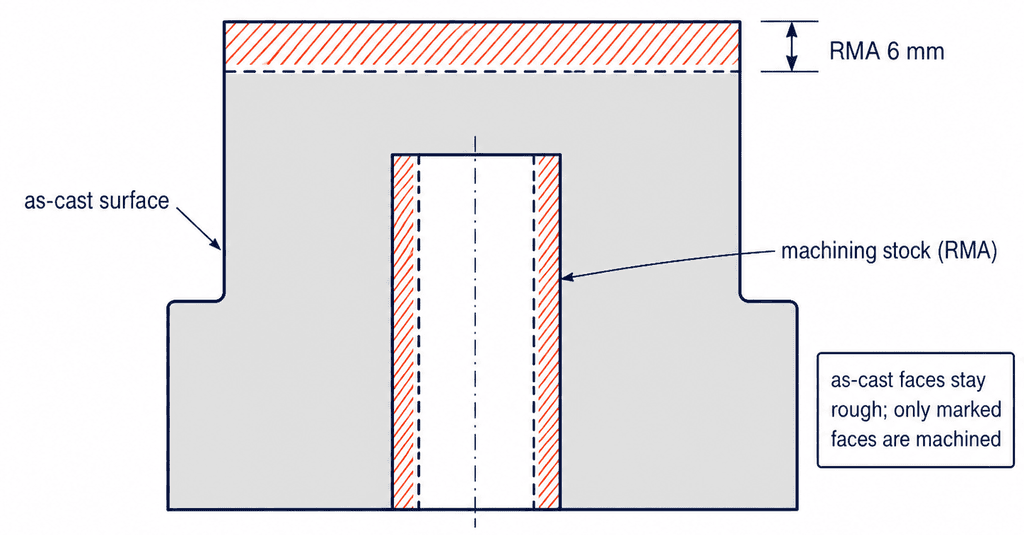
The allowance is not read from the local feature. RMA comes from a grade A to K, and you look it up against the casting’s largest overall dimension, not the size of the face being cut (ISO 8062-3:2023, §10.1, Table 12). For a casting in the 400 to 630 mm range at RMA grade H, that stock is 6 mm (ISO 8062-3:2023, Table 12). One grade and one RMA normally cover every machined surface on the part, but sand-cast top surfaces can need more, so a coarser grade is allowed there, and a single face that needs special stock gets its own callout (ISO 8062-3:2023, §10.1, §11.2).
On the drawing, the general tolerance reads as one line. A part at DCTG 12 with 6 mm allowance at grade H, plus GCTG 7:
ISO 8062-3, DCTG 12, RMA 6 (RMAG H), GCTG 7
What a sand-cast iron part can actually hold is separate from what the standard mandates. Annex A gives typical achievable grades, informative not specified: machine-moulded gray or ductile iron in long-series production sits around DCTG 8 to 12 (ISO 8062-3:2023, Annex A, Table A.1). Pick the achievable grade from Annex A, then read the real tolerance value from Table 7. At DCTG 10 and a 100 to 160 mm nominal size, that value is 3.6 mm total (ISO 8062-3:2023, Table 7, specified). Keep the two straight: the DCTG 8-to-12 range is foundry capability guidance, the 3.6 mm is the standard’s specified tolerance.
Two things to hold onto. A DCT value is a total tolerance width, not a plus-or-minus, so 3.6 mm means about ±1.8 mm only under the default symmetric distribution (ISO 8062-3:2023, §7.2). And wall thickness defaults one grade coarser than the general dimensions, so a DCTG 10 part carries DCTG 11 walls (ISO 8062-3:2023, §9).
6. Where the choice actually lands
Fix the grade on both sides before the comparison means anything. For a machine base or a housing that carries compression and needs to kill vibration, gray iron is the cheaper right answer, and it cuts easily dry with a K-group insert. For a pump body under pressure or a bracket that takes impact, move to ductile iron and accept the harder cut and the lower damping. For a part that has to be welded into an assembly, or one that needs a heat-treated strength window a casting cannot reach, go to steel: 1018 or 1045 wrought, 4140 when you need to quench and temper into the 900 to 1150 MPa range through-section.
The reversal most people miss: gray iron machines easier than the mild steel sitting next to it, but it is rough on the insert, not the spindle. The first roughing pass through the cast skin is where the edge takes its worst beating, and the abrasive graphite dust that comes off dry is a health control, not a nuisance to wave away. Size the first cut to clear the skin in one pass, run K-group carbide or ceramic, and treat the dust like the exposure it is. Engine blocks, gearbox housings, and brake components are the high-volume iron-casting jobs where this plays out, which is why they sit inside automotive parts machining. Send the drawing with the machined faces and as-cast faces marked, or start with a machined prototype in the production alloy to confirm fit before committing a casting pattern.
7. FAQ
Is cast iron stronger than steel?
It depends on the load. Gray iron beats steel in compression, roughly three to four times its own tensile strength (ASM Handbook Vol. 1, p. 55). In tension and impact, steel wins: gray iron is brittle, with fracture elongation near 0.6% (ASM Handbook Vol. 1), while a hot-rolled 1045 bar carries about 570 MPa tensile at 16% elongation (ASM Handbook Vol. 1, Table 9, estimated).
Is cast iron harder than steel?
Class 40 gray iron runs about 235 HB as-cast (ASM Handbook Vol. 1, Table 12, typical). Quenched-and-tempered 4140 can reach 341 HB and higher depending on temper (ASM Handbook Vol. 1, Tables 4 and 5, typical). Heat-treated alloy steel goes harder; as-cast iron does not reach it.
Can cast iron be machined on a CNC?
Yes, and gray iron cuts more easily than mild steel because the graphite breaks chips and lubricates the tool (ASM Handbook Vol. 16, p. 649). It is usually cut dry with a K-group carbide or ceramic insert (ISO 513:2012, Table 5; ISO 3685:1993, Clause 6).
What is the difference between cast iron and cast steel?
Carbon and graphite. Cast iron holds 2.5 to 4% carbon that mostly forms free graphite; cast steel keeps carbon below about 2% and forms none, which gives it higher tensile and impact strength and lets it be welded, at the cost of the damping and easy machinability that graphite gives cast iron (ASM Handbook Vol. 1).
Related resources
Related Capability: CNC machining tolerances and GD&T standards. Covers the Ra and dimensional callouts a machined iron casting needs on the print.
Related Guide: DFM design guidelines. Covers separating as-cast faces from must-machine faces before tooling is cut.
Related Article: moving a machined part from prototype to low-volume production. Covers how material and setup decisions change as iron-casting volume climbs.
Ready to Quote Your CNC Prototype?
Upload your STEP file and get a DFM review + quote within 12 hours.
No tooling cost. Minimum 1 part.