

Dewey Wu General Manager & senior mechanical engineer at EPOC CRAFTER, 15 years in design engineering, quality, and metallurgy. Hands-on across CNC machining, metalwork, sheet metal, and prototyping (subtractive + 3D printing).
An alloy is a metallic material made by combining a base metal with one or more additional elements. Alloying changes the crystal structure or phases that form, which can shift strength, hardness, corrosion behavior, conductivity and machinability. Composition alone does not define the finished material. Grade, heat treatment or temper, product form and the governing material specification can change the result. For engineers and buyers, an alloy definition is only the first step. The material callout still has to identify the condition and acceptance requirements that control the part.
1. What Is an Alloy?
An alloy contains a principal metal plus one or more intentionally added elements. The additions can be metallic, such as zinc in brass, or nonmetallic, such as carbon in steel. That is the practical alloy meaning used in engineering: the base metal remains the matrix, while alloying elements change the material response. In plain language, metal alloys are metals whose composition has been deliberately adjusted.
Metal and alloy are not interchangeable labels. A pure metal is dominated by one metallic element. A metal alloy is an engineered composition whose alloy constituents are selected to change one or more properties. The change can favor strength, hardenability, corrosion resistance, wear, conductivity, castability or another design need. The trade can move in the opposite direction too. Copper alloy conductivity data show that strength can rise while electrical conductivity falls. The phrase alloy material is therefore broader than one grade; alloy materials cover many families and conditions.
The difference between metal and alloy becomes a purchasing issue as soon as a drawing reaches RFQ. “Aluminum alloy” or “stainless steel” still leaves the exact material grade, condition, product form and specification unresolved. A family name can screen candidates. It cannot release the stock for purchase.
2. How Are Alloys Made, and What Does Alloying Change?
How are alloys made? The production route depends on the alloy system, but alloy manufacturing starts by combining a base metal with controlled additions, then using solidification, thermal processing or mechanical processing to create the required structure. The article does not treat alloy production as one universal recipe because wrought, cast, powder and deposited materials follow different routes. That distinction also explains how alloys are made across different alloy manufacturing routes without treating one alloy manufacturing process as universal.
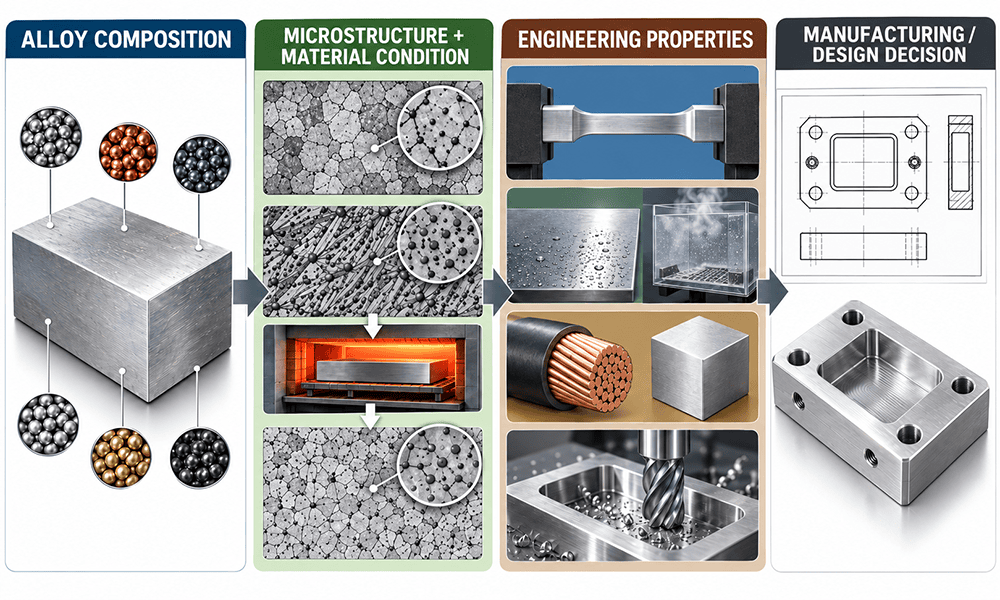
What is alloying? Alloying is the controlled addition of elements to change alloy chemistry and the phases or defects that develop. Alloy composition sets the chemical range. Microstructure and condition decide how much of that potential appears in the supplied stock. A heat treatable aluminum alloy in a solution treated condition does not carry the same strength as the same alloy after artificial aging.
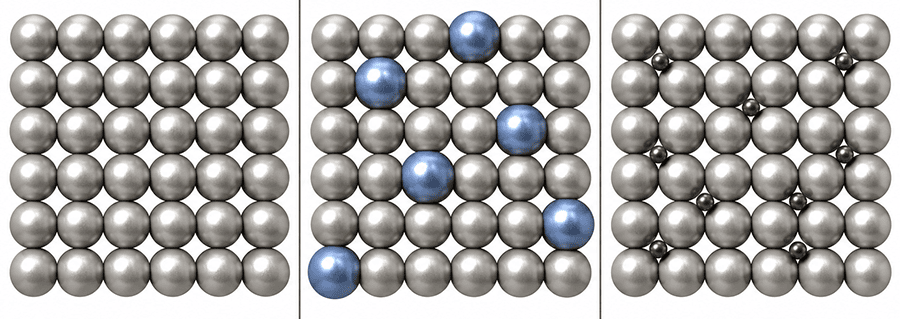
Substitutional and interstitial alloy structures explain two common solid solution mechanisms. In a substitutional alloy, solute atoms replace host atoms on lattice sites. In an interstitial alloy, much smaller atoms occupy spaces between host atoms. Zinc in copper is a familiar substitutional case; carbon in iron is the standard interstitial case. Both can impede dislocation motion, but neither label predicts a complete property set.
3. What Are the Main Types of Alloys?
Several classification systems are valid. For sourcing, the most practical types of alloys are ferrous alloys and nonferrous alloys, followed by the base metal family. Ferrous alloys are iron based. Non ferrous alloys use another base metal, such as aluminum, copper, nickel, titanium, magnesium or zinc. These alloy types answer the broad query “types of metal alloys,” while different types of alloys still need grade level separation for engineering work.
Common alloys then split into grade families. Alloy steel, stainless steel alloy, aluminum alloy, copper alloy, brass alloy, bronze alloy, nickel alloy, titanium alloy, magnesium alloy and zinc alloy all sit at this family level. These alloy examples are useful for screening, but they are too broad for final acceptance. An engineering alloy becomes purchase ready only after the grade, product form, condition and specification are fixed. These are examples of alloys used across industrial alloys and engineering alloys, not fixed property sets.
| Family | Representative example | Decision meaning |
| Carbon and alloy steels | 1018, 1045, 4140 | Use carbon steel when its strength and hardenability are enough. Move to alloy steel when section hardenability or a controlled heat treated condition drives the design. |
| Stainless steels | 304, 316L, precipitation hardening grades | Choose by corrosion environment, strength requirement, product form and condition. “Stainless” alone is not an acceptance callout. |
| Aluminum alloys | 6xxx and 7xxx series | Temper changes strength and machining response. Grade and temper belong together on the drawing. |
| Copper alloys | C360 brass, bronzes, Cu-Ni families | Alloying can raise strength or wear resistance while reducing conductivity. Keep conductivity in the selection criteria when the part carries current or heat. |
| Nickel alloys | N-series nickel alloys | High temperature or corrosion performance can justify the family, while work hardening and tool load affect machining. |
| Titanium alloys | Ti-6Al-4V family | Low density and high specific strength can justify the material, while low thermal conductivity changes the machining plan. |
Grade-level examples are covered in EPOC CRAFTER’s 6061 vs 7075 aluminum and 4140 alloy steel articles, so this page keeps those families at screening depth.
4. How Alloy Composition Changes Properties
Properties of alloys come from more than the element list. Alloy mechanical properties depend on composition, phase balance, grain structure, heat treatment, cold work and product form. Published alloy properties therefore need a grade and condition before they can be used for design or purchasing.
High strength alloys use different strengthening routes. Solid solution strengthening, precipitation hardening and phase transformation can all raise alloy strength or alloy hardness. “Why are alloys stronger?” has no single universal answer because some alloys are created for corrosion, conductivity control or casting behavior instead of maximum strength. Strong alloys and a high strength alloy only become meaningful descriptions after the grade and condition are stated.
A corrosion resistant alloy also needs an environment. Chromium-bearing stainless steels rely on passivation, while nickel and molybdenum additions can shift resistance to specific media. NIST testing on localized corrosion of 316L shows that chloride exposure, temperature and H2S conditions can change localized corrosion behavior. Corrosion resistant alloys can still pit, crevice corrode or crack under the wrong combination of chemistry, temperature and stress. Alloy corrosion resistance should be checked against the service condition, not inferred from a family name. A corrosion resistance alloy label on its own still leaves the test environment undefined.
Alloy density and alloy conductivity create separate tradeoffs. Lightweight alloys can cut mass, but stiffness and required section size still control part weight. Copper alloy systems show the conductivity trade directly: the Copper Development Association notes that conductivity is often sacrificed as strength rises in specialty copper alloys.
Use condition-specific values when numbers enter a design calculation. EPOC CRAFTER’s metal strength chart keeps grade, condition, product form and test context attached to the reported values.
5. Alloy vs Metal: What Changes for the Part?
A pure metal vs alloy comparison should be tied to the part function. Alloy vs metal is not a ranking. Alloying changes the property balance. The advantages of alloys and disadvantages of alloys only make sense against the required function. That is also the direct answer to why are alloys used.
| Question | Pure metal tendency | Alloy decision |
| Strength and hardness | Some commercially pure metals are soft or low strength. | Use the specified alloy and condition when higher strength, hardenability or wear resistance is required. |
| Corrosion | Some pure metals already resist certain environments. | Choose the grade against the actual medium, temperature, stress and surface condition. |
| Conductivity | High purity copper and aluminum retain high conductivity. | Accept the conductivity loss only when strength, wear or another property justifies it. |
| Machinability | Softness can create smearing or long chips. | Alloy machinability depends on grade, condition, work hardening, thermal behavior and chip formation. |
| Cost | Raw material may be cheaper or more expensive depending on purity and supply. | Compare finished part cost, including machining, tooling, heat treatment, finishing, inspection and certification. |
6. Alloy Machining, Fabrication and Cost
Alloy machining has to be judged at grade and condition level. Hardness, work hardening, thermal conductivity, ductility, abrasive phases and chip behavior change the cutting load. Nickel Institute machining guidance warns that work hardening can make subsequent passes harder in nickel alloys. TIMET titanium machining guidance identifies low thermal conductivity as a reason cutting heat concentrates near the tool. Alloy machinability and the machinability of alloys therefore belong to the exact grade and condition, not to the base metal name.
Machining alloys also means reading geometry with the material. A rigid 6061-T6 block with short tool reach is a different job from a thin wall 7075-T6 housing with deep pockets. Alloy fabrication adds forming, welding, heat treatment and surface finishing, each of which can alter the condition that reaches inspection.
Alloy cost is wider than alloy price. Stock availability, material removal, cycle time, tool consumption, heat treatment, finishing, inspection and certification all enter the quote. EPOC CRAFTER’s CNC machining materials guide expands that cost chain across common metals.
7. Alloy Selection for a Manufactured Part
Alloy selection should start from the failure mode and service condition. Load path, fatigue, corrosion medium, temperature, stiffness, mass, conductivity, joining, finish and certification narrow the field. Geometry then adds thin walls, deep pockets, long reach, datum transfers and inspection access. There is no universal best alloy; the specification follows the failure mode and the manufacturing route.
Product form belongs in the same decision. Plate, bar, sheet, tube, extrusion, forging and casting carry different processing histories and specification scopes. The required grade may be easy to buy as bar and awkward as thick plate. Procurement should confirm the form and condition before the drawing is frozen.
Surface finishing can change the selection too. Anodizing, plating, passivation and coating depend on the substrate and can change dimensions or corrosion behavior. EPOC CRAFTER’s surface finishing page maps these processes to material and drawing requirements.
For dimension-critical parts, the material callout sits beside the geometry callout. EPOC CRAFTER’s tolerances and GD&T resource separates size, geometry and inspection so the material and drawing requirements remain independently verifiable.
| RFQ question | Specify | Why it changes the decision |
| What can fail? | Yield, fatigue, wear, corrosion, conductivity, temperature or another functional limit | Prevents the material choice from being driven by a familiar grade name. |
| What stock is required? | Product form, section size, condition or temper | Links the design to material that can be purchased in the required state. |
| What happens in manufacturing? | Machining, forming, welding, heat treatment and finish | Shows whether the process changes the property or condition being relied on. |
| What must be accepted? | Specification, revision, tests, certification and part inspection | Turns a material preference into a verifiable purchase requirement. |
| What is the cost basis? | Stock plus processing, tooling, finishing, inspection and certification | Compares finished part cost instead of raw material price alone. |
8. UNS Number, Material Grade and Alloy Specification
ASTM E527-23 gives the Unified Numbering System a narrow job: identification and cross-referencing. Section 4.2 states that a UNS number is not itself a specification because it establishes no requirements for form, condition or quality. ASTM lists E527-23 as the active edition.
A UNS designation uses a letter prefix plus five digits. The prefix identifies a broad family. ASTM E527 places G-series numbers in carbon and alloy steels, S-series in heat and corrosion resistant stainless steels, C-series in copper and copper alloys, N-series in nickel and nickel alloys, and R-series in reactive and refractory metals and alloys. The digits do not follow one universal rule for composition, strength, temper or product level.
A material grade, metal grade, alloy designation or material designation can identify a grade within a recognized system, yet acceptance still comes from the applicable material specification and purchase requirements. A UNS alloy entry on an MTR does not prove compliance with a product specification by itself. The same rule applies when a drawing uses a UNS metal identifier without the governing product specification.
For an RFQ or MTR review, record the UNS material identity where relevant, then the alloy specification or metal specification, revision, grade or type, product form, condition or temper, dimensions, required tests, certification and acceptance requirements. EPOC CRAFTER’s Ti-6Al-4V vs 316L comparison shows how grade, UNS identity, product form and condition stay separate in aerospace and medical callouts.
| Field | What it answers | What it does not answer by itself |
| Material family | Which broad alloy family? | Exact grade, condition or acceptance. |
| UNS number / UNS designation | Which registered material identity? | Product form, condition, mechanical properties, quality or acceptance. |
| Grade or type | Which grade inside the chosen system? | The full purchase requirement without its governing specification. |
| Material specification | Which supply and acceptance rules apply? | Every part level dimension, tolerance, finish or inspection requirement. |
| Condition / temper | In what material state is the stock supplied? | All drawing and certification requirements. |
The purchasing sequence used here follows the ASTM E527 boundary: material identity first, then the specification and purchase requirements that control acceptance.
9. Frequently Asked Questions About Alloys
9.1 Are Alloys Metals?
Yes. An alloy is metallic material, so alloys are metals. The alloy contains a base metal plus controlled additions that change its properties. A family name such as aluminum alloy or stainless steel still needs a grade and condition for engineering use.
9.2 Is Brass an Alloy?
Yes. Brass is a copper and zinc alloy family. The exact composition changes by brass grade, so “brass” is not a complete material specification for a production drawing.
9.3 Is Aluminum an Alloy?
Aluminum is an element. Many engineering grades are aluminum alloys, including 6061 and 7075. The grade and temper need to be stated together when strength or machining behavior controls the part.
9.4 Is Bronze an Alloy?
Yes. Bronze is a copper alloy family. Tin bronze is one branch, while aluminum bronze, silicon bronze and other copper alloy systems also sit under the bronze name. Specify the grade when wear, corrosion or strength is functional.
9.5 Is Stainless Steel an Alloy?
Yes. Stainless steel is an iron-based alloy family containing chromium, with nickel, molybdenum, carbon, nitrogen and other additions controlled by grade. Austenitic, ferritic, martensitic, duplex and precipitation-hardening grades do not share one property set.
9.6 Why Are Alloys Stronger Than Pure Metals?
Some alloys are stronger because solute atoms, precipitates or transformed phases impede dislocation motion. The statement has limits. Alloying can target corrosion, castability, wear or temperature performance instead of strength, and the final strength still depends on grade and condition.
10. Release the Material Callout Before You Quote the Part
An alloy family is enough for early screening. A production RFQ needs the specified grade, product form, condition, governing specification and acceptance evidence. Keep the material callout tied to the process route and the drawing. For CNC parts with the alloy grade already fixed, EPOC CRAFTER’s CNC machining services are the next step for process review and quotation.
Ready to Quote Your CNC Prototype?
Upload your STEP file and get a DFM review + quote within 12 hours.
No tooling cost. Minimum 1 part.