

Dewey Wu General Manager & senior mechanical engineer at EPOC CRAFTER, 15 years in design engineering, quality, and metallurgy. Hands-on across CNC machining, metalwork, sheet metal, and prototyping (subtractive + 3D printing).
Among common CNC machining materials, the cheapest metal to machine for most parts is aluminum 6061-T6. The best metal for a specific job depends on corrosion environment, load path, and volume. Raw stock is not the reason 6061-T6 wins. Aluminum removes fast, wears tools slowly, and finishes in fewer setups than any other common shop metal. Raw material price sets the floor of a CNC part quote. Machinability, cycle time, tool life, setup count, inspection, and finishing set the ceiling. The ceiling moves more than the floor.
This guide compares aluminum, stainless steel, brass, copper, and titanium on total part cost, not on datasheets alone. You will see how a low material price can end up costing more per finished part, and how a switch from 316L to 6061-T6 with hard anodize saves 30–40% on the right kind of part at EPOC CRAFTER. Numbers come from AISI machinability data, Copper.org datasheets, and EPOC CRAFTER shop records from 12 months of precision CNC machining orders.
1. Cheapest Metal to Machine: The 60-Second Answer
For general-purpose parts under 5,000 pieces, aluminum 6061-T6 wins the cost race. Machinability rating: ≈190 against the AISI 1212 baseline of 100 (Sandvik cutting data). Cycle times run shorter, cutters last longer, and setups are easier. A simple 6061-T6 housing quoted in EPOC CRAFTER’s shop prices at 1.0×; the same part in 304 or 316L stainless runs 1.6–2.0× before finishing.
That answer breaks down in three situations:
Corrosion-critical parts. Chloride environments, medical wash cycles, marine hardware. 316L holds up where 6061-T6 with anodize does not.
High strength-to-weight parts. Aerospace brackets, robotics arms, structural clamps. 7075-T6 or Ti-6Al-4V justify their raw price on load path.
High-conductivity parts. Bus bars, RF grounding, thermal spreaders. Copper C110 is the answer even at 3× the raw material cost of aluminum.
Below aluminum, only free-cutting brass C36000 competes on machine time. Its machinability rating of 100 is the copper-alloy industry benchmark. C36000 raw stock costs 4–6× aluminum by weight, so it wins on cycle time and loses on material. For small threaded parts and valves under 100 g, that trade works. Above that mass, aluminum stays ahead.
2. Five Metals at a Glance: Aluminum, Stainless, Brass, Copper, Titanium
Five metals cover 80% of the metal CNC machining volume at EPOC CRAFTER: 6061-T6, 316L, C36000, C110, and Ti-6Al-4V. Each shows up on quotes for a different reason.
| Metal | Machinability | Raw material index | Tool wear | Where it wins |
| Aluminum 6061-T6 | ≈190 (AISI 1212 = 100) | 1.0× | Low | Housings, brackets, plates, prototypes |
| Free-cutting brass C36000 | 100 | 4–6× | Very low | Fittings, valves, connectors under 100 g |
| Stainless steel 303 | 78 (AISI) | 3–4× | Medium | Shafts, fasteners, non-critical hardware |
| Stainless steel 316L | 45 (AISI) | 4–5× | High | Medical wash cycles, chloride, chemical |
| Copper C110 | 20 | 3× | Medium (gummy chip) | Bus bars, RF grounding, thermal spreaders |
| Titanium Ti-6Al-4V | 22 (Sandvik cutting data) | 8–12× | Very high | Aerospace load path, orthopedic implants |
Machinability uses two baselines: AISI 1212 = 100 for steel and aluminum, Copper.org C36000 = 100 for copper alloys. Treat the ratings as ordinal within their own alloy family. Raw material index shown as ratio to 6061-T6 spot price, Q3 2026 US domestic distribution.
The grades in bold are what EPOC CRAFTER cuts by volume. Adjacent grades (7075-T6, 303, C26000, C145, Ti Grade 2) show up when specs require them, and every grade in the table sits on the shop’s regular materials and properties list.
Two observations from the table.
Aluminum’s machinability advantage does not scale linearly with cost. It does not remove 190× the material of steel in the same cycle. It runs higher spindle speeds and feeds, breaks chips clean, and puts less heat into the cutter. The finished-cost benefit lands between 30 and 60% for common CNC part geometries.
Raw material index is a floor, not a total. C36000 at 4–6× aluminum still finishes cheaper than aluminum for small threaded valve stems under 25 mm. The next section explains why.
3. Why Material Price Does Not Equal Part Cost
Raw material is 12–38% of the final CNC part price at EPOC CRAFTER shop rates, depending on complexity. Everything else is machine time, tool consumption, setups, inspection, finishing, and scrap. A 20% cut in material cost saves 3–8% of the final quote. A 20% cut in cycle time saves 8–12%. That ratio decides most alloy switches.
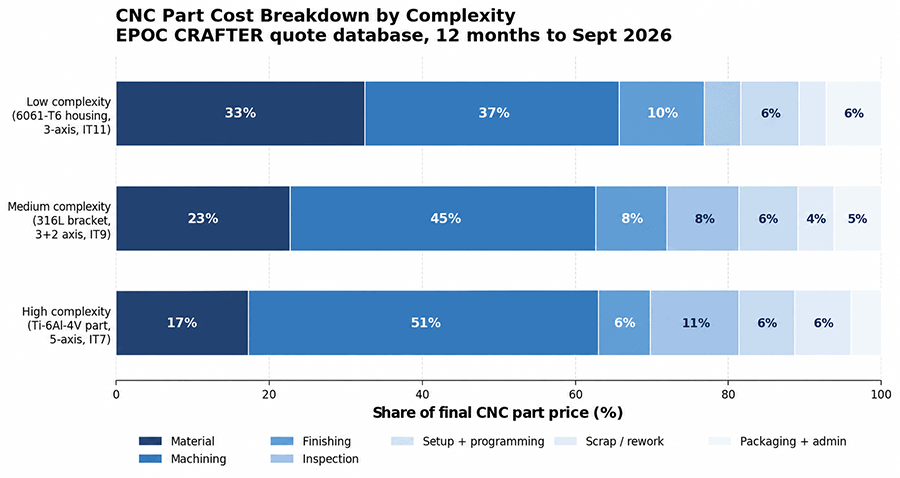
| Cost driver | Low complexity | Medium complexity | High complexity | What moves it |
| Material | 28–38% | 18–28% | 12–22% | Raw stock, buy-to-fly waste, alloy premium |
| Machining (cycle + tool + machine rate) | 32–42% | 40–50% | 46–56% | Removal volume, feeds, tool life |
| Finishing (anodize, passivate, plating, polish) | 8–12% | 6–10% | 4–8% | Coating spec, surface area, batch size |
| Inspection (CMM, FAI, MTR, reports) | 3–6% | 6–10% | 8–14% | Tolerance grade, GD&T count, traceability |
| Setup + programming | 5–8% | 5–8% | 4–7% | Number of setups, quantity amortization |
| Scrap and rework | 2–4% | 3–6% | 4–8% | Thin walls, hard materials, tight tolerance |
| Packaging, freight, admin | 4–8% | 3–7% | 2–5% | Weight, destination, MOQ |
EPOC CRAFTER database, 12 months ending September 2026, 50–200 piece batches, standard lead time. Ranges cover the middle 80% of quotes in each band.
Low complexity means a 6061-T6 housing with 3-axis milling, IT11 tolerance, and Type II anodize. Medium is a 316L structural bracket with 3+2 axis, IT9, passivation, and CMM first article. High is a Ti-6Al-4V precision part with 5-axis, IT7, 100% CMM, and full MTR traceability.
Material share drops as complexity rises. On a titanium precision part where raw stock costs 8× aluminum, machining time and inspection absorb more of the final quote than the alloy premium does. The lever that cuts price is geometry, tolerance, and finish spec, not the material line on the BOM. Our DFM design guidelines cover which geometry choices move which cost buckets.
Three cost drivers get missed on RFQ:
Buy-to-fly ratio. A finished part that weighs 200 g machined from a 900 g billet has a 4.5:1 buy-to-fly. Four fifths of the raw material becomes chip. Titanium at 4.5:1 costs more in chip than aluminum at 8:1 in the finished part. Design out the buy-to-fly before switching alloys.
Tool life on hard alloys. A carbide end mill running 6061-T6 lasts 180–300 minutes at cut per edge. The same cutter running Ti-6Al-4V lasts 25–40 minutes (Sandvik application data, dry cut, 8000 RPM equivalent). Titanium quotes carry 4–7× the tool consumption on a matched feature.
Inspection escalation with tolerance. Moving a non-critical dimension from ±0.05 mm to ±0.025 mm on 316L adds one CMM cycle per part, one operator check, and 3–5% scrap on thin sections. Non-critical tightening inflates a quote without gaining function. Our CNC machining tolerances and cost breakdown shows how each precision tier moves the final quote..
4. Machinability Rating: The Number That Predicts Your Quote
Machinability rating measures how fast a metal can be cut relative to a standard baseline. Steel and aluminum use AISI 1212 free-cutting steel = 100%. Copper alloys use C36000 free-cutting brass = 100%. A rating of 200% means twice the recommended surface feet per minute at the same tool life; 50% means half.
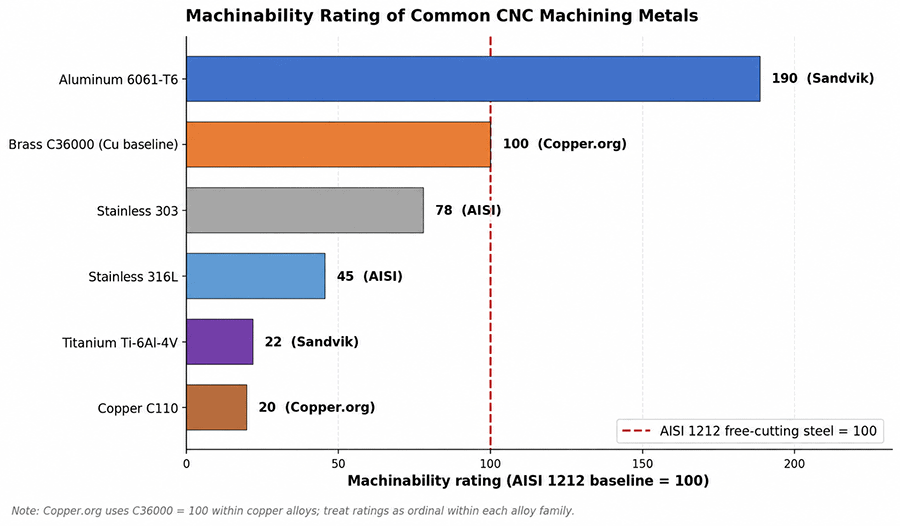
The rating predicts three things on a CNC quote:
Cutting speed the shop can run. 6061-T6 at machinability 190 lets a 12 mm carbide end mill run 1200–1500 SFM. 316L at 45 caps the same tool near 250–400 SFM. Cycle time on a comparable feature moves in proportion.
Tool life per edge. Sandvik cutting data across matched geometries shows carbide end-mill life drops from 240 minutes on 6061-T6 to 60 minutes on 303 and 25 minutes on Ti-6Al-4V. Tool cost per finished part scales inversely with the rating.
Surface finish achievable in one pass. Higher machinability metals hit Ra 1.6 μm as-milled without a finishing pass. Lower machinability metals need a finish operation for the same Ra, adding cycle time.
The rating does not predict:
Corrosion behavior. 316L machines slower than 303 and 304 but survives chloride environments neither of them handle. Machinability trade-off is not a corrosion trade-off.
Fatigue life or strength retention at temperature. Titanium’s poor machinability and aluminum’s strong machinability say nothing about how each performs at 400 °C load. Match strength requirements first, then optimize machinability within the eligible alloy set. Reading yield strength vs tensile strength for CNC part selection separates the two properties that get conflated on RFQ.
Weldability or post-processing behavior. 6061-T6 and 7075-T6 machine at similar speeds; 6061-T6 welds, 7075-T6 does not without loss of properties. Machinability is one axis of a multi-axis selection.
Two shortcut rules for RFQ triage. If the rating is above 100, the machining line item usually stays under 45% of the quote. If it drops below 40, machining passes 55% and starts pulling inspection and scrap up with it. That threshold explains most of the “why is my titanium quote so high” reactions on RFQ.
5. Aluminum, Stainless, Brass, Copper, Titanium: What Each Actually Costs
Grades in bold are what EPOC CRAFTER runs by volume; adjacent grades appear when specs require them.
5.1 Aluminum: 6061-T6, 6061-T651, 7075-T6
6061-T6 covers 70% of aluminum orders. Machinability 190, tensile strength 310 MPa (T6 temper, Alcoa datasheet), corrosion resistance good with Type II or Type III anodize. Housings, brackets, mounting plates, fixtures. First choice for prototypes and pilot runs. A thin-wall 6061-T6 optical base that held a 45 mm deep bore at 0.015 mm on 3.5 mm walls is documented in our thin-wall aluminum optical base case study.
6061-T651 is the plate form of the same alloy, stress-relieved for dimensional stability on large flat parts. Same machinability, same cost. Used when the part is wider than 100 mm and warp control matters.
7075-T6 doubles the tensile strength to 570 MPa (T6, Alcoa datasheet) at the cost of weldability and 30% higher raw material price. Machinability drops to about 130. Aerospace brackets, robotics load path, high-clamping fixtures. Not a substitute for 6061 on general parts; the raw premium does not pay back without a strength requirement.
Skip 6063-T5 unless the part starts as an extrusion. Skip 2024 unless the drawing calls it out for aerospace fatigue reasons.
5.2 Stainless Steel: 303, 304, 316L
303 is the free-cutting stainless. Sulfur and phosphorus added, machinability 78, tensile 620 MPa. Shafts, threaded fittings, non-critical hardware. Choose 303 over 304 when the part is turned and corrosion demand is modest.
304 is the general-purpose austenitic. Machinability 45, tensile 505 MPa (annealed, ASTM A276). Food equipment, general enclosures, instrument covers. 40–50% slower to machine than 303. Choose 304 when the part sees moisture but not chlorides.
316L adds molybdenum for chloride and reducing-acid resistance. Machinability 45, tensile 485 MPa (annealed, ASTM A276), L grade for weldability. Medical, marine, chemical, pharmaceutical. Costs 30–50% more per finished part than 304 at matched geometry, and the premium fits anything a chloride environment or medical wash cycle will see.
For hardenable stainless (17-4 PH, 15-5 PH, 410, 420, 440C), spec them only when strength or wear demands justify the machining slowdown. Machinability on the PH grades drops to 35 in the aged condition.
5.3 Brass: C36000, C26000, C46400
C36000 free-cutting brass is the CNC baseline for small threaded parts. Machinability 100, tensile 385 MPa (H02 temper). Valve bodies, hose fittings, connectors, decorative fasteners. Cycle times run close to aluminum on small features; the lead content that gives C36000 its rating limits some drinking-water and medical applications.
C26000 cartridge brass has a machinability of 30. Formable in ways C36000 is not, but on straight CNC work it runs 3–4× slower. Choose it only when the drawing forbids leaded brass or when a cold-forming step precedes the machining.
C46400 naval brass adds tin for saltwater corrosion resistance. Marine fittings, propeller hardware. Machinability drops to about 30. Spec it for marine, avoid it otherwise.
Skip C23000 red brass on CNC unless the application is decorative and the drawing specifies the alloy.
5.4 Copper: C110, C145, C101
C110 electrolytic tough pitch is the standard electrical copper. Machinability 20, 100% IACS conductivity. Bus bars, terminals, thermal spreaders, RF grounding. The low machinability rating reflects gummy chip behavior, not hardness. Sharp positive-rake tools and coolant fix most of it, but cycle times still run 4–6× longer than free-cutting brass on matched features.
C145 tellurium copper trades a small conductivity drop (94% IACS) for machinability of 85. When the part is copper by spec and volume is above 200 pieces, C145 pays back the small conductivity loss within one order.
C101 oxygen-free copper is C110 without the residual oxygen, for vacuum, high-purity, and RF applications. Machines like C110. Specify it only when the drawing calls it out; the premium over C110 is 20–40%.
5.5 Titanium: Grade 2, Grade 5, Grade 23
Grade 2 commercially pure titanium. Machinability 40, tensile 345 MPa (ASTM B348). Chemical equipment, medical non-load, marine hardware. Choose Grade 2 when corrosion is the driver and load is modest.
Grade 5 (Ti-6Al-4V) covers 80% of titanium orders. Machinability 22 (Sandvik cutting data), tensile 950 MPa (annealed, ASTM B348). Aerospace brackets, robotics arms, orthopedic instruments, high-strength fittings. The raw material premium is 8–12× aluminum by weight; the finished part premium runs 5–8× a matched 6061-T6 part on our shop records.
Grade 23 (Ti-6Al-4V ELI) is the extra-low interstitial version for medical implants. Same machining behavior as Grade 5, tighter chemistry, 15–30% raw premium. Spec it only when the application is implantable or the drawing calls out ASTM F136.
Skip Grade 9 and Grade 1 on CNC unless the drawing specifies them.
6. Three Real EPOC CRAFTER Scenarios
Three cases from the last 12 months, anonymized by customer request, show where the alloy switch pays back and where it does not.
6.1 Case A: 316L to 6061-T6 with hard anodize, 30–40% unit price cut
A European industrial automation OEM ordered instrument enclosures in 316L stainless, batch 100–500 pieces per release, general dimensions to ISO 2768 Edition 2 medium class, critical bores at ±0.05 mm.
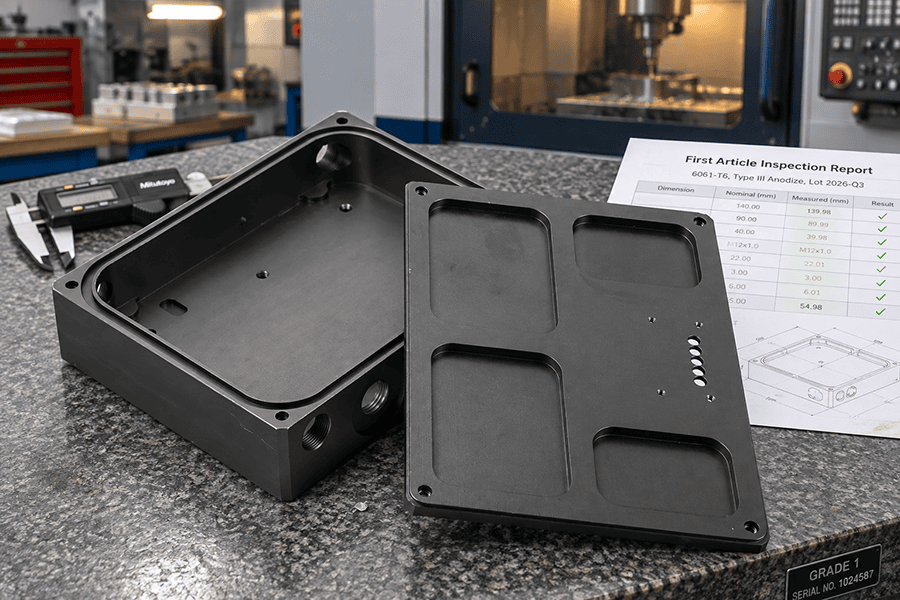
Switched to 6061-T6 with Type III hard anodize (50 μm coating, MIL-A-8625F Type III Class 2). Unit price dropped 30–40%. Cycle time dropped 35–50%. Machinability rating jumped from 45 to 190; three-setup part collapsed to two setups. Anodize added one process step and 8–12% back to the cost, and the net still landed 30% cheaper than the 316L baseline.
The decision hinged on the corrosion spec allowing the substitute. When the drawing calls out 316L for medical wash cycles or chloride process fluid, this switch does not exist. When the drawing says “corrosion-resistant, salt-spray ≥ 500 h,” the switch is on the table.
6.2 Case B: C36000 to C26000, 5–15% material saved, 15–30% part price up
A North American precision valve manufacturer moved from C36000 free-cutting brass to C26000 cartridge brass on connectors, batch 500–5,000, driven by a lead-content restriction in the target market. Raw material dropped 5–15% per kilogram at the mill. Finished part price went up 15–30%.
Machinability collapsed from 100 to 30. Cycle time on turned features rose 35–60%. Carbide insert life dropped in similar proportion. New tooling spend and slower cycle absorbed the raw savings and added a margin on top.
The lesson is the machinability rating, not the raw price. C26000 is the right alloy when a lead restriction, forming step, or specific corrosion path requires it. It is the wrong alloy when the only driver is unit material cost. A route review at RFQ stage catches this before purchasing changes the alloy.
6.3 Case C: 316L locked, 20–35% cut through DFM and tolerance work
An Asian medical device OEM ordered a 316L structural bracket, batch 100–300, that could not switch material. Their regulatory file called out 316L by ASTM A276 grade and heat lot traceability. Cost reduction had to come from geometry and inspection.
Three moves cut the unit price 20–35% without changing the alloy:
Non-CTQ dimensions relaxed from ±0.025 mm to ±0.05–0.10 mm on faces that did not mate or seal. Inspection load dropped, scrap on thin sections fell 30–40%.
Internal corners increased from R2 to R4, letting a larger end mill run the profile. Cycle time on the pocket dropped 15–25%.
Setups reduced from four to three by consolidating fixturing on the back face. Setup and programming amortization improved across the batch.
The same DFM-first approach shows up in our thin-wall aluminum inspection case, where a part that passed gauge on the machine had moved by the next day, showing where geometry and residual stress dominate the final dimension. When material is locked, geometry and tolerance are the levers.
7. Choosing the Right Material: A Decision Path
Material selection decisions collapse to five inputs: corrosion environment, strength requirement, conductivity requirement, batch size, and tolerance grade.
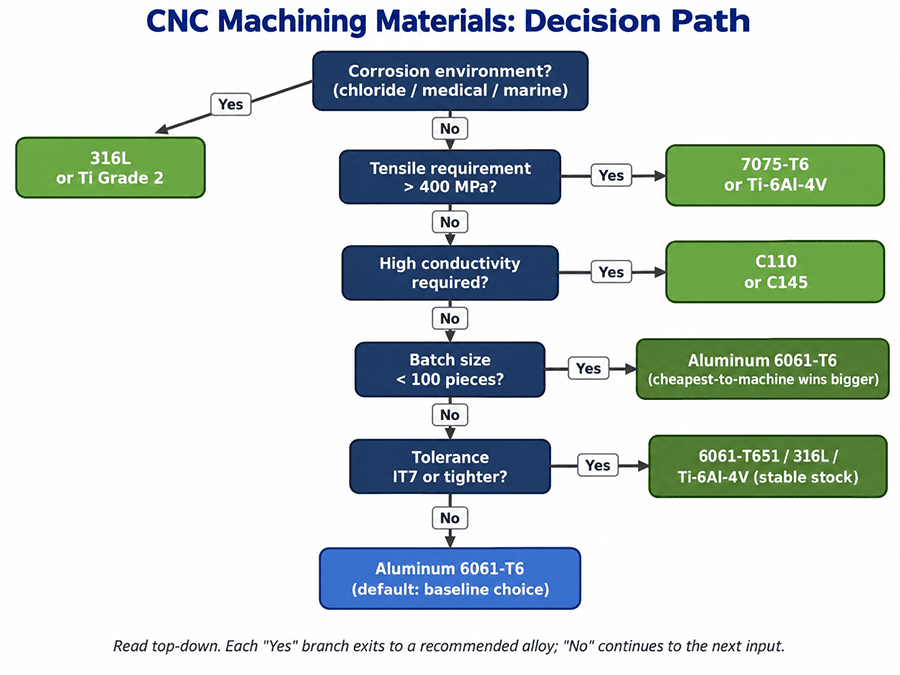
Run the inputs in this order:
Corrosion environment first. Chlorides, seawater, medical wash cycles, or acidic process fluids drive to 316L or Ti Grade 2. Everything else is open.
Strength-to-weight second. Load path parts above 400 MPa tensile need 7075-T6 or Ti-6Al-4V. Load path parts under 300 MPa run in 6061-T6 with margin.
Conductivity third. Bus bars, RF grounding, thermal spreaders drive to C110 or C145. No substitute exists at scale.
Batch size fourth. Batches under 100 pieces amortize setup poorly, so the cheapest-to-machine alloy wins by a wider margin. Batches above 1,000 pieces let higher raw-cost alloys pay back through cycle time gains.
Tolerance grade last. IT7 and tighter push toward alloys that hold dimensional stability through machining: 6061-T651 for plate, 316L for stainless, Grade 5 for titanium. IT9 and looser open the choice back to whichever alloy wins on the first four inputs.
When two inputs conflict, run the materials reference against the drawing before the RFQ goes out.
8. FAQ
What is the cheapest metal to CNC machine?
Aluminum 6061-T6 for general parts under 5,000 pieces. Free-cutting brass C36000 for small threaded parts under 100 grams. The choice depends on part mass and geometry, not raw material spot price.
Why is titanium so expensive to machine?
Machinability rating of 22 against the AISI 1212 baseline of 100 (Sandvik cutting data). Cutting speeds run 20% of aluminum. Carbide tool life drops 5–8×. Raw material costs 8–12× aluminum by weight. Together these push a matched titanium part to 5–8× the price of the same part in 6061-T6.
Is brass cheaper than aluminum for CNC parts?
Only for small threaded parts under 100 grams. C36000 raw stock costs 4–6× aluminum by weight, and the machinability edge only offsets the material premium on parts where cycle time dominates the quote. Above 100 grams, aluminum wins.
6061 or 7075 aluminum for CNC parts?
6061-T6 for housings, brackets, plates, and prototypes. 7075-T6 for aerospace load paths and high-clamping fixtures where tensile strength above 500 MPa is required. 7075-T6 costs 30% more raw and machines 30% slower without justifying it on general parts.
Which stainless steel is cheapest to machine?
303, at machinability 78 against 45 for 304 and 316L. Choose 303 for shafts and non-critical fasteners. Choose 304 for general corrosion resistance without chlorides. Choose 316L for chloride, medical, and marine environments.
Ready to Quote Your CNC Prototype?
Upload your STEP file and get a DFM review + quote within 12 hours.
No tooling cost. Minimum 1 part.