

Dewey Wu General Manager & senior mechanical engineer at EPOC CRAFTER, 15 years in design engineering, quality, and metallurgy. Hands-on across CNC machining, metalwork, sheet metal, and prototyping (subtractive + 3D printing).
ABS often deserves earlier screening for elevated-temperature FDM parts, while PETG is often easier to print with less warping. Neither material is universally stronger or more durable. The better choice depends on the specific filament grade, operating temperature, sustained load, part geometry and printing conditions. For functional brackets, fixtures and electronics enclosures, compare mechanical properties under equivalent test conditions and check the finished part for dimensional stability, assembly fit and deformation under load.
1. ABS vs PETG: Key Differences at a Glance
ABS and PETG can both produce functional FDM parts, but they present different manufacturing risks. ABS often requires tighter thermal control to limit shrinkage and warping. PETG generally prints with less distortion, although its performance under sustained heat and mechanical load still needs verification.
| Property | ABS filament | PETG filament |
| Tensile strength | Match ASTM D638 specimen, direction and definition | Match ASTM D638 specimen, direction and definition |
| Impact resistance | Notch and grade matter; assess rib roots and fastener shocks | Notch and grade matter; assess rib roots and fastener shocks |
| Heat resistance | Screen grade-specific heat performance under applied load | Measure creep and displacement under applied load |
| Warping and shrinkage | Higher distortion risk; chamber control often beneficial | Typically lower warping risk; geometry and cooling still matter |
| Layer adhesion | Sensitive to chamber, cooling and interlayer bonding | Can achieve strong layer bonds with controlled conditions |
| Chemical and UV exposure | Chemical and UV performance depends on formulation | Chemical and UV performance depends on formulation |
| Surface finishing | Suitable grades support controlled acetone smoothing | Mechanical finishing more common |
| Dimensional accuracy | Corner lift and residual stress need attention | Often easier to maintain flatness, but not distortion-free |
| Printing environment | Heated bed and controlled enclosure commonly used | Heated bed common; chamber depends on grade and geometry |
| Use cases | Candidate for warm fixtures and housings; verify final fit | Candidate for brackets and covers; verify loaded deformation |
These differences are useful for initial material selection, not final part qualification. A tensile strength value obtained from an injection-molded specimen cannot be treated as the strength of a printed bracket. Build orientation, wall structure, voids and layer bonding change how the finished part carries load.
The same restriction applies to heat resistance. Glass transition temperature (Tg), heat deflection temperature (HDT) and sustained-load deformation describe different behaviors. A higher Tg does not guarantee that a mounting bracket will remain within its dimensional tolerance after 24 hours under load.
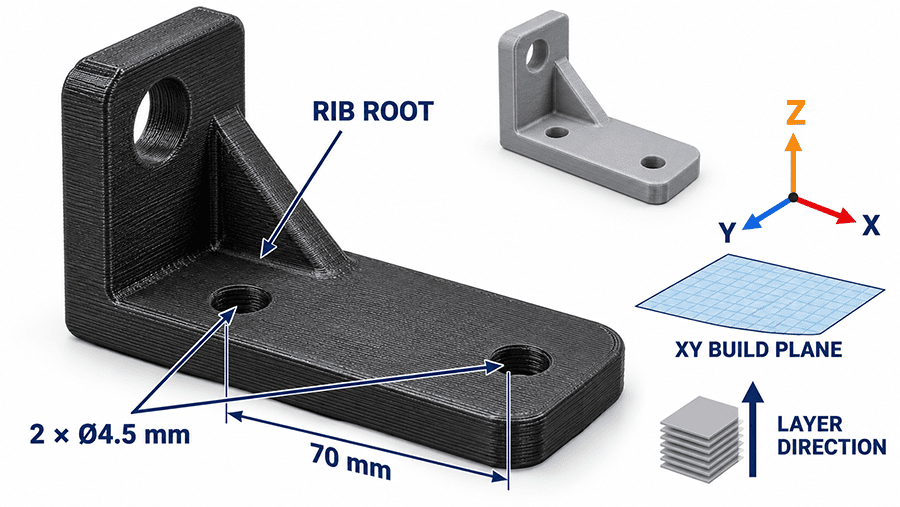
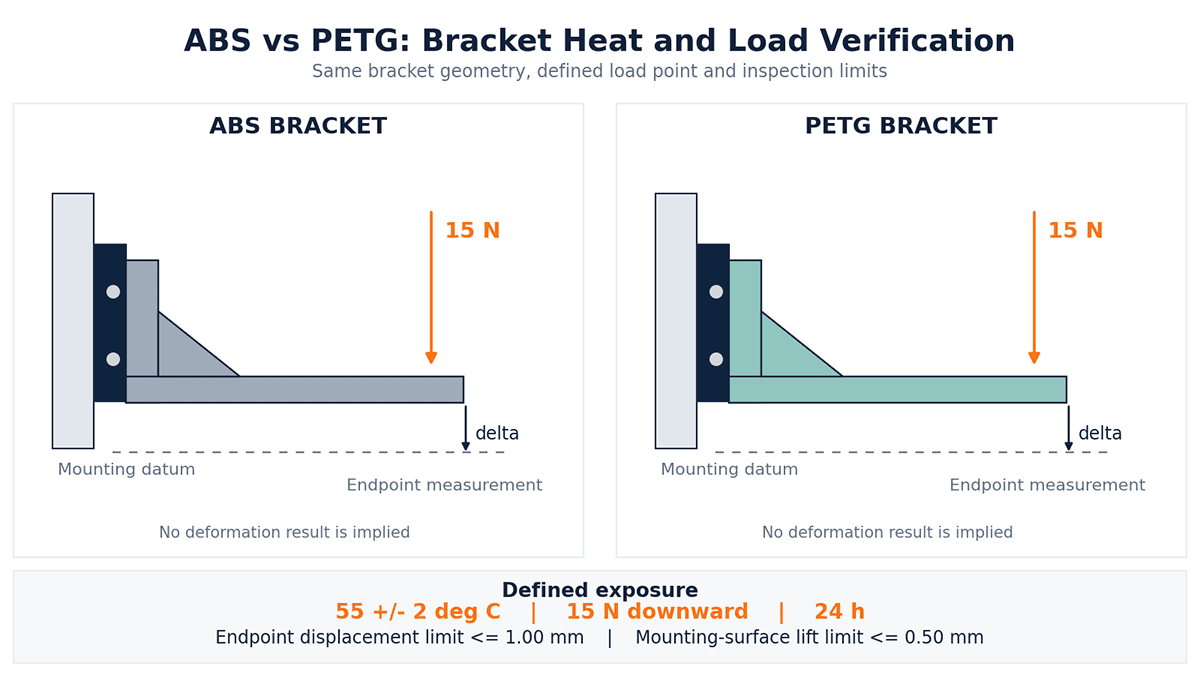
For a practical example, consider an FDM electronics mounting bracket with a 90 × 60 × 25 mm envelope and two Ø4.5 mm mounting holes. The engineering comparison uses a 55 ± 2°C exposure, a 15 N applied load and a 24-hour duration. Acceptance limits include no more than 0.50 mm mounting-surface lift and 1.00 mm endpoint displacement.
Under those conditions, material selection depends on the measured bracket response. A filament with higher published tensile strength can still produce an unsuitable part when warping, fastener contact damage or time-dependent deformation exceeds the assembly limits.
The wider 3D printer filament types guide places ABS and PETG alongside other polymers when neither meets the assembly requirement.
2. What Makes ABS and PETG Different?
ABS is an acrylonitrile-butadiene-styrene material family. PETG is a commercial label commonly used for glycol-modified PET-based copolyesters. Neither label identifies a single finished filament formulation. Two spools sold under the same family name can behave differently because their polymer composition, modifiers, pigments and production histories differ.
2.1 ABS Grades and Material Modifications
ISO 19062-1:2015 classifies ABS molding and extrusion materials using composition, fillers and reinforcement, processing characteristics, and property ranges including Vicat softening temperature, melt mass-flow rate, notched Charpy impact strength and tensile modulus. Those categories identify materials; they are not measured FDM part properties. An impact-modified ABS or glass-filled ABS cannot be substituted for an unfilled baseline without another comparison.
2.2 PETG Copolyester Identity and Additives
ISO 20028-1:2019 covers thermoplastic polyesters and copolyesters, with designation fields for polymer identity, additives, reinforcement, processing and property classes. It does not assign one composition or one tensile-strength value to everything sold as PETG. In procurement, specify the supplier grade, whether the filament is filled, and the applicable product lot. The PETG filament properties guide covers feedstock handling and material-specific processing in greater detail.
3. ABS vs PETG Strength and Toughness
The question “Is ABS stronger than PETG?” is incomplete without a failure mode. Maximum tensile stress, stiffness, strain at break, impact response and layer separation are different measurements. A material can resist an initial load but deform too much at a fastener, or can survive an impact yet creep under a modest static load.
3.1 Tensile Strength, Modulus and Elongation
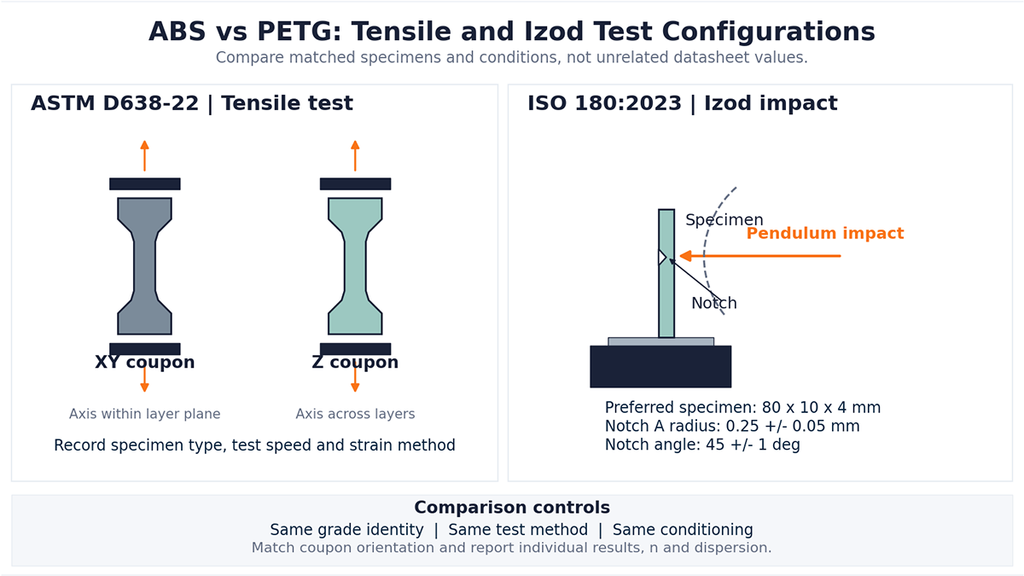
ASTM D638-22 provides tensile test procedures for plastics. Compare matched specimen types, measured cross-sections, loading rates, conditioning, extensometer methods and reported failure events. For FDM coupons, record XY or Z orientation, raster strategy, walls, infill and printing history. Tensile stress uses force divided by the original measured area, while modulus depends on an accurate initial strain measurement. Strength at yield, maximum strength and strength at break are not interchangeable.
A useful comparison reports each valid coupon and the sample count, mean and standard deviation, not just a vendor’s highest published value. Z-direction results matter when the bracket bending or fastener loading opens layer interfaces. The engineering material properties reference helps interpret those measurements without treating unlike resin datasheets as equivalent.
3.2 Izod Impact and Layer Adhesion
ISO 180:2023 specifies an Izod pendulum impact method. Notch A, notch B and unnotched results represent different crack initiation conditions. Compare the same specimen geometry, notch, conditioning, impact direction and fracture category. Do not insert ABS Charpy data from a material designation table beside a PETG Izod result and declare a winner.
Neither a high Izod value nor a good XY tensile result confirms that a finished FDM part will survive a screw tightening operation, a cabinet shock or a load pulling across layers. Check the actual hole edges, rib roots and layer interface affected by the service load.
4. Heat Resistance and Temperature Limits
For a warm, loaded enclosure or bracket, ABS is a reasonable first candidate among common unfilled grades. That is a screening choice, not a maximum operating temperature. Tg describes a polymer transition, Vicat measures penetration softening under a prescribed test, and HDT measures a specified bending deflection under a stated stress and heating condition. None is itself a continuous-use rating for a loaded assembly.
4.1 Tg, HDT, Vicat and Sustained Loads
A bracket held at 55°C for 24 hours under 15 N does not experience the same condition as an unloaded coupon briefly heated through its glass transition. The critical result may be accumulated displacement, fastener relaxation or cracking after cool-down. The grade-specific thermal test, load path, exposure duration and measured permanent deformation determine whether the material meets the part requirement.
Do not compare an ABS Tg with a PETG HDT as though both values describe the same failure threshold. For prolonged exposure, creep testing or direct part-level thermal loading gives more relevant evidence than a single transition temperature.
5. FDM Printing: Warping, Shrinkage and Build Orientation
ABS generally develops a greater need for controlled cooling because temperature gradients and contraction can pull corners off the build plate or distort mounting features. PETG is often more forgiving, although wet feedstock, excessive extrusion temperature, insufficient cooling control and unsuitable supports can still damage dimensional accuracy. Compare defect frequency on the actual geometry rather than assigning a universal printability score.
5.1 Extrusion, Bed and Chamber Conditions
For the engineering bracket comparison, the documented initial process settings are a 0.40 mm nozzle and 0.20 mm layers for both materials. ABS starts from a 250°C nozzle, 100°C bed and 45°C controlled chamber; PETG starts from a 240°C nozzle, 80°C bed and approximately 25–35°C chamber. These are case-specific starting settings, not recommended universal values. The same setup uses four perimeters, 35% gyroid infill and five solid layers at the top and bottom.
Use an enclosure, ventilation and appropriate machine controls for the selected materials. FDM 3D printing capability, process ventilation and filament handling all affect repeatability. Drying conditions must follow the actual filament manufacturer guidance and the material condition rather than one common temperature assigned to both polymers.
5.2 Part Geometry and Dimensional Accuracy
A wide flat base, sharp rib transition and two closely constrained mounting holes can convert small thermal distortions into assembly failure. A generous rib-root transition helps avoid a local stress concentration, but it does not eliminate layer weakness or bolt-bearing damage. The case uses 4.00 mm base and upright walls, a 3.00 mm reinforcing rib and an R3.0 mm root fillet as the bracket configuration under review.
Inspect the contact face for lift, measure the hole spacing and each hole diameter, then check fit with the intended fasteners. Do not correct an out-of-tolerance print through unrecorded heating and then treat it as a repeatable as-printed result. Use DFM design guidelines to control those assembly features before comparing the materials.
6. Chemical Resistance, Water and Outdoor Exposure
Neither “chemical resistant” nor “weather resistant” is enough to specify an FDM component. The relevant variables are the chemical identity, concentration, temperature, duration, stress and grade. Cleaning fluids around a control cabinet, for example, can affect a highly stressed fastener hole differently from an unloaded flat sample.
For the bracket case, the evaluated environment is a dry indoor cabinet without direct UV exposure, with no intentional contact with acetone or other organic solvents. That boundary does not justify a general outdoor durability claim. Unmodified ABS is susceptible to UV-related degradation, while PETG outdoor behavior varies by commercial grade, stabilizer package and exposure. A long outdoor service life needs application-specific evidence.
7. Which Material Works for Functional Parts?
Begin with the failure that would make the part unusable. A cosmetic cover may prioritize warpage and surface finish. An electronics support carries loads through screw holes and ribs. A fixture near warm equipment may fail through permanent displacement long before a tensile coupon breaks. Material choice follows the application and its acceptance criteria.
7.1 Electronics Enclosures, Brackets and Fixtures
For consumer electronics enclosures, a clean assembly fit, housing temperature and compatible fastener details usually matter more than one headline strength figure. For a jig, consider the load at repeated contact points, thermal exposure and replacement frequency. During functional prototype development, validate the feature most likely to fail before committing to a material family.
7.2 Engineering Case: Electronics Mounting Bracket
Case EC-ABS-PETG-2026-1010 concerns an L-shaped FDM bracket for an approximately 0.6 kg control box inside an industrial automation electrical cabinet. The comparison identifies unfilled Polymaker PolyLite ABS and PolyLite PETG as candidate commercial grades, with exact color and lot identification to follow the selected spool. Both are evaluated using the same 90 × 60 × 25 mm bracket envelope, two nominal Ø4.5 mm mounting holes and a 70.00 mm hole-center spacing.
The defined heated-load condition is 55 ± 2°C with a 15 N downward load for 24 hours. The acceptance criteria are mounting-surface lift no greater than 0.50 mm, hole-center spacing of 69.80–70.20 mm, hole diameters of 4.40–4.60 mm, endpoint displacement no greater than 1.00 mm, and no cracking or assembly interference. The case specifies the same acceptance thresholds for both filaments. It does not contain comparable completed values for the two candidates, so the published case cannot establish a winning material.
This is a real selection problem because warp-induced hole misalignment, bearing damage around M4 fasteners and deformation at the rib root have different causes. Examine the assembled load path and record what happens at each critical feature. The part-specific limits can be linked to dimensional tolerance standards in the assembly specification.
8. Manufacturing Cost, Finishing and Supplier Qualification
Material price per spool is not the same as cost per accepted part. A print that requires repeated restarts, additional enclosure control or post-print rework can cost more even when its filament is cheaper. Estimate cost from actual machine time, rejected builds, operator intervention, finishing, inspection and quantity. Do not assume either polymer always wins on cost.
ABS can be attractive when suitable acetone-based finishing is required and its effects on geometry and material properties have been validated. PETG may require sanding or other mechanical finishing instead. Machining holes after printing can improve a fit but changes the manufacturing route and should be included in the inspection plan.
When production quantity changes, compare FDM with ABS injection molding or other qualified processes rather than extending prototype performance claims to molded production parts. The route for low volume production also depends on tooling cost, revision risk and inspection needs. Qualify replacement filament by grade, lot, dimensions, feedstock condition and part-level acceptance, not by a generic ABS or PETG label.
9. ABS vs PETG FAQs
9.1 Is ABS Stronger Than PETG?
Not universally. Compare strength at the same failure event and with matched test geometry, orientation, environment and rate. A high supplier tensile value does not establish a bracket load capacity.
9.2 Is ABS More Heat Resistant Than PETG?
ABS is often the more promising starting point for elevated-temperature applications among common unfilled filament grades. The actual limit depends on the grade, load, exposure time and acceptable deformation. Tg and HDT alone do not qualify a loaded component.
9.3 Is PETG Easier to Print Than ABS?
PETG typically presents less warping risk on many FDM machines. Wet filament, poor adhesion, nozzle settings and part geometry can still create defects. ABS may print reliably in a controlled thermal environment.
9.4 Is ABS or PETG Better for Outdoor Use?
Neither should receive a universal outdoor rating. Standard ABS can lose properties with UV exposure; PETG formulations differ in weathering stability. Use the actual stabilized grade and a relevant environmental test before specifying long exposure.
9.5 Can PETG Replace ABS in Functional Parts?
Sometimes. Check the service temperature, sustained force, fastener details, chemicals, dimensions and actual printed-part performance. A replacement is acceptable only when it satisfies the same part requirements.
10. Final Material Selection Checklist
| Check | Requirement before selection |
| Material | Supplier grade, additives, reinforcement and lot identified |
| Mechanical | Loading direction, fastener interfaces and failure mode reviewed |
| Thermal | Temperature, duration, load and allowed movement defined |
| FDM | Orientation, moisture, print settings and feature geometry controlled |
| Inspection | Hole fit, flatness, cracks and key dimensions checked |
| Validation | Matching test conditions and actual part acceptance compared |
| Procurement | Cost and repeatability evaluated per accepted part |
Choose the material that meets the bracket or enclosure acceptance criteria under its real operating conditions. Higher published strength or a smoother print is not a substitute for a verified fit and stable load-bearing geometry.
Ready to Quote Your CNC Prototype?
Upload your STEP file and get a DFM review + quote within 12 hours.
No tooling cost. Minimum 1 part.