

Dewey Wu General Manager & senior mechanical engineer at EPOC CRAFTER, 15 years in design engineering, quality, and metallurgy. Hands-on across CNC machining, metalwork, sheet metal, and prototyping (subtractive + 3D printing).
Aluminum heat sink material is a choice between thermal conductivity and strength, because the grades that move heat best are the softest ones. 6063-T5 conducts at roughly 209 W/m·K at 25 °C, 6061-T6 sits near 167 W/m·K, and pure 1050 reaches about 229 W/m·K but holds no thread and no flat mounting face under load. These are supplier and handbook typical values at 25 °C, not acceptance limits. ASTM B209/B209M-21a and ASTM B221/B221M-21 specify chemistry and mechanical properties, and neither sets a thermal conductivity requirement.
The manufacturing route and the load decide the grade. The highest conductivity number rarely wins on its own.
This guide compares 6061, 6063, and 1050 by conductivity, temper, and anodizing, shows why 5052 and 7075 fall short for cooling, and maps each grade to LED, power electronics, and EV heat sinks.
1. Aluminum heat sink material, the short answer
For a CNC machined base, 6061-T6 is the default at about 167 W/m·K with 290/240 MPa strength per ASTM B209-21a. For extruded fins, 6063-T5 leads at about 209 W/m·K per ASTM B221-21. Reach for 1050 only when load is near zero. Skip 5052 and 7075 as thermal-first bases. For full aluminum material properties by grade and temper, see the reference table.
The Thermal-First Alloy Screen runs four checks in order. Set the conductivity target, set the strength and temper floor, decide the anodize and finish need, then pick the product route, extrude or machine. One grade usually survives.
Table 1. Aluminum heat sink grades by thermal conductivity, strength, and product route (typical values at 25 °C)
| 1050 (O) | ~229 | ~65 / 20 | rolled sheet, non-B209 | uniform, good | Max-conductivity, low-load spreaders |
| 6063 (T5) | ~209 | 150 / 110 | extruded profile, ASTM B221-21 | excellent | Default extruded fin heat sinks |
| 6063 (T6) | ~201 | 205 / 170 | extruded profile, ASTM B221-21 | excellent | Extruded fins needing more thread strength |
| 6061 (T6) | ~167 | 290 / 240 | sheet and plate, ASTM B209-21a | good | CNC machined bases, threads, structural mounts |
| 5052 (H32) | ~138 | 215–265 / ≥160 | sheet, ASTM B209-21a | good, high corrosion resistance | Formed covers and spreaders, not thermal-first bases |
| 7075 (T6/T651) | ~130 (20 °C) | ≥540 / ≥470 | plate, ASTM B209-21a | possible, higher Zn and Cu | Structural-first parts, rarely a thermal pick |
k values are supplier and handbook typical at 25 °C (7075 at 20 °C), method not stated, sourced separately from ASTM B209 and B221, which do not specify thermal conductivity. Strength values are standard minimums that vary with thickness and temper.
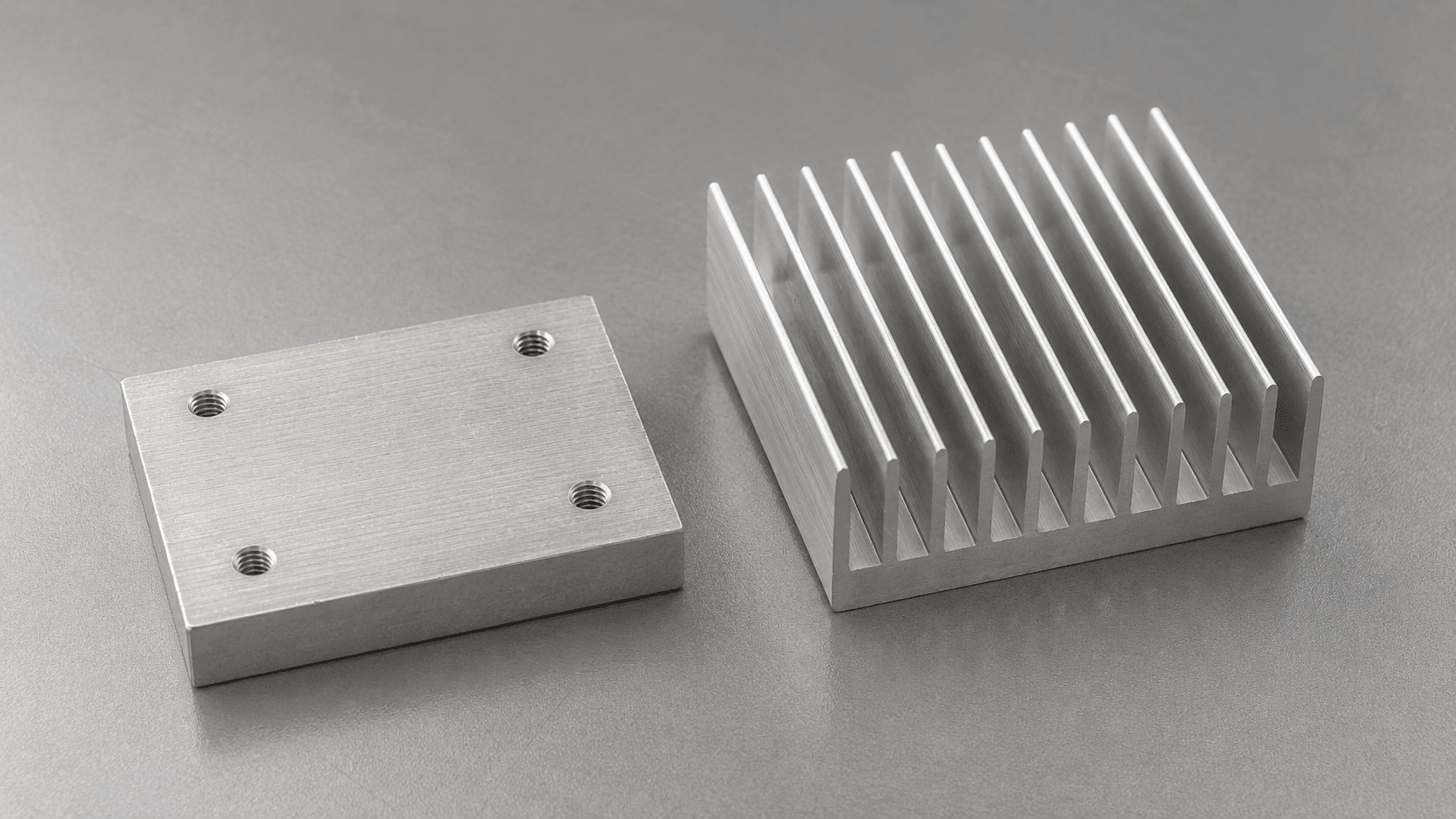
Engineering note. 6061-T6 is the safe default for a machined base because it holds threads and a flat seating face that 6063 and 1050 deform under load. The exception is a pure fin profile with no fasteners, where 6063-T5 gives you about 25 percent more conductivity at lower extrusion cost.
2. Thermal conductivity of 6061, 6063, and 1050 compared
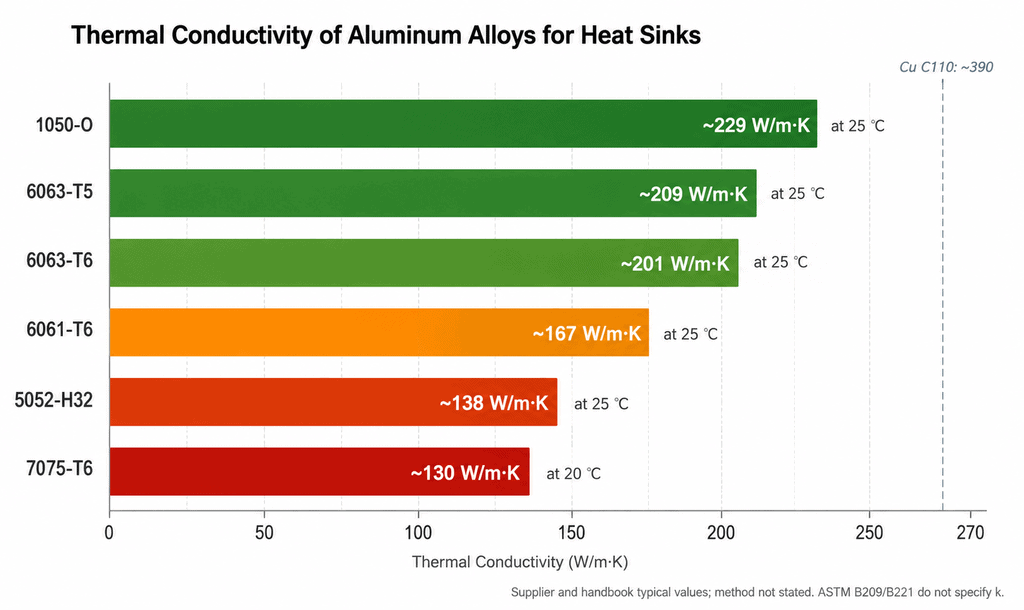
Conductivity ranks 1050 first, 6063 second, 6061 third, because heat in aluminum rides free electrons and every alloying atom scatters them. 1050 at about 229 W/m·K beats 6061-T6 at about 167 W/m·K by roughly 37 percent, yet 1050 cannot hold a tapped hole. Between the two grades you would machine or extrude, 6063 and 6061, the gap is about 25 percent, enough to shift fin count on a dense array but not enough to override a strength requirement.
Table 2. Aluminum conductivity with the condition each value carries
| 1050-O | ~229 | 25 °C | handbook typical | not stated |
| 6063-T5 | ~209 | 25 °C | supplier typical | not stated |
| 6063-T6 | ~201 | 25 °C | supplier typical | not stated |
| 6061-T6 | ~167 | 25 °C | supplier typical | not stated |
| 5052-H32 | ~138 | 25 °C | handbook typical | not stated |
| 7075-T6 | ~130 | 20 °C | supplier typical | not stated |
Copper (C110) sits near 388–400 W/m·K for reference. Stainless steel runs 14–16 W/m·K, roughly one twelfth of 6063.
2.1 Why alloying lowers conductivity
Magnesium, silicon, copper, and zinc dissolve into the aluminum lattice and scatter the electrons that carry heat, so a stronger grade almost always conducts worse. 6061 carries 0.8–1.2 percent magnesium and 0.15–0.40 percent copper per B221M-21 Table 1. 6063 carries less, 0.45–0.90 percent magnesium and 0.10 percent copper maximum, which is why it conducts higher and anodizes cleaner. 7075 loads 5.1–6.1 percent zinc plus copper and magnesium, dropping conductivity to about 130 W/m·K.
Temper matters too, since aging pulls solute out of solution and can raise conductivity at a fixed composition.
Engineering note. Composition explains the trend, not the exact number. You cannot calculate a batch k value from a B209 chemistry table. The order 6063 > 6061 > 7075 holds, but the decimal places move with temper, temperature, and supplier.
2.2 How to read a conductivity value correctly
A conductivity number means nothing without its temper, its temperature, and its method, so compare only values that share all three. ASTM E1225-25a, the guarded-comparative-longitudinal heat flow technique, measures solids from 0.2 to 200 W/m·K over 90 to 1300 K, and its own worked example carries about 6.9 percent uncertainty. Two labs reporting 167 and 175 W/m·K for 6061-T6 are inside that band, not in disagreement.
Pure 1050 near 229 W/m·K sits above the E1225 upper bound, so those values often come from the flash method (ASTM E1461-13(2022)), which measures diffusivity first and calculates k from density and specific heat.
According to Dewey Wu, “when a supplier sheet lists 6061 at a flat 180 with no temper and no temperature, we treat it as a typical property, not a design input. We size cooling on 167 at 25 °C for 6061-T6 and add margin from geometry, because a 5 percent conductivity swing changes junction temperature far less than fin area and airflow do.”
Engineering note. Chase test conditions before you chase decimals. A value with temper, temperature, and method beats a rounder number with none of them.
3. Strength versus conductivity, the temper trade-off
Strength runs opposite to conductivity across these grades, so the temper you pick sets both how much load the part holds and how much heat it moves. 6061-T6 gives about 290 MPa tensile against 6063-T5 at 150 MPa, nearly double, and pays for it with roughly 20 percent lower conductivity. 5052-H32 lands between them on strength but drops to about 138 W/m·K. The number that matters here is yield, because a heat sink base that creeps under a clamped power module loses flatness and gains contact resistance.
Table 3. Standard minimum mechanical properties by grade and temper
| 6063-T5 (≤12.5 mm) | extrusion, ASTM B221-21 | 150 | 110 | 8% |
| 6063-T6 (≤3.2 mm) | extrusion, ASTM B221-21 | 205 | 170 | 8% |
| 6061-T6 (≤6.3 mm) | extrusion, ASTM B221-21 | 260 | 240 | 8% |
| 6061-T6 sheet/plate | ASTM B209-21a | 290 | 240 | 10% |
| 5052-H32 | sheet, ASTM B209-21a | 215–265 | ≥160 | 7% |
| 7075-T6/T651 (1–12.5 mm) | plate, ASTM B209-21a | ≥540 | ≥470 | 9% |
Minimums vary with thickness and temper, so requery the exact thickness row before release.
3.1 What each temper costs you
T5 and T6 are two aging routes, and the choice changes lead time and price, not just strength. 6063-T5 cools straight from the extrusion press and ages once, so it runs faster and cheaper and still holds 110 MPa yield, enough for most fin profiles. 6063-T6 adds a solution treatment for 170 MPa yield, which raises cost and lead time for thread strength you may not need.
6061-T651 stretches the plate after T6 to relieve residual stress. Unrelieved stock warps as you remove material and forces a second flattening pass.
Engineering note. Buy the temper the load needs, not the strongest one available. Specifying 6061-T651 plate for a lightly loaded fin bracket adds cost and machining time with no thermal or structural payback. The exception is any base over about 150 mm where flatness must hold tolerance, where T651 pays back the premium by cutting warp-driven rework.
3.2 Where strength beats conductivity
Pick strength over conductivity only when the part carries real load, because heat you can solve with more fin area, but a stripped thread or a bowed mounting face you cannot. A power module clamped at high torque needs the 240 MPa yield of 6061-T6, not the 110 MPa of 6063-T5.
A thin cosmetic fin under no load takes the opposite call, where 6063-T5 wins on conductivity, finish, and extrusion cost.
Engineering note. Load path first, conductivity second, once the base sees clamping or fasteners. Below roughly 50 MPa of service stress the rule flips and you pick for conductivity and finish instead.
4. Why 5052 and 7075 fall short for heat sinks
5052 and 7075 lose on the one axis a heat sink is bought for, conductivity, so neither belongs as a thermal-first base despite both being common shop stock. 5052 conducts at about 138 W/m·K, a third below 6063. 7075 drops to about 130 W/m·K because its 5.1–6.1 percent zinc load scatters carriers hard. Buyers reach for them out of habit, and both habits cost cooling performance.
4.1 5052, a forming grade, not a cooling grade
5052 earns its place on corrosion resistance and bend behavior, not heat transfer, so use it for the enclosure around a heat sink, not for the heat path itself. Its 138 W/m·K sits 34 percent below 6063-T5, which means a 5052 base needs more fin area to match the same junction temperature, and that added size often costs more than switching grade would.
Engineering note. 5052 for the box, 6061 or 6063 for the heat path. The exception is a formed spreader plate under light heat load where corrosion drives the spec, where 5052 is acceptable if you size fin area for 138 W/m·K, not for a 6xxx number.
4.2 7075, strength you pay for twice
7075 buys aerospace-grade strength you rarely need in a heat sink, and you pay for it twice, once in conductivity and again in cost and machinability. At about 130 W/m·K it conducts worse than every 6xxx grade here, and its ≥470 MPa yield is wasted on a part whose job is moving heat.
According to Dewey Wu, “we see 7075 called out on heat sink drawings about once a quarter, almost always copied from a structural part. Swapping to 6061-T6 lifts conductivity from about 130 to 167 W/m·K, near 28 percent more, and cuts material and cycle cost at the same time. We flag it at DFM review before it reaches quoting.”
Engineering note. Over-specifying strength on a thermal part is a common and expensive buyer error. The only case for 7075 in a cooling context is a single part that must carry high structural load and shed heat as a secondary duty.
5. Does anodizing help or hurt a heat sink
Anodizing helps a passive heat sink and barely touches a fan-cooled one, because it trades a thin conduction penalty for a large radiation gain. Bare aluminum radiates at an emissivity near 0.05. A black anodized surface reaches about 0.85, roughly 17 times higher. The oxide layer conducts worse than aluminum, but at 5 to 25 µm for Type II it adds negligible resistance to the conduction path.
5.1 The three heat paths, and which one anodizing changes
Anodizing changes radiation, leaves conduction nearly untouched, and does little to convection. In a sealed or still-air enclosure, radiation carries 25 to 40 percent of the load, and lifting emissivity from 0.05 to 0.85 there is a measurable gain. In a fan-cooled sink, convection dominates and radiation contributes little. Color does not change the physics, since a clear anodize radiates almost the same as a black one.
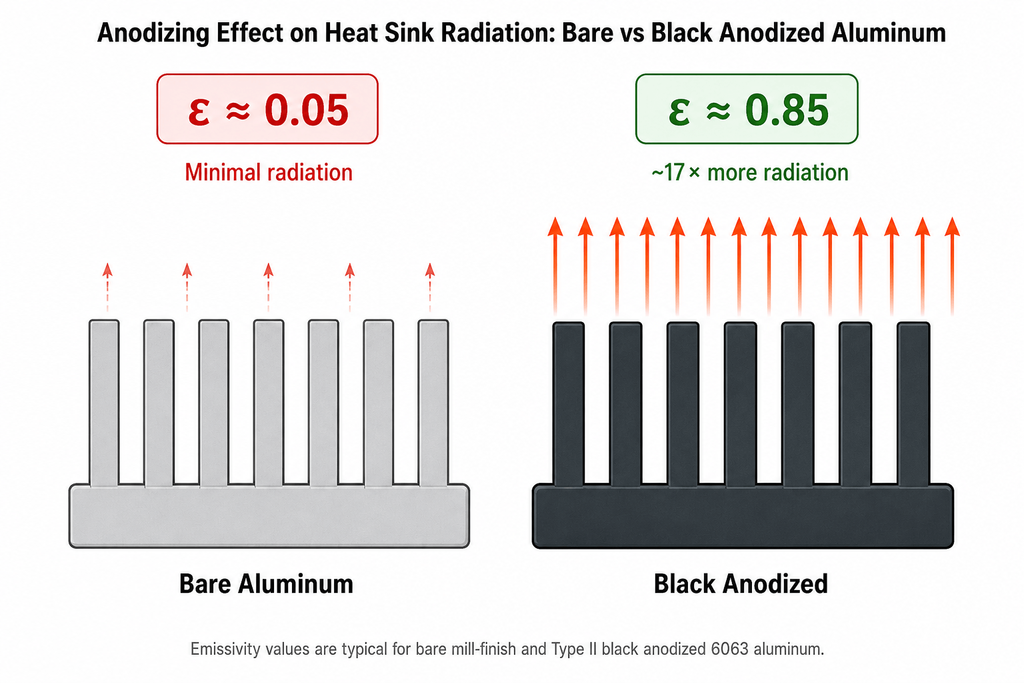
Engineering note. Anodize for radiation in natural convection, for protection in forced convection. Below any real airflow, emissivity pays back. Above it, treat anodizing as a durability and surface finishing choice, not a thermal one.
5.2 Type II versus Type III, and when the coating starts to cost you
Type II runs 5 to 25 µm and adds negligible thermal resistance, so it is the default for heat sinks. Type III hardcoat runs 25 to 50 µm or more, and at the thick end it begins to add measurable resistance at the mounting interface. Powder coat above about 50 µm acts as an insulator and can cut conductive transfer outright.
Engineering note. Keep the coating thin where the heat crosses. Specify Type II on seating faces and reserve thick Type III or powder coat for outer surfaces. The exception is a military or outdoor sink where the environment forces hardcoat everywhere, where you accept the interface penalty and recover it with a thermal interface material rated 5 to 8 W/m·K.
6. Extrude or machine, 6063 profile versus 6061 CNC base
Volume and geometry decide the route, so extrude 6063 fins for high-volume uniform profiles and machine 6061 bases for low-volume, complex, or threaded parts. Extrusion runs cheapest above about 10,000 units but only makes constant cross sections. CNC machining wins below roughly 500 units and cuts features extrusion cannot: mounting bosses, fluid channels, pockets, and threaded holes. The two often combine, a 6063 extruded fin stack on a 6061 machined base.
6.1 The standard splits by product form
Product form sets which standard governs. Extruded 6063 fins fall under ASTM B221/B221M-21. A machined 6061 base from sheet or plate falls under ASTM B209/B209M-21a. Write both on the bill of materials, since calling 6063 for a threaded structural base or 6061 for a thin complex fin profile fights the material and raises cost. See the tolerances and standards reference for proper callout format.
Engineering note. One heat sink, two standards, is normal and correct. B221 for the fins, B209 for the base. The exception is a monolithic sink cut from a single 6061 billet, where B209 covers the whole part and you trade some fin conductivity for a seamless base with no interface resistance.
6.2 What CNC machining a heat sink demands
Hold base flatness to about ±0.05 mm, since poor flatness opens gaps at the component interface and raises contact resistance. Keep the fin aspect ratio at or below 10 to 1, so a 1 mm fin stays under 10 mm tall. Aluminum fins machine down to about 0.8 mm minimum, copper to 1.0 mm, below which tool deflection ruins the finish.
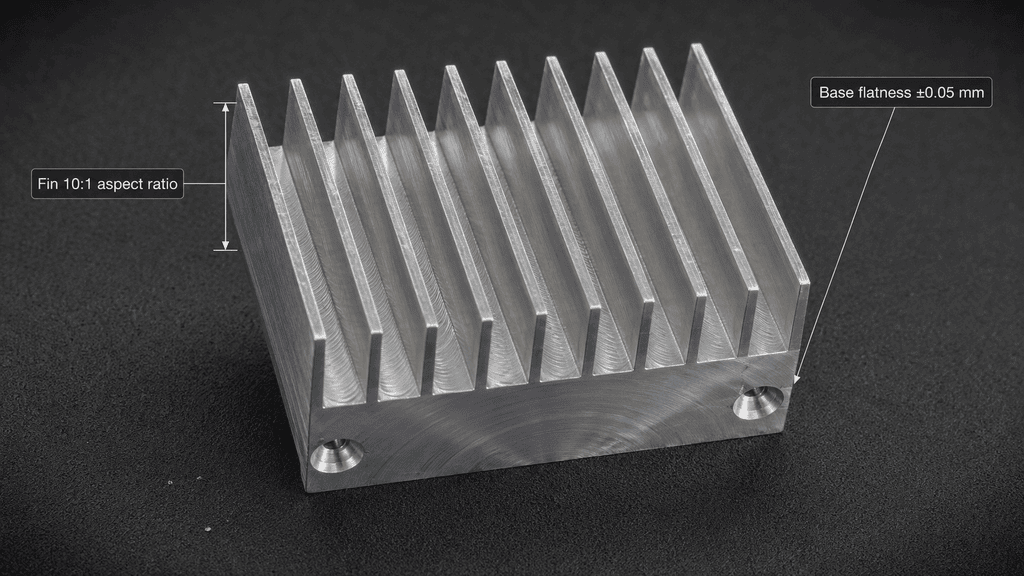
Engineering note. Below 500 units or with any non-uniform feature, precision CNC machining beats tooling up an extrusion die, since die cost of 800 to 3,000 USD only amortizes at high volume. For a first cooling prototype, rapid prototyping turns a 6061-T6 billet into a testable part in days, where an extrusion die adds weeks.
7. Application picks: LED, power electronics, and EV
Application sets the grade through its load and its finish need, so LED and telecom take 6063 fins, power modules take 6061 bases, and EV takes whichever the structural duty demands. For compact consumer electronics thermal parts, either grade works depending on enclosure geometry. Power electronics clamp modules at torque, where the 240 MPa yield of 6061-T6 holds flatness.
Table 4. Grade and route by application
| LED lighting | light, passive | 6063-T5 | extrusion | black anodize for radiation |
| Telecom / 5G | light, outdoor | 6063-T5 | extrusion | Type II or III, weatherproof |
| Power electronics (IGBT) | clamped, high torque | 6061-T6 | CNC base, extruded fins | Type II on seating face |
| Consumer electronics | light, compact | 6063-T5 or 6061-T6 | CNC for complex bases | Type II, cosmetic |
| EV / automotive | vibration, structural | 6061-T6 | CNC or die cast | per environment |
7.1 The reliability trap, CTE mismatch
Thermal cycling, not steady heat, is what breaks many electronics heat sinks. 6061 has a coefficient of thermal expansion near 23.6 × 10⁻⁶ per °C against silicon at about 2.6 × 10⁻⁶. Across an 80 °C swing that mismatch strains solder and bond joints by roughly 0.17 percent per cycle, and over 10,000 power cycles that fatigue can crack joints.
Engineering note. For high-cycle power modules, match the interface, not just the conductivity. A CTE-matched interlayer such as AlSiC composite at 6 to 10 × 10⁻⁶ per °C cuts the strain per cycle. The exception is low-cycle or steady-state gear, where CTE mismatch never accumulates enough fatigue to matter.
8. FAQ
8.1 Is aluminum a good heat conductor for heat sinks
Yes. Pure aluminum reaches about 229 W/m·K and common 6xxx grades run 167 to 209 W/m·K at 25 °C, well above stainless steel at 14 to 16 W/m·K. Copper conducts better at roughly 388 W/m·K, but it weighs and costs three times more to machine. For air-cooled designs, aluminum wins on cost and weight, and fin area plus airflow close most of the gap to copper.
8.2 Which aluminum alloy is best for heat sinks
6063-T5 for extruded fins, 6061-T6 for machined bases, 1050 only for max-conductivity low-load spreaders. 6063-T5 conducts at about 209 W/m·K, extrudes into complex fins, and anodizes cleanly. 6061-T6 holds 240 MPa yield, threads, and a flat seating face. Pick by product route and load first, not by the highest conductivity number, since geometry and airflow shift junction temperature more than a 20 percent conductivity difference does.
8.3 Is 6061 or 6063 better for heat dissipation
6063 dissipates heat better, 6061 carries load better. 6063-T5 conducts about 25 percent higher than 6061-T6, near 209 against 167 W/m·K. 6061-T6 nearly doubles the yield strength, 240 against 110 MPa, which matters for a clamped base or threaded mount. For a plain fin profile under no load, choose 6063. For a base that seats and fastens a component, choose 6061.
8.4 Does anodizing reduce a heat sink’s thermal conductivity
Anodizing slightly lowers conduction at the surface but usually improves net cooling in still air. A Type II coat at 5 to 25 µm is too thin to add meaningful resistance to the main heat path. What it does add is emissivity, from about 0.05 bare to 0.85 black anodized, which lifts radiation heat transfer by a large margin. In fan-cooled designs the effect is small either way, so anodize there for corrosion, not cooling.
8.5 Are 5052 or 7075 good for heat sinks
No, both fall short as thermal-first grades. 5052 runs about 138 W/m·K and 7075 about 130 W/m·K, roughly a third below 6063. 5052 belongs on formed covers where corrosion resistance matters. 7075 belongs on structural parts, and specifying it on a heat sink wastes strength while losing cooling and adding cost. Swapping a 7075 callout to 6061-T6 raises conductivity near 28 percent.
8.6 What is the thermal conductivity of 6061-T6 aluminum
6061-T6 conducts at about 167 W/m·K at 25 °C as a typical supplier value, not a specification minimum. Values from 165 to 180 W/m·K across sources are normal and sit inside measurement uncertainty. Note the temper, since annealed 6061-O and aged 6061-T6 do not share one number. ASTM B209 and B221 specify chemistry and mechanical properties only.
8.7 Should I CNC machine or extrude an aluminum heat sink
Extrude for high volume and uniform fins, machine for low volume, complex geometry, or threaded features. Extrusion runs cheapest above about 10,000 units, and the die costs 800 to 3,000 USD. CNC machining wins below roughly 500 units at a flatness near ±0.05 mm. Many sinks combine both, extruded 6063 fins on a machined 6061 base. For sheet-based flat parts, compare grades in the 5052 vs 6061 aluminum sheet guide.
8.8 Does any standard specify aluminum thermal conductivity
No. ASTM B209/B209M-21a and ASTM B221/B221M-21 specify chemistry, temper, and mechanical properties, and neither lists a thermal conductivity acceptance value. Conductivity is measured by separate test methods such as ASTM E1225-25a, the guarded-comparative-longitudinal heat flow technique for 0.2 to 200 W/m·K. A conductivity figure is a material property from a datasheet or test report, never a B209 or B221 requirement.
9. Before you send the drawing
Write the grade with its temper on the drawing, since 6061 and 6061-T6 are not the same material. Split the standards by product form, B209 for the plate base and B221 for the extruded fins. Handle anodize type and film thickness in a separate finishing callout, not inside the material spec.
Download the Thermal-First Alloy Screen checklist to run before your next heat sink RFQ.
Send your STEP file with the material, temper, and finish already spelled out for a heat sink quote and DFM feedback within 12 hours.
Related Resources
- Related Capability: Precision CNC machining, for machined 6061-T6 bases with ±0.05 mm flatness on the seating face.
- Related Capability: Surface finishing and anodizing, for Type II and Type III anodize specification on aluminum heat sinks.
- Related Material Guide: 5052 vs 6061 aluminum sheet, for sheet-based covers and formed spreaders next to the heat path.
- Related Capability: Low volume production, for machined heat sink runs below 500 units where extrusion tooling does not pay back.
Ready to Quote Your CNC Prototype?
Upload your STEP file and get a DFM review + quote within 12 hours.
No tooling cost. Minimum 1 part.