

Dewey Wu General Manager & senior mechanical engineer at EPOC CRAFTER, 15 years in design engineering, quality, and metallurgy. Hands-on across CNC machining, metalwork, sheet metal, and prototyping (subtractive + 3D printing).
PLA and PLA+ are both used for FDM 3D printing, but PLA+ is not a standardized material grade. The “Plus” label identifies a manufacturer’s modified PLA product, not a guaranteed increase in strength, toughness, or heat resistance. Some formulations improve impact resistance or flexibility while offering lower stiffness than conventional PLA. The actual difference depends on the specific filament grade, additives, printing conditions, and test method. For functional parts, compare verified material properties and printed part performance before choosing PLA+ over PLA.
1. What Is PLA+ and How Is It Different From PLA?
PLA (polylactic acid) is a thermoplastic polyester commonly used in FDM 3D printing. It is relatively easy to print and works well for visual prototypes, housings, models, and parts with modest mechanical or thermal demands.
PLA+ is a commercial name used for modified PLA filaments. Manufacturers may change the polymer formulation or incorporate additives to improve a particular property. The formulation varies by supplier, and the name alone does not identify the modification.
A PLA+ filament designed for better impact resistance may deform further before breaking. That does not mean it has higher tensile strength or stiffness. A tougher material can be less rigid, and increased ductility does not guarantee improved resistance to sustained loads.
1.1. PLA, PLA+, and PLA Pro: Are They Different Material Grades?
PLA+ and PLA Pro are manufacturer product names, not interchangeable technical specifications. Two filaments carrying these labels may have different polymer blends, additives, mechanical properties, and recommended printing conditions.
ISO/ASTM 52903-1:2020 provides requirements for plastic feedstock used in material extrusion additive manufacturing. It addresses material identification, feedstock characteristics, traceability, and related supply requirements. It does not establish a universal PLA+ formulation or minimum mechanical performance.
The broader 3D printer filament types and polymer families guide separates polymer identity from product names. For this comparison, the manufacturer, grade and lot identify the materials being evaluated.
A supplier’s claim of improved strength or toughness is useful only when the measured property, test method, and material condition are clear. For a functional printed part, those results must also be considered alongside build orientation, geometry, and loading conditions.
2. PLA vs PLA+: Mechanical and Thermal Properties
| Property | PLA | PLA+ | Engineering consideration |
| Tensile strength | Depends on grade and method | May be higher or lower | Compare the same strength definition and test method |
| Tensile modulus | Often relatively stiff | May decrease with toughening | Lower modulus means more elastic deformation under equivalent conditions |
| Elongation at break | Can show brittle fracture | Some grades deform more | Higher elongation does not establish higher strength |
| Impact resistance | Depends on formulation | Some grades improve | Use identical impact methods and specimens |
| Flexural response | Depends on material and processing | May increase or decrease | Flexural strength and modulus differ |
| Layer adhesion | Affected by print settings | May improve in certain formulations | Verify orientation and failure mode |
| Heat resistance | Grade and method dependent | Not automatically higher | Compare HDT with matched loads and conditions |
| Dimensional accuracy | Part and process dependent | Not inherently better | Inspect actual prints and repeatability |
2.1. Strength, Stiffness, and Toughness
A material can become tougher without becoming stronger. Tensile strength describes the stress reached during a tensile test, according to the reported strength definition. Tensile modulus describes stiffness in the measured strain region. Elongation at break describes how much the specimen extends before fracture. These values answer different design questions.
A rigid equipment housing may benefit from higher stiffness because excessive deflection can affect alignment or fit. A clip that must flex during assembly needs sufficient deformation capacity without cracking. A cable bracket must resist its applied load while maintaining an acceptable position over time.
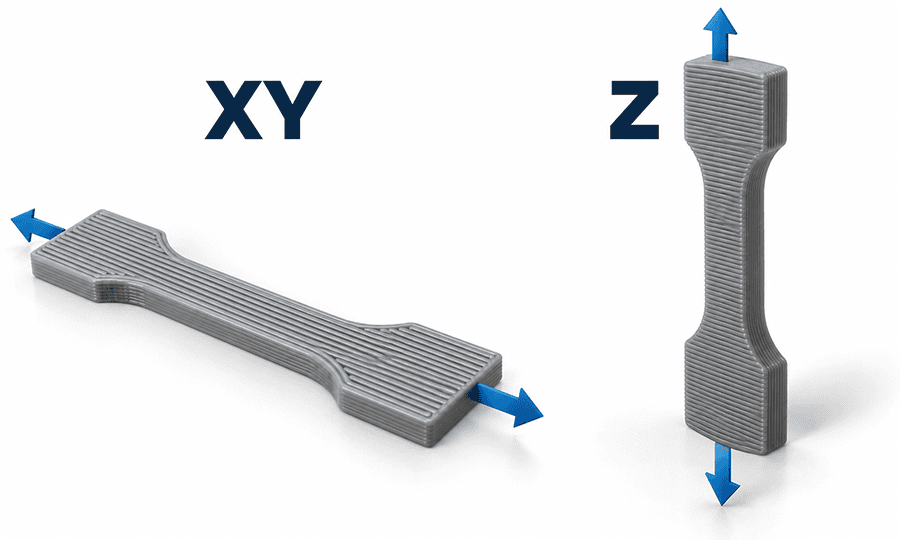
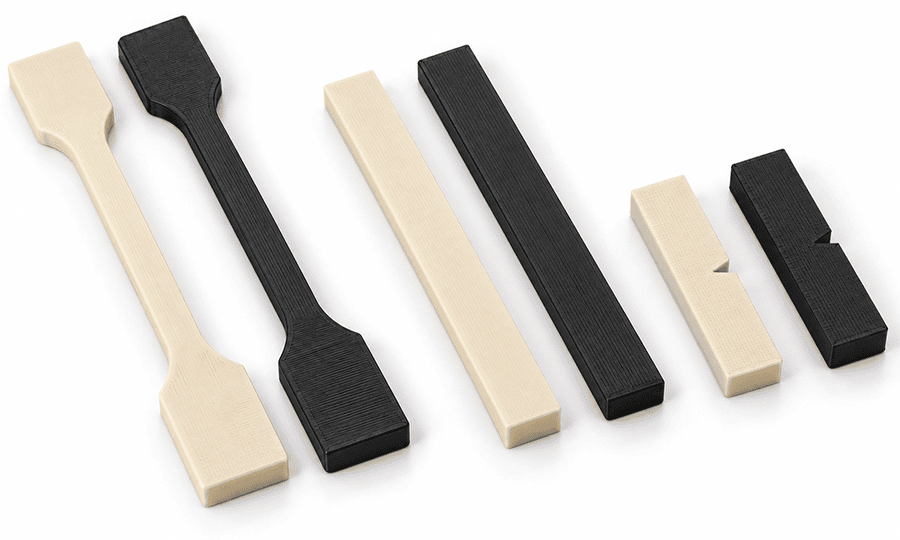
ASTM D638-22 governs plastic tensile testing. Compare specimen geometry, conditioning, speed and strain measurement before ranking PLA and PLA+. The tensile stress testing of 3D printed parts explains how print orientation affects the result.
Tensile strength at yield, maximum tensile stress, and tensile stress at break are not interchangeable. For FDM printed specimens, build orientation and internal toolpaths also matter. A flat printed specimen does not establish the same tensile capacity in the Z direction, where loading can cross deposited layers.
ASTM D790-25 addresses flexural testing. The measured response depends on support span, specimen dimensions, loading procedure, deflection measurement, and test endpoint. A specimen reaching a specified strain limit without breaking should not be assigned a measured flexural strength at fracture.
Impact resistance is another distinct metric. A higher notched impact result supports improved performance under that specific test, not automatically under sustained bending, repeated loading, or elevated temperature. Choose the property corresponding to the expected failure mode rather than the largest number on a datasheet.
2.2. Heat Resistance, Glass Transition Temperature, and HDT
PLA+ does not automatically provide better heat resistance than PLA. Glass transition temperature (Tg) describes a temperature region associated with changes in polymer mobility and mechanical behavior. Heat deflection temperature (HDT) is measured at a specified bending stress, heating procedure, and deflection criterion. Melting temperature relates to crystalline melting and is not a safe operating temperature for a loaded part.
A higher melting temperature does not establish a hotter service environment. HDT values measured at different bending stresses also cannot be directly ranked. Specimen thermal history matters: annealing can change polymer structure and dimensions, but its effect depends on formulation, treatment, printing history, and part geometry.
For a bracket or enclosure exposed to heat, verify that the finished part maintains its shape and function under the actual service load and temperature. A room temperature tensile value does not answer that question.
3. PLA vs PLA+: Print Settings and Part Quality
PLA and PLA+ can often be printed on the same FDM equipment, but identical settings do not guarantee identical results. Nozzle temperature, bed temperature, speed, and cooling depend on the specific filament formulation. Start with the supplier’s recommended settings and inspect the printed part.
3.1. Nozzle Temperature, Print Speed, and Cooling
Nozzle temperature affects melt flow, bead formation, and bonding. A setting that works with one PLA grade may cause poor adhesion, stringing, or dimensional variation in another. Excessive heat can increase oozing and soften small features; insufficient heat can cause inconsistent extrusion and weak bonding.
Print speed interacts with extrusion flow. Two products printed at the same travel speed may respond differently because their melt behavior is not identical. Strong cooling can improve overhangs and small features while reducing interlayer bonding in some geometries. Less cooling can help bonding but worsen distortion.
For a controlled comparison, document the machine, nozzle, slicer, temperatures, layer height, speed, flow, cooling, filament storage, and moisture management. Separate performance under matched settings from performance after optimizing settings for each grade. Both are useful, but they answer different questions.
3.2. Layer Adhesion, Warping, and Dimensional Accuracy
A printed part does not behave like a solid block of feedstock polymer. Load response depends on bead paths, interfaces, voids, and applied direction. A flat tensile specimen may carry load along continuous roads, while an upright specimen can load across layer interfaces. Comparing them without accounting for orientation confounds the material effect.
Wall count, infill, feature roots, and mounting holes also influence failure. The FDM 3D printing and additive manufacturing process context matters when selecting build orientation and toolpaths for functional parts.
Inspect mounting holes, thin roots, internal corners, mating surfaces, overhangs, and critical assembly dimensions. Filament diameter tolerance alone does not establish finished part accuracy. PLA+ is not automatically more dimensionally accurate than PLA, since shrinkage, temperature, cooling, and extrusion behavior vary.
A bracket can pass initial dimensional inspection and still deform excessively in service. The appropriate material is the one that produces the required geometry and maintains the needed function under actual load and environment.
4. How to Verify PLA+ Performance Claims
A PLA+ label cannot establish that the filament is stronger, tougher, or more suitable for a functional part. Begin with the exact manufacturer, product designation, and lot. Determine what was tested, how the specimen was prepared, and whether it represents the comparison material.
Injection molded tensile data are not directly equivalent to FDM printed specimen results. Even specimens printed with the same feedstock can differ with orientation, internal structure, and process settings.
4.1. ASTM D638 and ASTM D790: Comparing Mechanical Properties
ASTM D638-22 measures plastic tensile properties. ASTM D790-25 addresses flexural properties through three point bending. Neither defines a universal PLA+ grade.
D638 requires attention to specimen geometry, preparation, conditioning, test speed, gripping, and strain measurement. D790 distinguishes Procedure A and B, with nominal outer fiber strain rates of 0.01 and 0.10 mm/mm/min, respectively. The crosshead rate also depends on specimen depth and span.
A flexural stress at a 5% strain endpoint is not automatically a measured fracture strength. Correct span and deflection measurement, including applicable corrections, are essential.
| Verification item | Required comparison information | Why it matters |
| Material | Manufacturer, grade, lot | Commercial labels are not equivalent specifications |
| Specimen | Geometry, preparation, type | Dimensions change measured results |
| Build orientation | XY, XZ or Z; load axis | Layer direction affects response |
| Print setup | Layer, walls, raster, infill, temperature | Processing differences confound formulation |
| Conditioning | Time, temperature, RH | Specimen condition matters |
| Tensile procedure | Speed, grips, extensometer | Modulus and strength measurement vary |
| Flexural procedure | D790 edition, A/B, span, deflection | Different methods and endpoints are not interchangeable |
| Property definition | Yield, maximum, break, modulus | Different metrics answer different questions |
| Statistics | Valid n, individual results, mean, SD | One value cannot establish repeatability |
| Failure | Break position, layer failure, slipping | Failure mode affects interpretation |
For measurements that control mechanical fit, also review manufacturing tolerances and inspection standards and keep the specified dimensions distinct from any mechanical test endpoint.
4.2. Filament Quality, Material Identification, and Lot Control
ISO/ASTM 52903-1:2020 governs plastic feedstock requirements for material extrusion AM, addressing identity, characteristics, traceability, packaging, and purchaser defined verification. It does not prescribe a universal PLA+ nozzle temperature, filament diameter tolerance, or minimum mechanical strength.
| Procurement field | Information to identify or specify |
| Material identity | Manufacturer, commercial grade, code and material type |
| Composition | Declared polymer, blend, additives or reinforcement |
| Filament dimensions | Diameter and contractual tolerances |
| Feedstock characteristics | Applicable flow, thermal and physical requirements |
| Traceability | Lot, production date, unique identification |
| Packaging and storage | Moisture protection and specified storage |
| Quality documentation | Relevant specifications, inspection and requested certificates |
| Process compatibility | Validated print conditions and equipment |
| Finished part acceptance | Dimensions, mechanical response and functional limits |
A requested conformity certificate can support compliance with agreed feedstock requirements. It does not certify every part printed from the material. Accept substitution only when the specific grade, supplied material condition, manufacturing process, and finished part requirements are supported.
5. Which Filament Should You Choose?
Choose PLA or PLA+ based on load, geometry, environment, and the manufacturing requirements of the part. Ordinary PLA can work well for prototypes that require fit and stiffness without major impact loads. An identified PLA+ grade may help parts exposed to handling shocks or occasional bending, but neither should be approved for demanding structural duty from a label alone.
5.1. Prototypes, Housings, Fixtures, and Brackets
| Application | Initial material choice | Decision check |
| Visual prototypes and fit checks | PLA | Feature accuracy and assembly fit |
| Equipment housings | PLA or verified PLA+ | Deflection, fasteners, impact and heat |
| Flexible clips | Validated PLA+ candidate | Repeated flexing and permanent deformation |
| Assembly fixtures | PLA initially | Stiffness, alignment, wear and duration |
| Cable brackets | PLA or validated PLA+ | Root stress, hole behavior, creep and temperature |
| Sustained heat/load | Neither without further validation | Loaded deformation and service life |
A tougher PLA+ can reduce cracking during clip assembly while allowing more elastic bending in a positioning fixture. A sharp root or hole near a loaded edge may crack regardless of filament. A geometry or build orientation change can be more effective than switching materials.
Mounting-hole position, root thickness and load direction belong in the DFM design guidelines for functional parts. Similar assembly and impact constraints arise in consumer electronics prototype housings.
5.2. When Is PLA+ Worth the Additional Cost?
PLA+ is worth considering when a verified improvement addresses the failure mode that matters. For a clip that fractures during assembly, impact resistance and elongation may matter. For a bracket that deflects under steady loading, stiffness and creep become more important.
Compare the cost of acceptable finished parts, including material, print time, process changes, inspection, rejects, and functional results. A lower priced spool can be a higher cost production choice if it causes unacceptable parts.
- Identify the critical loads and failure mode.
- Select the material properties corresponding to those requirements.
- Compare identified grades with compatible test evidence.
- Check build orientation, print setup, and critical geometry.
- Validate the actual part at its intended operating condition.
- Compare cost after meeting the functional requirement.
For an early build used to evaluate material changes, rapid prototyping for material validation provides the appropriate process context. A successful FDM prototype does not establish injection molded part properties when the polymer grade and manufacturing route change.
6. PLA vs PLA+ Engineering Comparison Case
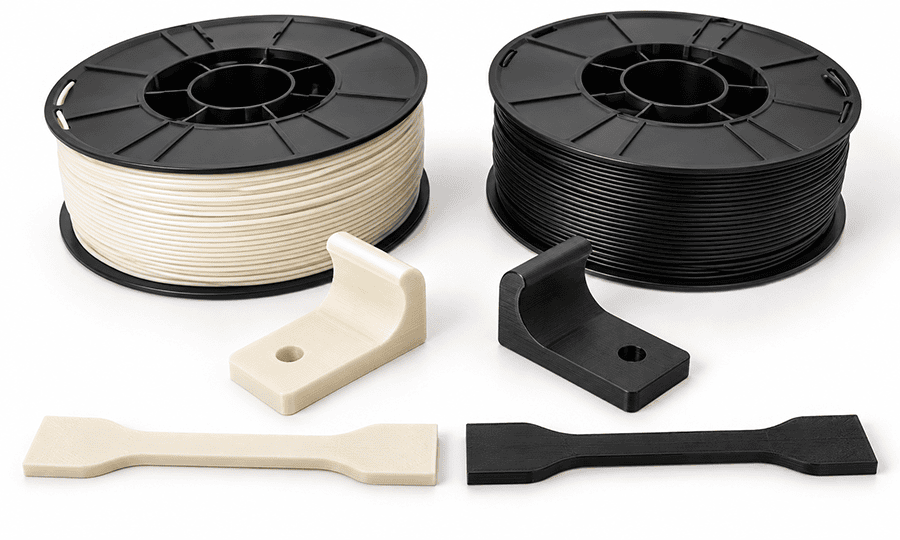
A comparison of Bambu Lab PLA Basic and eSUN PLA+ was recorded for a desktop equipment cable bracket loaded primarily in bending. The PLA specimens reported higher tensile and flexural properties. The PLA+ specimens showed greater elongation at break and higher notched impact strength. This is a product-specific comparison, not a universal PLA+ ranking.
6.1. Materials, Part Geometry, and Printing Conditions
The PLA was Bambu Lab PLA Basic, natural, unreinforced, 1.75 mm, lot PLA-BASIC-NAT-CASE-01. The PLA+ was eSUN PLA+, black, unreinforced, 1.75 mm, lot ESUN-PLAP-BLK-CASE-01. Both used a Bambu Lab P1S, the same slicer version and build plate, a 0.40 mm nozzle, flat XY orientation, and a 0.20 mm layer height.
| Production parameter | PLA | PLA+ |
| Material | Bambu Lab PLA Basic | eSUN PLA+ |
| Color / reinforcement | Natural / 0% fiber | Black / 0% fiber |
| Machine / nozzle | Bambu Lab P1S / 0.40 mm | Bambu Lab P1S / 0.40 mm |
| Build / toolpath | Flat XY / alternating ±45° | Flat XY / alternating ±45° |
| Layer / walls / infill | 0.20 mm / 4 / 40% Gyroid | 0.20 mm / 4 / 40% Gyroid |
| Nozzle / bed | 220°C / 60°C | 215°C / 60°C |
| Outer / inner / infill speed | 40 / 60 / 80 mm/s | 40 / 60 / 80 mm/s |
| Cooling after first layer | 100% | 100% |
| Predrying | 45°C, 6 h | 45°C, 6 h |
The nozzle temperatures differed by 5°C, while the other listed core settings matched. These results therefore describe the identified products under recorded process settings, not a comparison in which every variable was held identical.
6.2. Tensile, Flexural, Impact, and Thermal Results
The case lists five specimens per material and reported test category. Tensile specimens were identified as ASTM D638-22 Type I, with nominal 13 mm narrow section width, 3.2 mm thickness, 50 mm gauge length, and 5 mm/min test speed. Conditioning was 48 h at 23 ± 2°C and 50 ± 10% RH.
| Measured property | PLA | PLA+ |
| Tensile strength | 50.8 MPa | 47.6 MPa |
| Tensile modulus | 3,150 MPa | 2,850 MPa |
| Elongation at break | 5.2% | 9.1% |
| Reported flexural strength | 82.0 MPa | 74.0 MPa |
| Flexural modulus | 3,350 MPa | 3,000 MPa |
| Notched Izod impact strength | 28 J/m | 45 J/m |
| HDT at 1.80 MPa | 53°C | 54°C |
Reported tensile strength results were 50.8 ± 1.6 MPa for PLA and 47.6 ± 1.9 MPa for PLA+. Reported flexural strength results were 82.0 ± 3.0 MPa and 74.0 ± 3.5 MPa. The case records ASTM D790-17 Procedure A for bending, with 51.2 mm span and a nominal 1.37 mm/min crosshead speed. Impact testing is recorded as ASTM D256-23e1 notched Izod, and HDT as ISO 75-2:2013 Method A at 1.80 MPa.
Relative to the PLA results, PLA+ tensile strength was about 6.3% lower, tensile modulus 9.5% lower, reported flexural strength 9.8% lower, and flexural modulus 10.4% lower. Elongation at break was approximately 75% higher and notched impact strength approximately 61% higher.
Those observations support a toughness and stiffness tradeoff for these particular products. A 1°C HDT difference does not establish a meaningful service temperature advantage without accounting for variability and loading. The historical ASTM D790-17 edition in this case is retained as recorded, rather than presented as testing conducted to ASTM D790-25.
6.3. Dimensional Inspection and Functional Requirements
The cable bracket was specified for dry indoor use at 23 to 35°C. Intended loading was a 15 N static force at the bracket end and approximately ten short installation or removal operations per week.
| Feature | Specification | PLA | PLA+ |
| Body width | 25.00 ± 0.30 mm | 25.08 mm | 25.05 mm |
| Body thickness | 6.00 ± 0.20 mm | 6.04 mm | 6.02 mm |
| Mounting hole | 5.20 ± 0.20 mm | 5.23 mm | 5.25 mm |
| Clamping face width | 10.00 ± 0.25 mm | 10.10 mm | 10.08 mm |
Every reported dimension falls within its stated limit. These individual dimensions do not establish production repeatability or a general accuracy advantage for PLA+.
The case specifies functional acceptance criteria: no cracks after 24 h under 15 N; maximum end displacement of 2.0 mm; no more than 0.5 mm residual displacement after ten minutes unloaded; and at least 95% acceptance across 30 parts for each material.
The case did not record completed functional load results, so neither filament has a demonstrated pass status for these criteria. Potential concerns include root cracking, local failure near mounting holes, interlayer separation, and long duration bending deformation. The PLA+ impact result alone cannot demonstrate lower static deflection; its lower measured moduli make deflection important to verify.
6.4. Cost Comparison and Material Decision
| Cost parameter | PLA | PLA+ |
| Estimated filament cost | RMB 1.80 | RMB 2.10 |
| Equipment, electricity and labor | RMB 3.20 | RMB 3.20 |
| Estimated total per part | RMB 5.00 | RMB 5.30 |
| Estimated print cycle | 52 min | 52 min |
Estimated PLA+ cost was RMB 0.30 higher per part, or 6%. Cycle estimates excluded predrying and conditioning. PLA+ remains a candidate when handling impact is more important, while the tested PLA has higher tensile and flexural stiffness. The final material decision depends on the bracket meeting the actual sustained load, displacement, residual deformation, and handling requirements.
7. Frequently Asked Questions
7.1. What Is the Difference Between PLA and PLA+?
PLA is a thermoplastic polyester used in FDM printing. PLA+ is a commercial designation for modified PLA filament, not a standardized grade. Depending on formulation, it may improve toughness, elongation, or processing. It does not guarantee higher tensile strength, stiffness, or heat resistance.
7.2. Is PLA+ Stronger Than PLA?
Not necessarily. A PLA+ grade may have better impact performance but lower tensile strength or modulus. Compare identified grades with compatible test methods and print conditions. ASTM D638 tensile results alone do not establish the load capacity of a finished printed part.
7.3. Is PLA+ Worth the Additional Cost?
PLA+ can justify a higher price when a verified improvement solves a particular failure mode, such as assembly cracking. Ordinary PLA may be better for a rigid fixture if the selected PLA+ has lower stiffness. Compare acceptable finished part costs rather than spool prices alone.
7.4. Does PLA+ Need Different Print Settings?
Not always, but identical settings should not be assumed. Temperature, cooling, speed, and extrusion response depend on the grade. Start with the supplier’s stated range, then check layer bonding, surface condition, and critical dimensions on the actual part.
Ready to Quote Your CNC Prototype?
Upload your STEP file and get a DFM review + quote within 12 hours.
No tooling cost. Minimum 1 part.