

Dewey Wu General Manager & senior mechanical engineer at EPOC CRAFTER, 15 years in design engineering, quality, and metallurgy. Hands-on across CNC machining, metalwork, sheet metal, and prototyping (subtractive + 3D printing).
The only mandated difference between 316 and 316L stainless steel is carbon content. 316L caps carbon at 0.030% by mass; standard 316 allows up to 0.08%, per ASTM A240/A240M-24 and ASTM A276/A276M-25. Chromium, nickel, and molybdenum ranges are identical, so the two grades share nearly identical corrosion behavior in the solution-annealed condition. The low-carbon version gives up a small amount of room-temperature strength for far better resistance to weld-zone sensitization. That is why 316L dominates welded pressure vessels, sanitary piping, and surgical instruments. Standard 316 stays common when parts are machined from bar and never welded, and dual-certified 316/316L stock is often ordered to cover both callouts on one heat. In pure CNC work the two grades behave almost identically. The differences that matter live in the mill test report, the weld schedule, and the corrosion environment.
1. Carbon: what changes when you drop from 0.08% to 0.030%
The L stands for low carbon, and that is the whole spec change. ASTM A276/A276M-25 limits 316L to 0.030% C maximum; standard 316 permits up to 0.08%. Chromium sits at 16.0–18.0%, nickel at 10.0–14.0%, molybdenum at 2.00–3.00% for both grades. Manganese, silicon, phosphorus, and sulfur limits are shared, and nitrogen is capped at 0.10% in the standard-carbon variants of both.
The 0.05 percentage-point carbon drop has one practical effect: 316L keeps chromium in solid solution during and after welding. In standard 316, carbon binds chromium at grain boundaries during slow cooling through the 425–870°C range, forming Cr23C6 chromium carbides. The chromium-depleted strip along those boundaries loses corrosion resistance and becomes the failure path in chloride service. Low carbon starves that reaction, holding the microstructure as single-phase austenite even after weld thermal exposure.
The 316L vs 316 mechanical trade-off is small. ASTM A276/A276M-25 minimums drop from 515 MPa to 485 MPa tensile and from 205 MPa to 170 MPa yield when you move from 316 to 316L. Elongation stays at 40% for both. For most machined components those numbers are invisible in service. For pressure vessels designed close to code allowables, ASME BPVC Section VIII or the equivalent regional pressure vessel code decides which grade you specify.
2. Composition and properties compared: 304, 304L, 316, 316L
304, 304L, 316, and 316L are the four grades a designer weighs when selecting an austenitic stainless steel for machined or fabricated parts. All four share face-centered-cubic austenite, non-magnetic response in the annealed condition, and elongation minimums of 40%. The choice hinges on two variables: chloride exposure and welding.
Table 1. 304, 304L, 316, 316L side-by-side
| C max (%) | 0.08 | 0.030 | 0.08 | 0.030 |
| Cr (%) | 18.0–20.0 | 18.0–20.0 | 16.0–18.0 | 16.0–18.0 |
| Ni (%) | 8.0–10.5 | 8.0–12.0 | 10.0–14.0 | 10.0–14.0 |
| Mo (%) | n/a | n/a | 2.00–3.00 | 2.00–3.00 |
| Tensile min (MPa) | 515 | 485 | 515 | 485 |
| Yield min (MPa) | 205 | 170 | 205 | 170 |
| Elongation min (%) | 40 | 40 | 40 | 40 |
| Density (g/cm³) | 8.00 | 8.00 | 8.00 | 8.00 |
| PREN typical | 18–20 | 18–20 | 24–28 | 24–28 |
Composition and mechanical minimums per ASTM A276/A276M-25 Condition A (solution annealed). PREN = %Cr + 3.3×%Mo + 16×%N; ranges cover chemistry limits. Density from published wrought stainless steel data.
304 vs 316 is a molybdenum question. Molybdenum extends pitting-corrosion resistance into chloride-bearing environments (seawater, chlorinated process water, sanitary CIP cycles with hypochlorite). Without chloride exposure, 304 handles indoor architectural, food-service without CIP, fresh-water pressure vessels, and general industrial framing with margin. Add chloride, and 304 pits; 316 does not.
304L vs 316L is the same question with the L behavior overlaid. If the weldment lives in a low-chloride environment, 304L works and costs less. If the same weldment sees seawater, hot chlorides, or sanitary chemistry, 316L is the right callout regardless of what the fabricator would rather use.
316 vs 316L in machined-from-solid parts is the least consequential of these choices. Both meet the same corrosion baseline, and the L only pays for itself once heat input enters the picture. For bar-turned components that never see a torch, standard 316 is fully specified. Dual-certified 316/316L bar stock, common in mill supply, satisfies both drawings on one heat and removes the substitution question at the receiving dock. Bar-stock cost between the two is negligible; the meaningful cost step is 304 to 316, driven by the roughly 2.5% molybdenum content and the higher nickel loading. The metal strength chart for CNC materials puts 304, 304L, 316, and 316L against 6061-T6, 7075-T6, 4140, and Ti-6Al-4V on the same axes, and the yield strength versus tensile strength reading guide walks through why yield minimums matter more than tensile for CNC part design.
3. Corrosion: where the L pays for itself
Two corrosion modes decide 316 vs 316L in the field: pitting in chloride service, and intergranular attack after welding or slow cooling. The two behave differently, and only one is affected by the L.
Pitting is a chemistry question, not a carbon question. Pitting resistance scales with chromium, molybdenum, and nitrogen through the PREN index, and it is the same for 316 and 316L within their overlapping composition ranges. A 316L heat with 2.05% Mo and 0.043% N (values from a recent EPOC CRAFTER 316L bar heat, MTR H26-316L-047) delivers PREN ≈ 24.2. That places both grades in the same pitting-resistance class, roughly 5–6 points above 304 and 304L. Either 316 or 316L survives potable water, brackish water, food and beverage chemistries, and most sanitary CIP cycles within published safe operating envelopes. Neither one substitutes for duplex 2205 or 6-Mo super-austenitics in hot, high-chloride, low-pH service.
Intergranular attack is where the L earns its price. Chromium carbide precipitation depletes the chromium immediately adjacent to grain boundaries. Once chromium falls below roughly 12% in that narrow band, passivation fails locally and the boundary corrodes preferentially. In welded standard 316, the heat-affected zone (HAZ) sits inside the 425–870°C sensitization window for tens of seconds during cooling. Section thickness, ambient temperature, filler mass, and interpass management all shift the exposure, and standard 316 thicker than about 4 mm is where sensitization risk becomes real without post-weld solution annealing. 316L holds carbon low enough that carbide formation is starved; the same weld cycle leaves the HAZ chromium untouched.

The practical decision follows from the service:
- Welded and exposed to chlorides above trace levels: 316L. Verify passivation per ASTM A967/A967M-25 after welding and any post-weld cleanup.
- Welded but exposed only to dry indoor atmospheres, fresh water, or neutral organics: standard 316 with clean welding practice is acceptable, though 316L removes the sensitization variable at negligible cost.
- Machined from bar or forging with no welding at any downstream stage: standard 316, 316L, or dual-certified 316/316L all perform identically. The MTR carbon value closes the loop, not the grade name.
- Sanitary and biopharmaceutical service under ASME BPE-2024: 316L is the default across wetted components regardless of whether the specific part is welded, because the standard treats the whole product-contact system as one sensitization risk domain.
For sanitary and biopharmaceutical parts, the surface story runs alongside the alloy story. Wetted surface Ra values are set by the SF category on the drawing per ASME BPE-2024, not by the alloy specification. Passivation and free-iron control per ASTM A967/A967M-25 close out the corrosion package. This matters most for medical device CNC parts, where surface finish and passivation acceptance determine whether the finished part delivers the corrosion performance the alloy is capable of.
Chloride stress corrosion cracking (CSCC) is worth naming as a shared weakness. Both grades are vulnerable to CSCC in chloride solutions above roughly 60°C, especially under sustained tensile stress. The L version does not solve CSCC. Applications with concurrent chloride, heat, and sustained tension push the material selection past 316L into duplex, super-duplex, nickel alloys, or Ti-6Al-4V for aerospace and medical parts.
4. Welding 316 vs 316L: heat input, filler, and post-weld cleanup
Welding is where the L stops being an academic distinction. The two grades weld with the same processes (GTAW, GMAW, laser, resistance), the same shielding gases (argon or argon-helium mixes with small hydrogen or nitrogen additions on 316L for specific effects), and the same joint prep. Where they diverge is in what the weld does to the base metal a few millimeters back from the fusion line.
Filler selection is not interchangeable. ER316L and ER316LSi fillers are the default for both grades. ER316L deposits weld metal at or below 0.030% C, which resists sensitization inside the fusion zone itself and matches 316L base metal chemistry. Using standard ER316 filler on 316L base metal reintroduces the sensitization variable the L was chosen to eliminate, so ER316L filler is specified regardless of whether the base is 316 or 316L on any joint where the completed assembly sees chloride service or a corrosive environment.
For dissimilar joints (316L to carbon steel, 316L to 304L, 316L to duplex), the filler choice shifts. ER309L is the common bridge to carbon steel and 304L to accommodate dilution. Duplex-to-316L joints use the duplex filler (ER2209 for 2205) to preserve the duplex phase balance closer to the fusion line. Copying a standard 316L filler callout to these joints gets a weld that meets the drawing and fails in service.
Post-weld solution annealing is where the L saves schedule and cost. In chloride service, welded standard 316 requires post-weld solution annealing at 1040–1150°C followed by rapid quench to dissolve any carbides that formed during the weld cycle. That step costs schedule and money, and it constrains part geometry (large weldments distort during the anneal). 316L skips it entirely for most fabrication classes covered by ASME BPVC Section VIII and ASME BPE-2024, provided heat input, interpass temperature, and cooling rate follow the welding procedure specification. For CNC parts that see heat treatment separately from welding, the heat treatment sequence around CNC machining guide walks through when to machine before versus after the thermal cycle.
Two edge cases still require post-weld heat treatment even with 316L: multi-pass welds with cumulative heat exposure driving grain growth (a mechanical concern, not a sensitization concern), and applications specifying stress relief for dimensional stability. Neither is a corrosion issue.
Post-weld cleanup is where corrosion performance is made or lost. The weld deposit and adjacent HAZ carry a heat-tint oxide layer, embedded iron from wire brushes or grinding media, and weld spatter. Each of these is a corrosion initiation site. Sequence:
- Mechanical removal of scale using dedicated stainless brushes or flap discs, never carbon-steel or previously-used tooling
- Pickling with nitric-hydrofluoric paste or immersion, or electropolishing on sanitary and high-purity systems
- Passivation per ASTM A967/A967M-25 (Nitric 1, 2, 3, 4, 5 or Citric 1–5 per part chemistry and process constraints)
- Free-iron verification via water immersion, copper sulfate, or ferricyanide test per A967 Sections 8–9
Downstream passivation and surface finishing close the loop. Skipping any step leaves a corrosion path the alloy selection cannot compensate for. A 316L weld with residual heat tint pits earlier than a properly cleaned standard 316 weld. Grade selection sets the ceiling; cleanup determines whether the finished part reaches it.
5. Machining 316 and 316L on CNC: why the L barely matters here
On the machine, 316 and 316L behave as the same alloy. Both are austenitic with thermal conductivity around 15 W/m·K, both work-harden under rubbing edges, and both form long stringy chips without chip control. The L changes none of this. Machining strategy follows family behavior, not carbon level.
Cutting speeds run 20–30% below carbon steel. Feeds stay high enough to shear fresh material instead of glazing a work-hardened layer. Positive-rake, sharp-edge inserts with dedicated chipbreakers are baseline; high-pressure through-tool coolant breaks chips and holds cutting-zone temperature. Interrupted cuts risk built-up edge (BUE), which chips the cutting edge and pushes surface roughness off spec within tens of parts. EPOC CRAFTER’s precision CNC machining capabilities apply these controls across sanitary, medical, and instrument-grade 316/316L parts.
A representative case: dual-certified 316/316L sanitary port housing, 200 pieces. Part geometry: Ø58 mm main body, Ø25 H7 through-bore 48 mm deep, M20 × 1.5 internal thread, two Ø6 mm cross ports, 2.0 mm minimum local wall, Ra 0.8 μm maximum on the wetted sealing face per ASME BPE-2024. Material: cold-finished Ø65 mm bar in A276 Condition A, MTR C 0.021%. Machining on a DMG MORI NLX 2500SY/700 turn-mill center in two setups. Tooling: Sandvik CoroTurn 107, CCMT 09T308-MM insert in GC2220, positive 80° rhombic with 0.8 mm nose radius and MM chipbreaker.
Initial deep-bore roughing with a general-purpose insert produced long stringy chips and BUE. Chip recutting caused intermittent insert chipping and sealing-face Ra drift after 35–45 parts; critical-insert life sat at 42 parts per edge. Root cause was BUE at the tool tip during ap 2.0 mm passes, not carbon content.
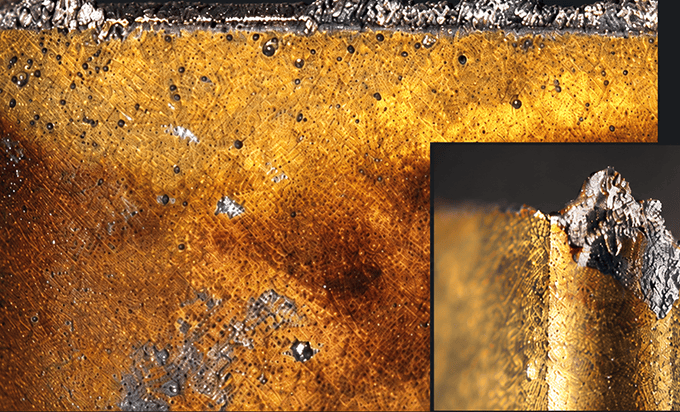
The fix was tool geometry and coolant delivery, not parameter escalation. A sharper positive MM chipbreaker in GC2220, 70 bar through-tool coolant at the chip formation zone, and removed dwell at bore exit resolved chip control. Final parameters ran rough Vc 160 m/min, fn 0.25 mm/rev, ap 2.0 mm; finish Vc 190 m/min, fn 0.08 mm/rev, ap 0.30 mm. Critical-insert life recovered from 42 to 96 parts per edge, cycle time from 11.4 to 10.6 min/part, sealing-face Ra stabilized at 0.45–0.70 μm, and first-pass batch yield closed at 99.5% over 200 pieces.
Design decisions matter more than grade choice on machined-from-solid stainless steel parts. Bore length-to-diameter ratios above roughly 1.5:1, sharp internal corners, thin walls near threaded features, and mixed Ra requirements on one setup drive cost regardless of the callout being 316, 316L, or dual-certified. The DFM guidelines for stainless steel parts cover the design decisions worth resolving before the grade discussion.
6. Reading the mill test report: dual-certified 316/316L
The drawing tells you what to specify; the MTR (mill test report) tells you what actually shipped. For 316 and 316L, that gap is where receiving-dock rejects come from. Five fields on the MTR carry the decisions:
- Actual carbon content. A drawing calling out 316L is satisfied only if the MTR reports C ≤ 0.030% on the specific heat. The §5 case heat H26-316L-047 shows 0.021%. A 316L drawing paired with a heat at 0.033% C is a rejection, not a discussion.
- Heat treatment condition. Condition A (solution annealed) per ASTM A276/A276M-25 is the supply state for machining and welding. Cold-worked Condition S and hardened Conditions H/T are separate acceptance categories with different mechanical minimums and different corrosion behavior.
- UNS number(s). S31600 alone is standard 316; S31603 alone is 316L; both listed on the same certificate is dual-certified stock.
- Mill identity and heat number. Traceability endpoint for any downstream nonconformance investigation.
- Mechanical test values. Actual tensile, yield, elongation, and hardness from that heat, compared against A276 minimums.

Dual-certified 316/316L bar meets both drawings on one heat because chemistry stays under the 0.030% C limit and mechanical values meet both grades’ minimums. It removes the substitution question at receiving, not the specification question at design: the drawing callout drives filler, weld schedule, and passivation class downstream. The tolerances and material standards on drawings guide walks through how dimensional and material standards resolve on one drawing.
7. Additive-manufactured 316L: don’t reuse wrought data
Laser powder bed fusion (LPBF) and directed energy deposition (DED) produce 316L parts that meet the same UNS S31603 chemistry limits, but the mechanical and corrosion data on a wrought 316L datasheet do not transfer to the printed part. LPBF 316L shows finer cellular-dendritic solidification structure, melt-pool boundaries, higher yield strength (often 450–590 MPa in the as-built condition per published characterization studies), residual tensile stress at the surface, and porosity from lack-of-fusion or gas entrapment. Pitting resistance drops when porosity opens crevice sites; hot isostatic pressing and solution treatment close some of that gap. Design allowables, corrosion certification, and passivation acceptance for AM 316L follow their own test data, not the wrought MTR. For projects where 316L parts move between subtractive and additive routes, EPOC CRAFTER runs both under the same quality system through our additive manufacturing services.
8. FAQ
Is 316L magnetic?
In the solution-annealed condition, 316L is non-magnetic (paramagnetic). Cold work from machining, drawing, or bending can induce a strain-induced martensite phase that shows weak ferromagnetic response, usually at cold-worked surfaces and threaded features. A weak magnet response on a machined 316L part does not fail material acceptance.
Is 316L stronger than 316?
No. 316L has lower minimums: 485 MPa tensile and 170 MPa yield versus 515 MPa and 205 MPa for 316 per ASTM A276/A276M-25. Elongation is 40% for both. For most machined parts the difference is not detectable in service.
Can I substitute 316L when the drawing calls out 316?
Not without engineering approval. 316L meets 316 chemistry limits (0.030% ≤ 0.08%) but the mechanical minimums are lower. Dual-certified 316/316L bar stock avoids the substitution question because it meets both grade minimums on one heat.
Does 316L cost more than 316?
Bar-stock cost between 316 and 316L is negligible on standard sizes. The meaningful step-up is 304/304L to 316/316L, driven by the roughly 2.5% molybdenum content and higher nickel loading.
Ready to Quote Your CNC Prototype?
Upload your STEP file and get a DFM review + quote within 12 hours.
No tooling cost. Minimum 1 part.