

Dewey Wu General Manager & senior mechanical engineer at EPOC CRAFTER, 15 years in design engineering, quality, and metallurgy. Hands-on across CNC machining, metalwork, sheet metal, and prototyping (subtractive + 3D printing).
Brass is a copper-zinc alloy. The most widely machined grade, C36000 free-cutting brass, contains Cu 60.0–63.0%, Pb 2.5–3.0%, Fe ≤0.35%, and Zn as remainder, per ASTM B16/B16M-24. C36000 carries a machinability rating of 100%, the baseline against which other copper alloys are measured. Rod and bar ship in H02 half-hard temper by default unless the purchase order states otherwise.
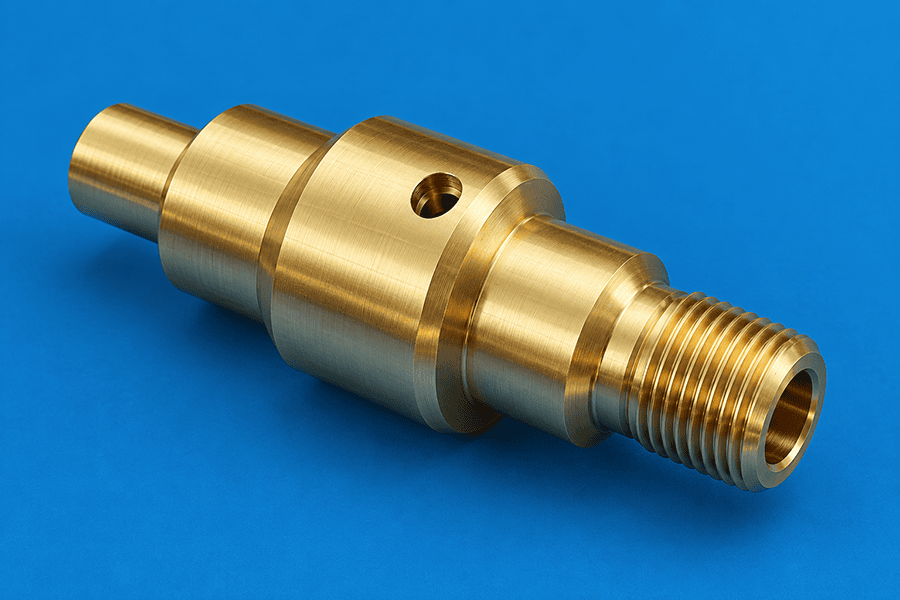
Brass shows up across fittings, valve bodies, electrical connectors, gears, and threaded inserts. It machines fast, resists corrosion in indoor and mild-marine environments, and threads cleanly with minimal burr.
1. Brass Composition and How Copper-Zinc Ratio Changes Properties
Brass starts with two elements: copper and zinc. Copper gives the alloy its corrosion resistance, electrical conductivity, and warm color. Zinc raises strength and hardness while lowering cost. A 70Cu-30Zn brass (C26000, cartridge brass) is softer, more ductile, and easier to cold-form than a 60Cu-40Zn brass (C28000, Muntz metal), which is harder and better suited to hot working.
Beyond copper and zinc, small additions shift behavior. Lead at 2.5–3.7% (as in C36000 and C36010) breaks chips during turning and drilling, which is why ASTM B16/B16M-24 labels these alloys as suitable for high-speed screw machining. Tin at around 1% (as in C46400 naval brass) improves resistance to saltwater dezincification. Iron up to 0.35% adds a small hardness increment and helps refine grain during hot working.
Alloys above 80% copper look reddish (red brass); 60–70% copper gives the familiar golden yellow; below 60% the tone shifts paler.
For CNC procurement, the composition that matters most is on the purchase order: UNS designation, temper, and product form. A drawing that calls out “brass” without a UNS number leaves the supplier choosing the alloy, and C36000 (free-cutting, leaded) behaves nothing like C26000 (unleaded, high-ductility) on a lathe.
2. Types of Brass by Crystal Structure
Zinc content determines crystal structure, and crystal structure determines what you can do with the material in a shop.
2.1. Alpha Brass (Zinc Below About 37%)
Alpha brasses form a single-phase FCC structure. They are the most ductile brasses and cold-work well: deep drawing, stamping, bending, and spinning all favor alpha grades. C26000 (70Cu-30Zn, cartridge brass) is the standard example. C22000 (90Cu-10Zn, commercial bronze, sometimes marketed as “red brass”) sits at the copper-rich end with higher corrosion resistance.
Alpha brasses do not machine as cleanly as leaded duplex grades. Without lead to break chips, C26000 produces long, stringy swarf. Machinability rating for C26000 is roughly 30% of the C36000 baseline.
2.2. Alpha-Beta (Duplex) Brass (Zinc 37–45%)
When zinc exceeds about 37%, a BCC beta phase appears alongside the FCC alpha phase. The beta phase is harder and stronger but less ductile. Duplex brasses hot-work and forge more readily than alpha grades, and adding lead to the beta-rich matrix produces the free-cutting behavior that makes C36000 the default screw-machine alloy.
C36000 sits at roughly 60Cu-37Zn-3Pb, squarely in the duplex zone. C37700 (forging brass) is another duplex alloy optimized for hot forging followed by machining.
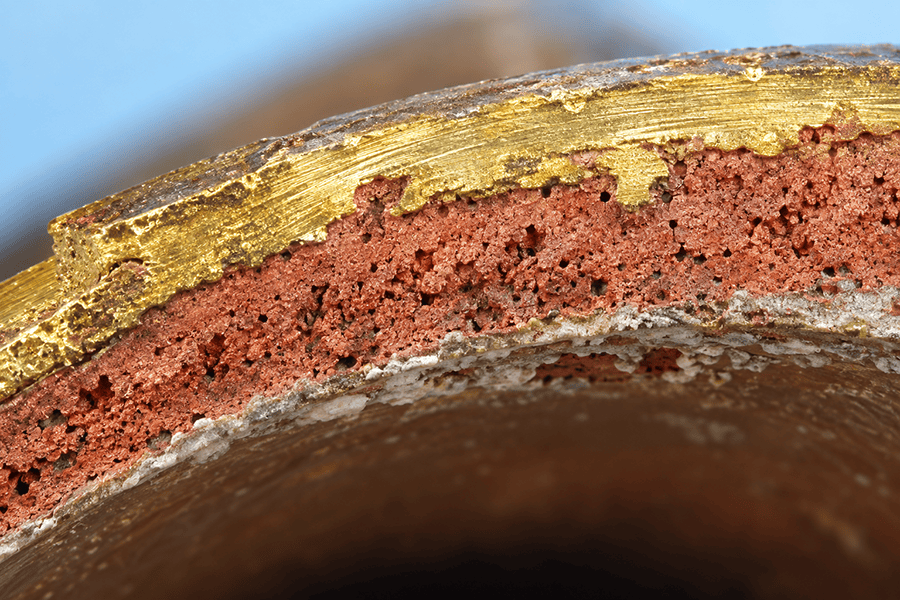
One downside: the beta phase is more susceptible to dezincification, where zinc leaches out and leaves behind a weak, porous copper skeleton. Dezincification accelerates in warm water above 60 °C or stagnant, high-chloride conditions. If your part operates in that environment, specify a dezincification-resistant grade or switch alloy family.
2.3. Beta Brass (Zinc Above About 45%)
Above 45% zinc, the microstructure becomes nearly all beta phase: hardest and strongest but brittle, only hot-workable or castable. Beta alloys are uncommon in CNC work.
3. Common Brass Grades for CNC Machining
The grade on your purchase order controls chip behavior, tool life, achievable surface finish, and corrosion performance.
| Property | C26000 (Cartridge) | C36000 (Free-Cutting) | C38500 (Arch. Bronze) | C46400 (Naval) | C48500 (Leaded Naval) |
| Cu % | 68.5–71.5 | 60.0–63.0 | 55–59 | 59–62 | 59–62 |
| Zn % | 28.5–31.5 | Remainder | 36.7–41.7 | 36.7–41.7 | 36.7–41.7 |
| Pb % | ≤0.07 | 2.5–3.0 | 2.5–3.5 | ≤0.20 | 0.40–1.0 |
| Sn % | — | — | — | 0.50–1.0 | 0.50–1.0 |
| Machinability (% of C36000) | 30 | 100 | 90 | 30 | 70 |
| Crystal structure | Alpha | Alpha-beta | Alpha-beta | Alpha-beta | Alpha-beta |
| Density (g/cm³) | 8.53 | 8.49 | 8.47 | 8.41 | 8.41 |
| Typical UTS, H02 (MPa) | ~395 | 338–469 | ~414 | 379–607 | ~455 |
| Corrosion | Good; no dezincification | Good; not for hot water | Good | Tin resists dezincification; marine | Tin resists dezincification |
| Primary use | Deep drawing, cold forming | Screw machining, CNC turning | Architectural extrusions | Marine fittings, pump shafts | Marine + moderate machinability |
Source: CDA published alloy datasheets. Machinability referenced to C36000 = 100%.
Benign indoor environment with no water contact: C36000. Cold forming first, light machining second: C26000. Saltwater or hot water: C46400 or C48500 with tin.
3.1. C360 Free-Cutting Brass and ASTM B16/B16M-24
ASTM B16/B16M-24 governs free-cutting brass rod, bar, wire, and shapes for screw-machine use. It covers two UNS designations.
C36000 vs C36010: the lead split. C36000 specifies Pb 2.5–3.0%. C36010 specifies Pb 3.1–3.7%. Copper range is identical (60.0–63.0%). Iron capped at 0.35% max. When a PO references ASTM B16 without specifying UNS, the standard defaults to C36000.
Do not write “C360 brass” on a drawing and assume the shop knows which one you mean. C36000 and C36010 are not interchangeable. The higher lead in C36010 improves chip breaking further but may not comply with the same regulations.
Temper and default delivery. ASTM B16 defines three tempers:
• O60 (soft anneal): lowest strength, highest ductility
• H02 (half-hard): default when the PO does not specify temper
• H04 (hard): highest strength, for small-diameter wire and rod
If your drawing says nothing about temper, you receive H02. This is the standard’s explicit default (Section 8.2).
Mechanical properties, C36000/C36010 rod and wire (ASTM B16/B16M-24, Tables 2–3):
| Temper | Diameter Range | Min. Tensile (MPa) | Min. 0.5% Ext. Yield (MPa) | Min. Elongation |
| O60 | ≤25 mm | 330 | 140 | 15% |
| O60 | >25–50 mm | 305 | 125 | 20% |
| O60 | >50 mm | 275 | 105 | 25% |
| H02 | <12 mm | 395 | 170 | 7% |
| H02 | 12–25 mm | 380 | 170 | 10% |
| H02 | >25–50 mm | 345 | 140 | 15% |
| H02 | >50–100 mm | 310 | 105 | 20% |
| H04 | 1.6–4 mm | 550 | 310 | — |
| H04 | >4–12 mm | 480 | 240 | 4% |
| H04 | >12–18 mm | 450 | 205 | 6% |
Source: ASTM B16/B16M-24, Tables 2–3. Tensile testing per ASTM E8/E8M.
For H02 12–25 mm rod specified for thread rolling: minimum tensile drops to 350 MPa, HRB tightens to 55–75. Only applies when thread rolling is called out on the order.
Acceptance rules. Section 9.1.1.1: acceptance or rejection is based on tensile strength alone. Yield and elongation appear in the tables but cannot be grounds for rejection. Rockwell B hardness is informational only, not a rejection basis.
Certification. Mill test reports and heat identification are optional under ASTM B16. State these on the PO if required. Full heat-to-bar traceability may not be achievable because billet-to-wrought conversion is discontinuous.
3.2. Other Grades Worth Knowing
C26000 (Cartridge Brass, 70/30). Workhorse alpha brass for cold forming. 68% elongation annealed (CDA data). Machinability 30% of C36000. Use when the part is deep-drawn first and only lightly machined afterward.
C46400 (Naval Brass). Tin at 0.5–1.0% provides dezincification resistance in seawater. Tensile reaches 607 MPa cold-drawn and stress-relieved. Machinability 30%. Reserve for marine and hot-water applications.
C48500 (Leaded Naval Brass). Lead at 0.40–1.0% improves machinability to about 70% while retaining tin-based dezincification resistance. A workable compromise when you need marine corrosion performance and acceptable cycle times on a CNC lathe or milling center.
4. Brass Properties and Performance Data
Brass properties shift with composition, temper, and product form. The numbers below separate ASTM B16 standard-required values from published typical values.
4.1. Bar Mechanical Properties from ASTM B16
| Temper | Thickness | Width | Min. Tensile (MPa) | Min. Yield (MPa) | Min. Elong. |
| O60 | ≤25 mm | ≤150 mm | 305 | 125 | 20% |
| O60 | >25 mm | ≤150 mm | 275 | 105 | 25% |
| H02 | ≤12 mm | ≤25 mm | 345 | 170 | 10% |
| H02 | ≤12 mm | >25–150 mm | 310 | 115 | 15% |
| H02 | >12–50 mm | ≤50 mm | 310 | 115 | 15% |
| H02 | >12–50 mm | >50–150 mm | 275 | 105 | 20% |
Source: ASTM B16/B16M-24, Table 3. Yield at 0.5% extension under load per ASTM E8/E8M.
Larger cross-sections carry lower minimums because cold work penetrates less deeply. Your design stress allowable should reflect actual stock size, not the highest number in the table.
Rockwell B hardness, rod and wire (ASTM B16/B16M-24, Table 5):
| Temper | Diameter | Round | Hex/Octagonal |
| O60 | ≥12 mm | HRB 10–45 | HRB 10–45 |
| H02 | 12–25 mm | HRB 60–80 | HRB 55–80 |
| H02 | >25–50 mm | HRB 55–75 | HRB 45–80 |
| H02 | >50–75 mm | HRB 45–70 | HRB 40–65 |
| H02 | >75–100 mm | HRB 40–65 | HRB 35–60 |
Source: ASTM B16/B16M-24, Table 5. Midpoint measurement per ASTM E18. Not a rejection basis.
4.2. Physical Properties (Published Typical Values)
CDA-published typical values for C36000 in H02 condition. Treat as design estimates, not specification limits.
| Property | C36000, H02 typical | Unit |
| Density | 8.49 | g/cm³ |
| Melting range | 885–900 | °C |
| Thermal conductivity (20 °C) | 115 | W/m·K |
| Electrical conductivity | 26 | % IACS |
| CTE (20–300 °C) | 20.5 | μm/m·°C |
| Elastic modulus | 97 | GPa |
Source: CDA alloy datasheet for C36000.
4.3. Corrosion Behavior and Dezincification
Brass does not rust; it contains no meaningful iron. The copper-rich surface forms a thin oxide layer that slows further attack in dry air, freshwater at moderate temperature, and mild industrial atmospheres.
Dezincification is the failure mode specific to brass. Zinc dissolves preferentially, leaving porous, weak copper residue. Stagnant or slow-moving water above roughly 60 °C and high chloride content accelerate it. Alpha-beta brasses like C36000 are more vulnerable than single-phase alpha grades because the beta phase dezincifies faster.
Mitigation: specify a DZR alloy (CZ132 / CW602N with arsenic), C46400 naval brass for marine, or copper alloys with no beta phase for hot-water plumbing.
5. CNC Machining Brass: Process, Tooling, and Chip Control
C36000 earned its 100% machinability rating because it breaks chips short, generates low cutting forces, and produces good surface finish even at high feed rates.
5.1. Turning, Milling, and Drilling
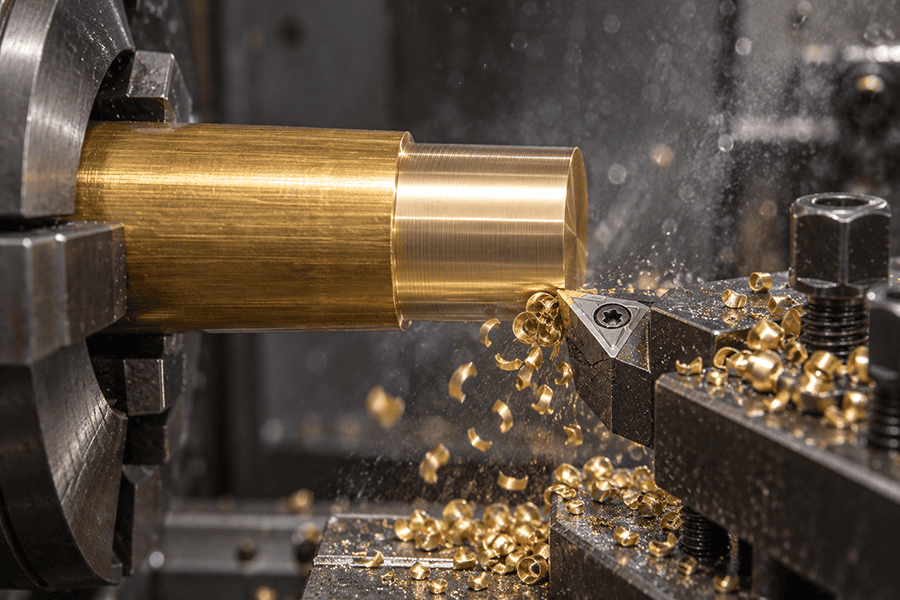
C36000 in H02 temper turns well with uncoated carbide (C2 / ISO K10–K20) or PCD at surface speeds from 150 to over 300 m/min. Feed rates of 0.05–0.25 mm/rev cover finish to roughing. Low cutting forces allow lighter fixturing, but thin-walled parts still need support against chatter.
ASTM B16/B16M-24 does not specify cutting parameters. The values above reflect general industry practice. Check your insert supplier’s recommendation and review DFM guidelines for CNC parts before locking the process plan.
Brass mills cleanly with sharp, positive-rake cutters. Negative rake smears the surface. Two-flute or three-flute end mills beat four-flute on brass because larger chip gullets prevent packing. Climb milling is the default.
Standard 118° split-point drills work for most holes. Reduce the point angle to 90–100° when the drill exits into a cavity, because a standard point can grab and pull the workpiece on breakthrough. Peck cycles are usually unnecessary for C36000 in shallow holes (depth <3×D).
5.2. Threading and Thread Rolling
ASTM B16 allows thread rolling only when the PO explicitly specifies it. For H02 round rod 12–25 mm, thread-rolling stock must meet 350 MPa minimum tensile and HRB 55–75. The standard says “moderate thread rolling” and does not extend this provision to O60, H04, bar, shapes, or diameters outside 12–25 mm.
Brass taps well with standard HSS taps. For metric thread sizes and tap drill charts, use published tap drill sizes. Thread depth beyond 1.5×D rarely adds meaningful pull-out strength in brass and increases tap breakage risk.
C26000 will bird-nest inside a tapped hole. C36000 and C36010 produce short chips that clear flutes easily. For unleaded brass, use a spiral-flute tap with through-coolant.
5.3. Tolerances and Workholding
Brass cuts with low forces, generates moderate heat, and does not work-harden significantly. Holding ISO 2768-f (fine) general tolerances is straightforward on most setups.
Thin walls and long unsupported bores are the weak spots. Clamping pressure alone can deform a brass part before the first cut. Soft jaws, expanding collets, or low-pressure hydraulic chucks prevent distortion on thin-walled sleeves. For L/D above 4:1, use a steady rest or tailstock center.
H02 brass does not spring back the way stainless does, and residual stress is modest. Dimensional stability after machining is good.
6. Surface Finish and Post-Machining Options
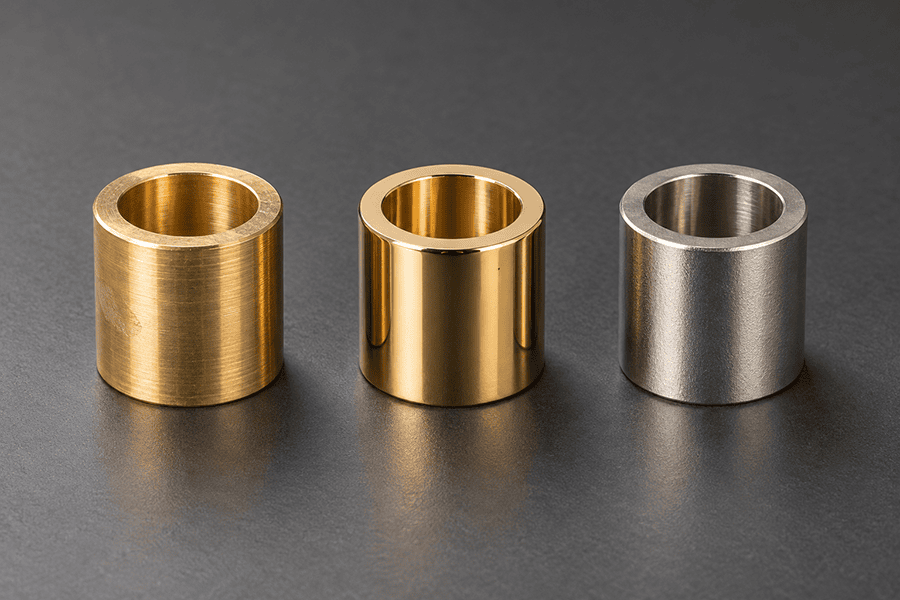
Many brass parts ship as-machined with a bright golden surface. Brass tarnishes over time from air, humidity, and handling. If appearance or functional surface properties matter, specify the finish at the drawing stage.
Polishing. Progressive abrasives (320 → 600 → 1200 grit, then buffing) give a mirror surface. Common on decorative hardware and musical instruments. Polished surfaces show tarnish faster.
Lacquer. Clear acrylic or epoxy lacquer seals against air and moisture, typically 10–25 μm. The most common tarnish-prevention for indoor brass hardware. Wears off on high-touch surfaces over time.
Nickel plating. Electroless nickel deposits a uniform Ni-P layer (5–25 μm) regardless of geometry. Electrolytic nickel builds thicker layers but concentrates on edges. Both improve wear resistance, corrosion resistance, and solderability. Standard for electrical connectors and fluid-handling components needing corrosion-resistant finishes.
Chrome plating. Chrome over nickel gives the hardest, most wear-resistant brass surface. Common on valve trim and faucet bodies. Hexavalent chrome is under REACH/EPA pressure; trivalent chrome is the replacement.
PVD coating. Thin ceramic films (TiN, ZrN, CrN) at 1–5 μm. Decorative colors (gold, black, rose) without chrome’s environmental issues. Hard (HV 2000+) but thin, so it resists flat-surface scratching but can chip on edges.
Passivation. Acid treatments (citric or phosphoric) remove contaminants and light tarnish. Brass passivation is a cleaning step, not long-term protection.
Anodizing: not applicable. Brass cannot be anodized by the sulfuric-acid process used on aluminum. Projects requiring anodized aluminum finishes need an alloy switch.
7. Brass vs Bronze vs Copper: When to Choose Which
All three are copper-base, and they get confused constantly. C38500 is called “architectural bronze” but is a leaded brass. C22000 is called “commercial bronze” but is a 90Cu-10Zn brass. Read the UNS number, not the trade name.
| Factor | Brass (Cu-Zn, e.g. C36000) | Bronze (Cu-Sn, e.g. C93200) | Copper (C11000) |
| Primary alloy element | Zinc | Tin (also Al, Si, Mn) | None (≥99.9% Cu) |
| Machinability (% of C36000) | 100 | 50–70 | 20 |
| Electrical conductivity | 26% IACS | 7–15% IACS | 101% IACS |
| Wear / bearing | Moderate | High | Low |
| Saltwater corrosion | Fair (dezincification risk) | Good to excellent | Good; erosion-corrosion risk |
| CNC applications | Fittings, connectors, valve bodies, inserts | Bushings, bearings, gears, wear plates | Bus bars, heat sinks, terminals |
| Cost per kg | Medium | Medium to high | High |
Brass wins on screw-machine parts, threaded components, and any job where machinability drives cycle time. Bronze wins on sliding-contact bearings and worm gears. Copper wins when electrical conductivity is the deciding factor: at 101% IACS it is four times more conductive than C36000. Aluminum grades for CNC machining compete with copper on thermal management when weight matters.
8. Brass Stock Forms and Procurement
ASTM B16/B16M-24 covers rod, bar, wire, and shapes. Dimensional tolerances reference ASTM B249/B249M (rod, bar, shapes) and B250/B250M (wire).
Round rod. Default CNC turning stock, 3 mm to 150+ mm diameter. Hex and octagonal rod eliminates milling wrench flats from round.
Flat and rectangular bar. For predominantly flat parts: mounting plates, contact strips, wear pads.
Wire (coil). Small-diameter C36000 in coils for automatic screw machines and Swiss-type lathes: pins, contacts, rivets, standoffs.
Sheet and plate. C26000 is more common than C36000 for sheet. Used in stamping, etching, and shims.
Tube. Common for fluid-handling parts and bushings machined from tube OD/ID rather than boring from solid.
Procurement checklist (ASTM B16 Section 5):
• ASTM B16/B16M-24 designation and year
• UNS number: C36000 or C36010
• Temper: O60, H02, or H04
• Product form: round, hex, square, or shape
• Diameter or across-flats dimension
• Straight lengths or coils
• Whether intended for thread rolling
• Whether material certification is required
• Whether heat identification/traceability is required
• Quantity: weight, length, or piece count per size
9. Lead in Brass: Compliance, RoHS, and Alternatives
RoHS. The directive limits lead in EEE to 0.1% in homogeneous materials. Brass at 2.5–3.7% Pb fails, except that Exemption 6(c) permits copper alloys with up to 4% lead. This covers C36000 and C36010 as of the current directive. The exemption is subject to periodic EC review.
REACH. Lead is an SVHC on the Candidate List. Solid wrought brass under normal handling poses no inhalation or absorption hazard. The risk arises during machining (lead dust and fumes); fabricators need extraction and PPE per occupational health requirements.
Drinking water. The U.S. Safe Drinking Water Act defines “lead-free” as ≤0.25% Pb by weighted average across wetted surfaces. C36000 at 2.5–3.0% Pb does not qualify. ASTM B16 does not certify drinking-water suitability. Use C27450, C69300, or ECO Brass for potable water.
Food contact. No universal rule governs lead in food-contact brass. Acidic foods (pH <6) accelerate leaching. Do not use leaded brass in direct food contact without a migration study.
Lead-free alternatives. C27450 (EnviroBrass, Bi-Se), C69300 (silicon brass), and ECO Brass grades replace lead with bismuth, silicon, or selenium. Machinability is 50–75% of C36000, tool wear increases, cost per kg is higher. For potable water or food contact, the switch is not optional.
10. Applications
Plumbing and fluid handling. Valve bodies, fittings, manifolds, hose barbs. C36000 for non-potable; lead-free grades for potable water; naval brass for saltwater.
Electrical connectors. Terminals, pins, sockets, bus-bar inserts. C36000 at 26% IACS provides adequate conductivity with far better machinability than copper.
Fasteners and threaded inserts. Inserts for plastic housings, set screws, standoffs, thumb nuts. Brass will not gall against steel the way steel-on-steel can.
Gears, bushings, and wear parts. Small spur gears, guide bushings, cam followers. Lower friction than steel against a hardened shaft. For heavy continuous-load bearings, phosphor bronze or bearing bronze outperforms brass.
Automotive. Sensor housings, fuel fittings, radiator connectors, battery terminals. Brass parts in automotive prototyping and production face vibration, thermal cycling, and fluid exposure.
Marine hardware (through-hulls, seacocks, deck fittings): C46400 and C48500. C36000 is not suitable for submerged marine service.
Musical instruments (trumpet bells, saxophone bodies): C26000 for cold formability and acoustic resonance.
Decorative and architectural hardware: door handles, cabinet pulls, signage. Post-machining surface treatments preserve the golden appearance.
11.Frequently Asked Questions
Q1: Is brass magnetic?
No. Brass contains no ferromagnetic elements and does not attract a magnet. If a “brass” part sticks to a magnet, it is not brass.
Q2: What is brass made of?
Copper and zinc, with optional lead, tin, iron, or other additions depending on the grade. C36000 contains Cu 60–63%, Pb 2.5–3.0%, Zn remainder.
Q3: Does brass rust?
No. Rusting requires iron, and brass contains none in meaningful amounts. Brass can tarnish (darken or develop green patina), but tarnish is cosmetic.
Q4: What color is brass?
Golden yellow at 60–70% Cu. Higher copper content shifts reddish; higher zinc shifts paler.
Q5: Is brass conductive?
Yes, but far less than copper. C36000 sits at about 26% IACS, adequate for connectors and signal circuits but not for power bus bars.
Q6: Does brass corrode?
Brass resists atmospheric and freshwater corrosion. The specific failure mode is dezincification in warm, stagnant, or chloride-rich water. Naval brass and DZR grades mitigate this.
Q7: Is brass food safe?
Leaded brass is not recommended for direct contact with acidic food. Lead and copper leach at low pH. Use lead-free alloys and confirm regulatory compliance.
Q8: Can brass be welded?
Brass can be TIG or oxy-fuel welded, but zinc vaporizes and produces toxic fumes. Brazing and soldering are preferred. Silicon bronze filler rod (ERCuSi-A) reduces zinc loss when welding is required.
Q9: Is brass a ferrous metal?
No. Brass is a nonferrous copper-zinc alloy.
Q10: Does brass work harden?
Mildly. C36000 does not work-harden enough to affect CNC machining. C26000 work-hardens more and may need intermediate annealing during deep drawing.
Q11: Is brass recyclable?
Yes, fully recyclable with no property loss. Scrap value is relatively high because copper retains commodity value.
Ready to Quote Your CNC Prototype?
Upload your STEP file and get a DFM review + quote within 12 hours.
No tooling cost. Minimum 1 part.