

Dewey Wu General Manager & senior mechanical engineer at EPOC CRAFTER, 15 years in design engineering, quality, and metallurgy. Hands-on across CNC machining, metalwork, sheet metal, and prototyping (subtractive + 3D printing).
Bronze metal is a copper-based alloy used in machined parts when wear resistance, corrosion resistance, sliding contact, and dimensional stability matter more than raw strength alone. For CNC machined bushings, sleeve bearings, thrust washers, gears, and wear plates, the useful question is not only “what is bronze?” The useful question is which bronze grade, stock form, drawing tolerance, machining allowance, inspection method, and material certificate apply to the part.
For continuous-cast bronze rod, bar, tube, and shapes, ASTM B505/B505M-23 can support material purchasing and incoming inspection. The standard can define alloy chemistry, product form, machining allowance, supplied stock tolerance, and ordered test requirements for covered copper-alloy castings. It does not define finished bushing design, PV limits, friction coefficient, CNC cutting speed, lubrication groove design, final bore tolerance, or wear life. Those decisions still depend on load, shaft material, lubrication, fit, surface finish, and inspection method.
1. What Is Bronze Metal?
Bronze metal is a copper-based alloy, traditionally copper and tin, used where a part needs better hardness, wear behavior, and corrosion resistance than pure copper. Modern bronze alloys can also include lead, zinc, aluminum, phosphorus, nickel, silicon, or manganese. The alloy family matters because a C93200 bushing, a C95400 aluminum bronze wear plate, and a phosphor bronze spring contact do not machine, wear, or certify the same way.
For an engineer or buyer, “bronze” is not enough information for a drawing or purchase order. A drawing that says only “bronze” leaves the supplier guessing the UNS grade, stock form, casting route, heat lot traceability, and inspection requirements. Before choosing bronze over brass, copper, steel, or aluminum, use EPOC CRAFTER’s CNC machining materials guide for bronze selection to compare material function, cost pressure, corrosion exposure, conductivity, wear, and batch size.
2. What Is Bronze Made Of?
Bronze is made mainly of copper plus one or more alloying elements. Tin is the traditional addition, but engineering bronzes are usually specified by alloy family, UNS grade, and product standard rather than by one simple copper-tin percentage.
ASTM B505/B505M-23 lists multiple copper-alloy continuous cast grades. An UNS number such as C93200 identifies the alloy grade. ASTM B505/B505M-23 identifies the product specification for covered continuous-cast rod, bar, tube, and shapes. The two are related, but they are not interchangeable.
| Bronze family | Examples within ASTM B505/B505M-23 scope | Practical meaning for machined parts |
| Tin bronze | C90300, C90500, C90700, C91000, C91300 | Used where strength, corrosion resistance, and bearing behavior matter, depending on grade. |
| Leaded tin bronze | C92200, C92300, C92700, C92800 | Lead can improve machinability and bearing behavior. Check regulation and application limits. |
| High-leaded tin bronze | C93200, C93400, C93600 and related grades | C93200 is a common bearing bronze for bushings, sleeve bearings, and thrust washers. |
| Aluminum bronze and nickel aluminum bronze | C95200, C95300, C95400, C95500, C95800 and related grades | Often considered for higher strength, corrosion resistance, or marine hardware. Do not treat all aluminum bronzes as substitutes for C93200. |
For C93200, ASTM B505/B505M-23 lists these key composition limits by mass percent in Table 10: copper 81.0 to 85.0, tin 6.3 to 7.5, lead 6.0 to 8.0, and zinc 2.0 to 4.0. The same table also controls other elements. These chemistry limits are purchasing and acceptance requirements for the covered product form. They are not a direct wear-life calculation.

3. Key Bronze Properties That Matter in Machined Parts
Bronze properties matter when they connect to the part’s job. Density, melting point, tensile strength, yield strength, hardness, corrosion resistance, and machinability are useful data points, but they do not choose the grade by themselves.
For machined bushings, the first decision is usually sliding behavior. A bronze sleeve bearing may run against a steel shaft, keep a controlled bore, carry load at low speed, and tolerate imperfect lubrication. In that setting, wear resistance, embedability, shaft compatibility, bore finish, and fit matter more than a single strength number.
ASTM B505/B505M-23 gives minimum mechanical properties for several continuous-cast grades when mechanical testing is specified in the purchase order. For C93200, the extracted standard summary lists tensile strength at 241 MPa minimum, specified yield strength at 138 MPa minimum, and elongation at 10 percent minimum. The same summary states that Table 9 does not list a C93200 hardness acceptance value, so the article must not create one.
| Property | Decision value | Boundary |
| Wear resistance | Helps screen bushings, thrust washers, gears, and sliding wear parts. | Load, lubrication, shaft material, and surface finish still control service behavior. |
| Machinability | Affects turning, boring, drilling, tool wear, and burr control. | Standards do not define CNC speeds and feeds. |
| Corrosion resistance | Matters for marine, pump, valve, wet industrial, and outdoor parts. | Do not apply C95800 seawater conditions to C93200 or all bronze grades. |
| Strength and yield data | Useful for early load screening. | Material table values are not final part performance. Geometry and fit still matter. |
| Hardness | Can help compare surface behavior. | ASTM B505/B505M-23 does not give a C93200 hardness requirement in the referenced summary. |
When a drawing includes controlled bores, shafts, or bearing seats, material choice has to meet the fit system. EPOC CRAFTER’s ISO 286 fits for bronze bushings and bearing seats explains clearance, transition, and interference fit selection for CNC parts. For drawing-level controls, the engineering drawing tolerances for CNC bronze parts guide shows which dimensions need explicit tolerances, GD&T, surface finish, or inspection notes.
4. Common Bronze Grades for Bushings and Wear Parts
Bronze grade selection starts with service behavior, not color or name. A buyer asking for “bronze bushings” may mean C93200 bearing bronze, C95400 aluminum bronze, a phosphor bronze part, or another copper alloy used for sliding contact. The correct answer depends on load, motion, lubrication, shaft material, corrosion exposure, and stock form.
| Grade or family | Typical use in machined parts | Engineering decision |
| C93200 bronze, also known as SAE 660 bronze | Bushings, sleeve bearings, thrust washers, low-speed sliding parts | Use when the part needs a common bearing bronze with good machinability and sliding behavior. Specify the product form and standard instead of writing only “SAE 660.” |
| C95400 aluminum bronze | Higher-load wear parts, marine hardware, stronger bushings, gears | Consider when strength and corrosion resistance matter more than easy machining. Do not substitute it for C93200 without checking shaft wear, load, and machining cost. |
| Phosphor bronze | Springs, electrical contacts, precision components, fatigue-loaded parts | Useful where fatigue behavior and fine features matter. It is not the default bushing material. |
| Tin bronze | Bearings, gears, wear components, corrosion-resistant parts | Use the specific grade and product form. The family name is not enough. |
C93200 deserves special treatment because it is a frequent default for machined bushings and sleeve bearings. In ASTM B505/B505M-23, C93200 is listed as a high-leaded tin bronze. That chemistry is useful for material verification, but it still does not define final bore tolerance, oil groove design, shaft finish, or service life.
A clear RFQ names the grade, product specification, stock form, inspection documents, and drawing requirements. “ASTM B505/B505M-23, UNS C93200, continuous-cast tube, MTR required, OD and ID stock sized for finish machining” is much clearer than “bronze bushing material.”
5. Bronze CNC Machining Considerations
Bronze CNC machining usually means turning, boring, drilling, milling, grooving, chamfering, and finishing copper-alloy stock into functional parts. A sleeve bushing usually starts on a lathe or mill-turn machine. A flat wear plate may need milling, drilling, countersinking, and surface finishing. A thrust washer may need both turning and secondary features.
C93200 bearing bronze is often friendly to turning and boring, but “easy to machine” is conditional. Tool sharpness, chip control, wall thickness, bore depth, clamping pressure, heat, and final inspection all change the result. Softer leaded bronzes can smear when the tool rubs instead of cuts. Harder aluminum bronzes can increase tool wear and need a more rigid setup.
| Feature | CNC concern | Better RFQ or drawing action |
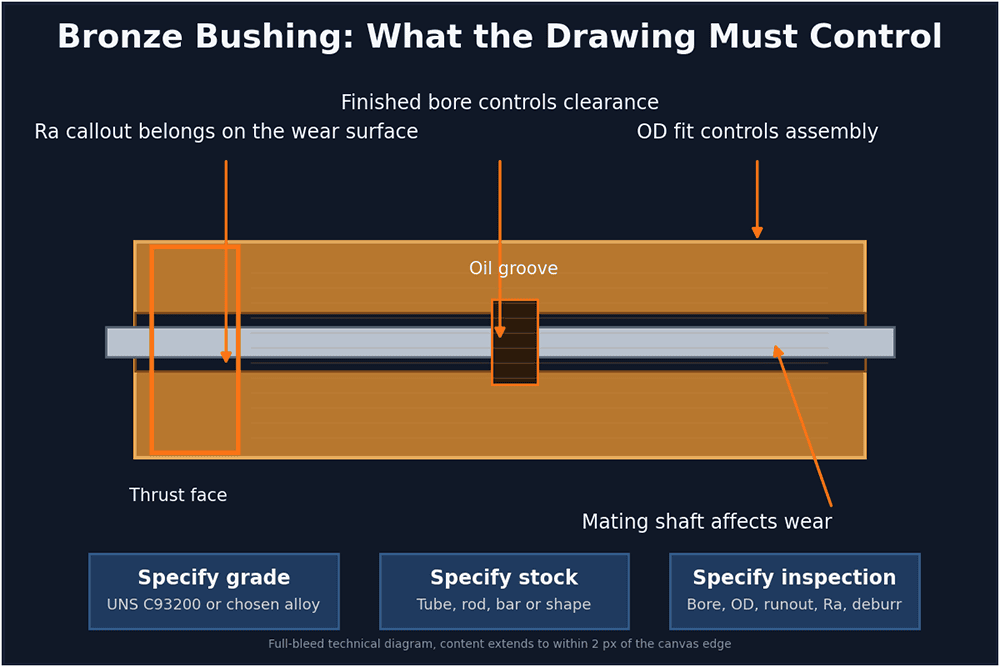
| Bushing ID | Bore size, roundness, finish, tool deflection | Call out the finished bore tolerance and inspection method. |
| Bushing OD | Press fit, concentricity, turning sequence | Define OD tolerance and relation to ID when load distribution matters. |
| Oil groove | Tool access, burrs, groove geometry | Dimension groove width, depth, edge condition, and deburring requirement. |
| Thin wall tube | Clamping distortion and boring pressure | Leave enough stock and avoid raw blanks that are too close to finished size. |
| Thrust face | Flatness and surface finish | Control the face only when it carries axial load or sealing contact. |
For round bronze parts with shoulders, collars, and bearing seats, the step turning guide for bronze shafts and shoulders is the more relevant companion than a generic material page. Before release, use CNC DFM design guidelines for bronze parts to check tool access, wall strength, setup count, and inspection risk.
6. ASTM B505 and Continuous Cast Bronze Stock
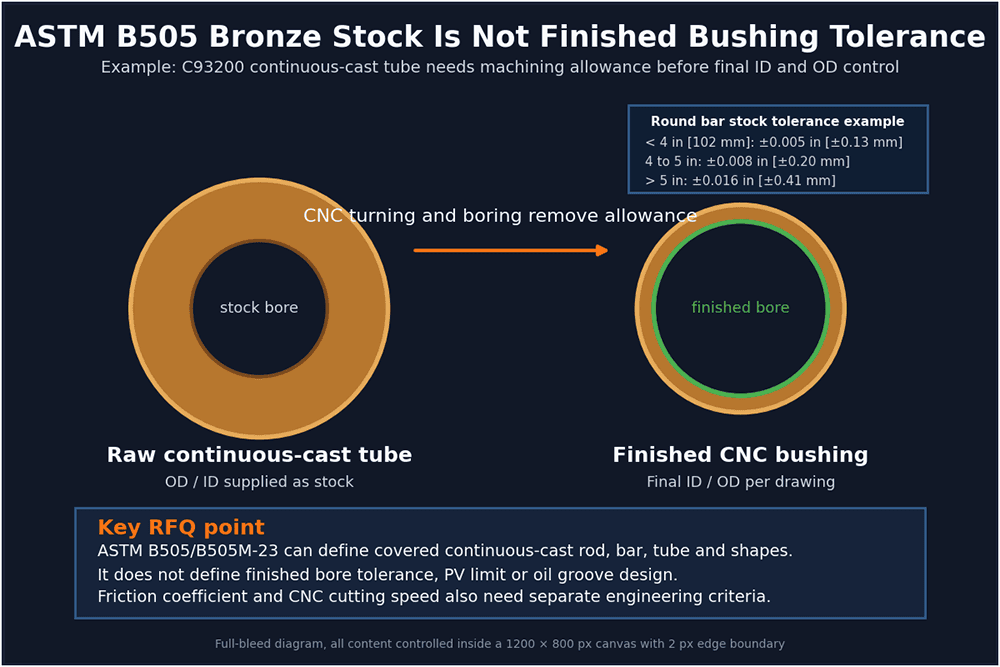
ASTM B505/B505M-23 matters because it covers copper-alloy continuous castings in rod, bar, tube, and shapes. It is directly relevant when the bronze blank is purchased as continuous-cast stock for CNC machining. It is not a universal bronze standard, and it is not a finished bushing design standard.
| ASTM B505/B505M-23 can support | ASTM B505/B505M-23 does not define |
| Covered continuous-cast copper alloy rod, bar, tube, and shapes | Finished bushing design |
| UNS grade identity such as C93200 | Friction coefficient or PV limit |
| Chemical composition limits | Lubrication groove design |
| Ordered mechanical testing requirements | Final CNC bore tolerance |
| Machining allowance and supplied stock dimensions | CNC cutting speeds and feeds |
| Batch definition, sampling, certification, and reports when ordered | Finished part surface roughness unless specified elsewhere |
The standard uses both SI and inch-pound units. The values are independent systems and should not be mixed to judge conformance. This matters when a metric drawing is quoted against inch-size tube stock. The purchase order needs to align dimensions, tolerance expectations, and inspection documents before material is cut.
For the general alloy group that includes C93200, the extracted summary lists ASTM B505/B505M-23 Table 5 diameter tolerance for round bar under 4 in. [102 mm] as ±0.005 in. [±0.13 mm]. Bars from 4 to 5 in. have ±0.008 in. [±0.20 mm], and bars above 5 in. have ±0.016 in. [±0.41 mm]. These are supplied stock tolerances, not finished CNC tolerances.
For tube stock, the buyer still has to check outside diameter, inside diameter, wall condition, and concentricity. Finished bushings need enough material for boring and turning. EPOC CRAFTER’s metal casting machining allowance for bronze blanks explains the wider problem: stock allowance is not the same as a finished machining tolerance.
7. Bronze vs Brass, Copper and Steel
Bronze, brass, copper, and steel can all appear in machined parts, but they solve different problems. Bronze is usually a wear and sliding-contact decision. Brass is often a machinability and cost decision. Copper is often a conductivity decision. Steel is often a strength, stiffness, and heat treatment decision. The final choice still needs the drawing, load case, fit, environment, quantity, and inspection plan.
| Comparison | Better choice when | Watch point |
| Bronze vs brass | Choose bronze for bushings, sleeve bearings, thrust washers, wear plates, and sliding contact. Choose brass for fittings, decorative parts, electrical hardware, and easy high-volume machining when bearing wear is not the main issue. | Do not substitute C360 brass for C93200 bearing bronze just because both machine well. |
| Bronze vs copper | Choose bronze when pure copper is too soft for the wear or load condition. Choose copper when electrical or thermal conductivity dominates the design. | Alloying usually improves hardness and wear behavior but reduces pure copper’s conductivity advantage. |
| Bronze vs steel | Choose bronze where sliding contact against steel, corrosion resistance, or anti-galling behavior is useful. Choose steel when strength, stiffness, cost, or heat treatment options dominate. | Bronze is not automatically stronger than steel. Shaft condition can control bushing life. |
| C93200 vs C95400 | Choose C93200 for common bearing bronze bushings and sleeve bearings. Consider C95400 aluminum bronze where higher strength or corrosion resistance is more important. | C95400 is not a drop-in upgrade for every C93200 part. Tooling, shaft wear, cost, and fit can change. |
For strength, density, and hardness screening across CNC metals, use the metal strength chart for CNC material comparison before the bronze grade is locked.
8. How to Specify Bronze Parts in an RFQ
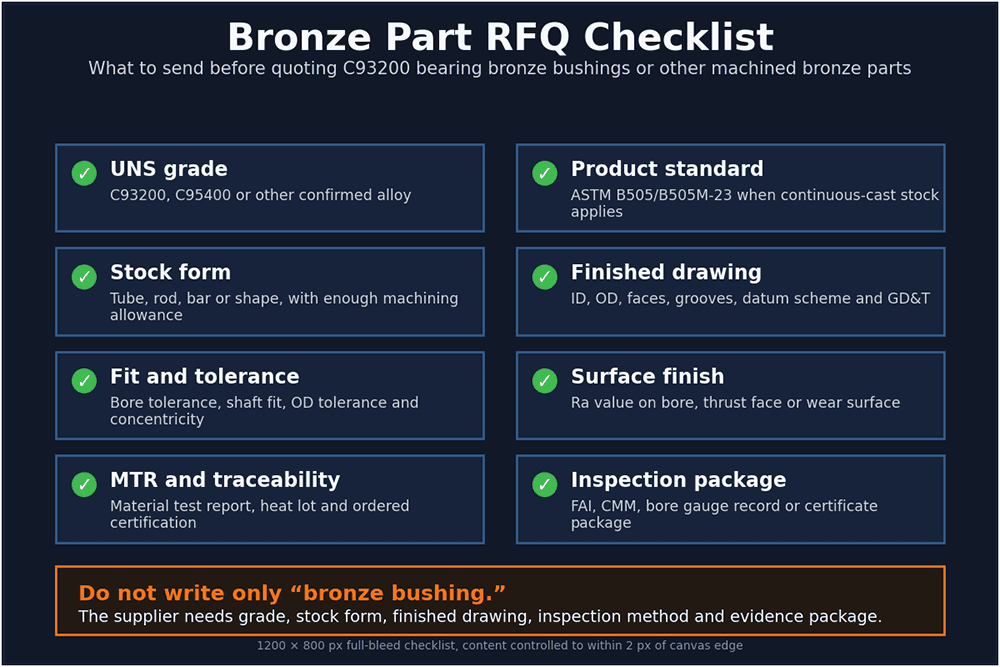
A bronze RFQ should tell the supplier what material to buy, what surfaces to machine, what evidence to deliver, and how the finished part will be inspected. “Bronze bushing, quote 100 pcs” leaves too much room for different assumptions.
| RFQ item | What to write | Why it matters |
| Grade | UNS C93200, C95400, or another confirmed grade | Prevents the supplier from choosing a convenient bronze substitute. |
| Product standard | ASTM B505/B505M-23 when continuous-cast rod, bar, tube, or shapes apply | Connects the purchase to a product form and acceptance basis. |
| Stock form | Continuous-cast tube, rod, bar, or shape | Stock form changes allowance, machining time, and cost. |
| Finished drawing | ID, OD, faces, grooves, holes, chamfers, datums, GD&T | The standard does not define final part geometry. |
| Fit and tolerance | Bore tolerance, shaft fit, OD tolerance, concentricity, roundness where needed | Fit controls assembly, running clearance, load distribution, and wear. |
| Surface finish | Ra value on bore, thrust face, seal face, or wear surface where needed | “Smooth” is not an inspection requirement. |
| MTR and traceability | Material test report, heat or lot traceability, certification requirements | ASTM B505 does not mean every report is automatically supplied unless ordered. |
| Inspection package | First article report, CMM report, bore gauge record, material certificate | Prevents disputes about what proof the supplier must deliver. |
A strong RFQ sentence can stay short: Machine bronze bushings from ASTM B505/B505M-23 UNS C93200 continuous-cast tube. MTR and heat or lot traceability required. Final ID, OD, concentricity, groove geometry, deburring, and Ra values per drawing. Provide first article inspection report before production release.
For RFQ structure, use EPOC CRAFTER’s CNC machining quote checklist for bronze RFQs. For traceability and audit evidence, the CNC supplier audit checks for material traceability guide explains why inspection deliverables should be defined before the quote is released. When the drawing, grade, and evidence package are ready, EPOC CRAFTER’s bronze CNC machining services page is the correct capability route.
9. FAQ
9.1 Is bronze a metal?
Yes. Bronze is a metal alloy, usually copper-based with tin or other alloying elements. In engineering purchasing, “bronze” should be followed by a grade such as C93200, C95400, or another UNS designation.
9.2 Is bronze an alloy?
Yes. Bronze is an alloy, not a pure metal. Alloying changes hardness, strength, corrosion behavior, machinability, and wear behavior compared with pure copper.
9.3 What is bronze used for?
Bronze is used for bushings, sleeve bearings, thrust washers, gears, wear plates, pump parts, valve parts, marine hardware, electrical contacts, springs, and decorative components. For CNC machined parts, bushings and wear components are among the most important engineering uses.
9.4 What bronze is used for bushings?
C93200 bearing bronze, also known as SAE 660 bronze, is a common choice for machined bushings and sleeve bearings. It is not the only choice. Load, speed, lubrication, shaft material, corrosion exposure, and drawing requirements still decide whether C93200, C95400, phosphor bronze, or another copper alloy is appropriate.
9.5 Can bronze be CNC machined?
Yes. Bronze can be CNC turned, bored, drilled, milled, grooved, and finished. The machining route depends on grade, stock form, wall thickness, feature depth, tolerance, surface finish, and quantity. ASTM B505/B505M-23 helps define covered stock, but it does not supply cutting speeds or finished part tolerances.
Ready to Quote Your CNC Prototype?
Upload your STEP file and get a DFM review + quote within 12 hours.
No tooling cost. Minimum 1 part.