

Dewey Wu General Manager & senior mechanical engineer at EPOC CRAFTER, 15 years in design engineering, quality, and metallurgy. Hands-on across CNC machining, metalwork, sheet metal, and prototyping (subtractive + 3D printing).
Steel for CNC machining is not one material choice. Carbon steel, alloy steel, stainless steel, and tool steel differ in steel composition, hardenability, corrosion behavior, steel machinability, heat treatment, and cost. For production parts, the grade name is only the start. You also need the product form, delivery condition, hardness or mechanical-property requirement, raw-stock tolerance, surface condition, and certification. ASTM A108-24 covers cold-finished carbon and alloy steel bar, while ASTM A276/A276M-25 covers stainless steel bars and shapes. This guide compares the steel grades most relevant to CNC steel parts, then shows how to specify steel bar stock, inspect critical features, and release a complete RFQ.
1. What Changes the Steel Choice for CNC Machining
For most buyers, the useful question is not “what is steel?” but which steel family, grade, and condition fit the part. The CNC machining material selection guide covers the wider metal-selection problem. Within steel, the main decision is narrower: match required strength and hardenability, corrosion exposure, geometry, heat-treatment route, inspection, and quantity to the stock you will actually machine.
The properties of steel cannot be read from the grade name alone. Steel properties change with product form and condition, and steel material properties used for design must match the applicable specification or verified test data. A generic steel hardness chart is especially risky because 4140 steel properties, 420 stainless steel hardness, and 440C stainless steel hardness depend on condition and heat treatment.
| Decision factor | What changes | Why it matters to machining or purchasing |
| Strength and hardenability | Carbon level, alloy content, section size, heat treatment | Determines whether a carbon steel grade is enough or an alloy steel route is justified. |
| Corrosion exposure | Stainless steel composition, service medium, surface condition | Can move the choice from carbon or alloy steel to corrosion resistant steel. |
| Geometry | Slender shafts, thin walls, deep pockets, fit features | Changes deflection, residual-stress sensitivity, setup count, and inspection effort. |
| Condition | Cold-finished, annealed, stress relieved, quenched and tempered, hardened | Changes steel machining behavior, hardness, remaining heat treatment, and finishing route. |
| Quantity | Prototype, pilot, low-volume, repeat production | Changes how strongly stock consistency, setup time, and cycle time affect total cost. |
| Evidence | MTR, hardness record, FAI, CMM, profilometer | Separates material identity from finished-part acceptance. |
2. Types of Steel and Steel Grades for CNC Parts
Among the main types of steel used for machined parts, carbon steel, alloy steel, stainless steel, and tool steel solve different problems. These steel types overlap in strength, but their chemistry and processing routes differ. A steel grades chart is useful only when it shows the condition and the decision boundary, not just a row of typical values.
2.1 What Is Carbon Steel?
Carbon steel uses carbon content as a primary grade distinction. The common types of carbon steel are low carbon steel, medium carbon steel, and high carbon steel. For CNC work, 1018 steel is a common low-carbon example and 1045 steel is a common medium-carbon example. Carbon steel composition, carbon steel properties, and the delivered condition all matter; no single value describes every carbon steel bar. The main carbon steel grades in this guide stay focused on CNC-relevant bar stock. Carbon steel vs stainless steel is mainly a corrosion and service-environment decision, not a simple strength ranking.
Carbon steel machining is attractive when the part does not need the hardenability of alloy steel or the corrosion resistance of stainless. For a focused grade decision, EPOC CRAFTER’s 4140, 1018, and 1045 steel comparison separates carbon steel vs alloy steel by chemistry, hardenability, and condition.
2.2 What Is Alloy Steel?
Alloy steel adds elements that change hardenability and heat-treatment response. Common alloy steel grades in CNC work include 4130 steel, 4140 steel, and 4340 steel. Most of these are low alloy steel rather than high alloy steel in the way engineers use those categories. If you ask what is low alloy steel, the practical answer is a steel whose intentional alloy additions improve behavior such as hardenability without moving it into stainless or other high-alloy families. Alloy steel composition is therefore part of the heat-treatment decision, while alloy steel properties still depend on product form and condition. For alloy steel vs carbon steel, hardenability is often the reason to move to the alloy route; for alloy steel vs stainless steel, corrosion exposure changes the decision.
Alloy steel machining depends strongly on condition. A 4140 alloy steel bar supplied annealed is a different machining problem from quenched-and-tempered stock. That is why 4140 hardness must be stated or verified when it affects the process. The same logic applies when comparing 4130 vs 4140 or 4140 vs 4340: choose against the required mechanical condition, not the grade number alone.
2.3 What Is Stainless Steel?
Stainless steel is a chromium-bearing family selected when corrosion behavior, cleaning, or the service environment matters. The main stainless steel types in ASTM A276/A276M-25 include austenitic stainless steel, ferritic stainless steel, martensitic stainless steel, and duplex stainless steel. These types of stainless steel include 300 series stainless steel grades such as 304 stainless steel, 304L, 316 stainless steel, and 316L stainless steel, plus 400 series stainless steel grades such as 410 stainless steel, 420 stainless steel, 430, and 440C stainless steel. Stainless steel properties must still be read by grade and condition rather than by family name alone.
Stainless steel composition should be tied to the service requirement. In the supplied ASTM A276/A276M-25 technical summary, 316 and 316L contain 2.00 to 3.00% Mo; 316L also limits carbon to 0.030% maximum. That chemistry does not prove that 316 works in every corrosive medium, and it does not prove that 316 is always harder to machine than 304. The detailed 316 vs 316L stainless steel guide covers the low-carbon distinction without treating it as a universal machinability claim.
2.4 What Is Tool Steel?
Tool steel is used when wear, tooling duty, or high hardness drives the part. Tool steel grades such as A2 tool steel and O1 tool steel belong to a different selection path from general carbon, alloy, and stainless grades. The types of tool steel and their heat-treatment routes deserve their own material guide; here they stay as a boundary category so they do not dilute the main CNC selection problem.
| Grade | Family | When it enters the shortlist | Decision boundary |
| 1018 steel | Low carbon steel | General pins, spacers, fixtures, shafts when deep hardening is not required | Specify form and condition; do not treat 1018 steel properties as one guaranteed value. |
| 1045 steel | Medium carbon steel | Shafts, journals, keyed components where more strength or wear capability is needed | Define cold-finished or other condition and any hardness requirement; 1045 steel properties vary with condition. |
| 4130 steel | Alloy steel | Parts needing alloy hardenability with moderate section demands | Define condition and heat-treatment route before quoting. |
| 4140 steel | Alloy steel | Loaded shafts and drive parts where controlled heat treatment matters | 4140 steel properties and 4140 hardness require a condition such as annealed or Q&T. |
| 4340 steel | Alloy steel | Higher-strength applications that justify the material and heat-treatment route | Use only when the mechanical requirement needs it; do not treat it as an automatic upgrade. |
| 303 stainless steel | Free-machining stainless | Production turning where stainless steel machinability is a major driver | Use the free-machining stainless procurement route; compare 303 vs 304 stainless steel against service requirements. |
| 304 stainless steel | Austenitic stainless steel | General corrosion-resistant machined parts | Select by environment and condition; do not infer a fixed cutting rate from ASTM A276. |
| 316 / 316L stainless steel | Austenitic stainless steel | Chloride or process environments where the specified chemistry is required | For 304 vs 316 stainless steel and 316 vs 316L, separate corrosion need from machining assumptions. |
| 410 / 420 stainless steel | Martensitic stainless steel | Hardenable stainless parts needing strength or wear resistance | Condition and heat treatment control hardness and machining risk. |
| 440C stainless steel | Martensitic stainless steel | High-hardness wear-related parts where its chemistry is justified | Separate annealed machining condition from final hardened condition. |
For a broader cross-material view, the metal strength chart for CNC materials is useful only when each grade is tied to a stated condition. That is the correct way to compare high strength steel, wear resistant steel, and general steel material options without pretending that one number represents every condition.
3. Machinability of Steel: Grade, Condition, Hardness, and Stock
The machinability of steel depends on more than chemistry. Steel machinability changes with hardness, prior cold work, heat treated steel condition, stock geometry, surface state, tool engagement, and how much material is removed. Machining steel successfully therefore starts with a complete material callout rather than a grade-only assumption.
3.1 Cold Finished Steel, Cold Rolled Steel, and Hot Rolled Steel
ASTM A108-24 covers cold finished steel bar for carbon and alloy grades. A cold finished steel bar can be cold drawn, turned, ground, polished, or supplied through combinations recognized by the specification. Cold rolled steel is one cold-finishing route for some shapes, but it is not a synonym for every cold-finished product. Hot rolled steel belongs to a different product condition and specification path.
The practical hot rolled vs cold rolled steel question is whether the starting size, straightness, surface, scale, and cleanup allowance change the process enough to justify the stock choice. For near-net steel bar stock, a better-defined starting condition can reduce roughing or setup variation. For a heavily machined block, the premium may add little value.
3.2 Steel Hardness and Steel Heat Treatment
Steel hardness must be tied to grade and condition. ASTM A108-24 recognizes conditions including annealed, normalized, stress relieved, quenched and tempered, and induction hardened. For 4140 alloy steel, the order should state the applicable condition because grade alone does not define hardness or machining risk. The steel heat treatment before or after CNC machining guide covers the process-sequence decision in more depth.
Avoid using a generic steel hardness chart as a purchasing specification. It can hide the difference between as-supplied stock, a heat-treatment response test, and finished-part hardness. Where hardness changes tool wear, grinding allowance, or final performance, put the requirement on the drawing or PO and define how it will be verified.
3.3 Stainless Steel Machining and Work Hardening
Stainless steel CNC machining needs the same separation between material specification and cutting process. ASTM A276/A276M-25 does not supply cutting speed, feed, chipbreaker, coolant strategy, tool life, or work-hardening rate. Stainless steel machining data must come from validated tooling guidance or shop records. When machining stainless steel, avoid rubbing and unstable engagement that can aggravate steel work hardening, especially in austenitic grades.
Free machining steel and free-machining stainless grades can improve chip control, but the exact grade and application still matter. 303 stainless steel may be attractive when machining rate is a major requirement, while 304 or 316 may be preferred when the service environment or material specification controls the decision. That is why “best stainless steel for machining” has no context-free answer.
4. ASTM A108 vs ASTM A276: How to Specify Steel Bar Stock
Material identity, product specification, incoming stock, and finished-part requirements should be separate lines of thought. ASTM A108-24 is the baseline used here for cold-finished carbon steel bar and alloy steel bar. ASTM A276/A276M-25 is the baseline for ordinary stainless steel bar and shapes. ASTM A582/A582M is the separate free-machining stainless bar family used for grades such as 303 and 416.
| Specification | Product scope used here | What the RFQ still needs |
| ASTM A108-24 | Cold-finished carbon and alloy steel bars | Grade, condition, shape, size, length, finish, tolerance level, heat treatment, certification/testing. |
| ASTM A276/A276M-25 | Stainless steel bars and shapes | Grade/type, UNS, product form, hot/cold-finished state, condition, size, length, A484/A484M tolerances, MTR/certification. |
| ASTM A582/A582M | Free-machining stainless steel bars | Use when the selected free-machining stainless grade falls under this product family; do not force it into A276. |
ASTM A108-24 ordering information can include the material name, cold-finish method, specification and edition, grade or chemistry, surface condition, tolerance level, shape, size, length, heat analysis report, end use, and supplementary requirements. It does not define CNC cutting parameters or finished-part GD&T.
For stainless bar, ASTM A276/A276M-25 works with ASTM A484/A484M for general dimensions, length, straightness, and surface requirements. Raw-stock tolerance is not finished-part tolerance. A stainless steel bar can meet its material delivery requirements while the finished bore, shaft, or position tolerance is controlled separately by the drawing.
An MTR should be requested when grade, heat or lot identity, chemistry, reported mechanical properties, supply condition, or traceability are part of acceptance. Do not assume certification is included unless the order requires it.
5. Tolerances, Surface Finish, Inspection, and a 1045 Shaft Case
Once the material is selected, the drawing and inspection plan take over. The CNC tolerance and standards guide separates general tolerances from feature-specific controls. For steel parts, raw-stock diameter and straightness help process planning; finished journal size, runout, hole position, and surface roughness decide whether the part passes.
Steel surface finish also needs two meanings kept apart. The incoming steel bar surface can be cold drawn, turned, ground, or polished. The finished CNC surface is controlled by the drawing, such as a bearing journal with a specified Ra value. Post-machining finishing is a third layer because black oxide, plating, passivation, or another process can change the final acceptance state.
When a coating or conversion finish can affect a fit or exposed surface, the steel surface finishing and corrosion protection options should be reviewed with the drawing so the acceptance condition is clear.
5.1 Real Production Evidence: AISI 1045 Shaft
EPOC CRAFTER internal project STL-CNC-0925-A was a 320-piece industrial-automation locating and drive shaft. The finished envelope was Ø42 × 168 mm with two precision journals, an M20 × 1.5 external thread, a 6 mm keyway, and an Ø8 H7 cross-hole. AISI 1045 cold-finished carbon steel was selected. AISI 4140 Q&T was reviewed but rejected because the specified load case did not need the additional hardenability or strength and the higher material and machining cost was not justified.
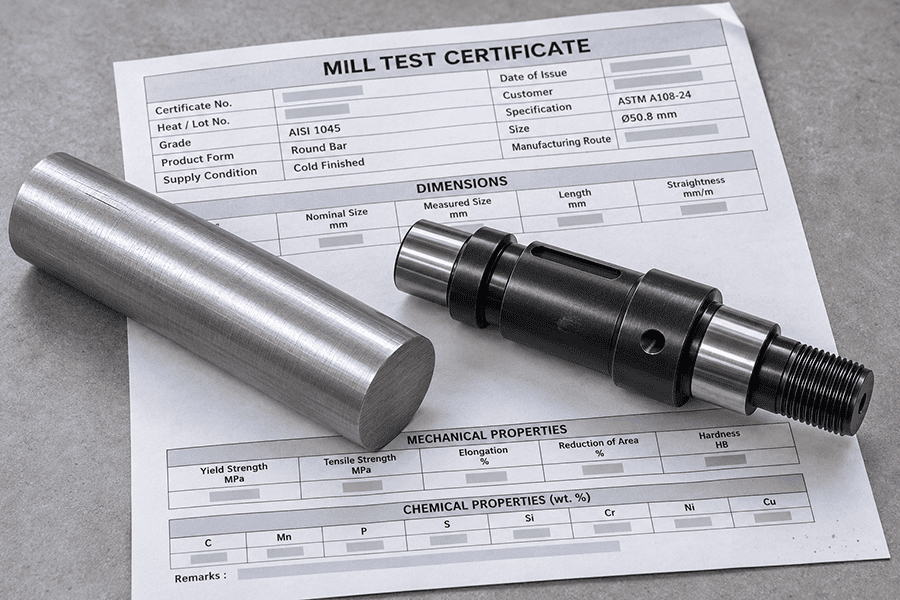
The incoming callout was tightened from generic “1045 steel” to AISI 1045 cold-finished round bar to ASTM A108-24 with an incoming hardness requirement of 170 to 210 HBW. The Ø50.8 mm stock was accepted at Ø50.74 to 50.82 mm, with project straightness limited to 0.45 mm over 1 m. Representative hardness checks were 187, 191, and 194 HBW.
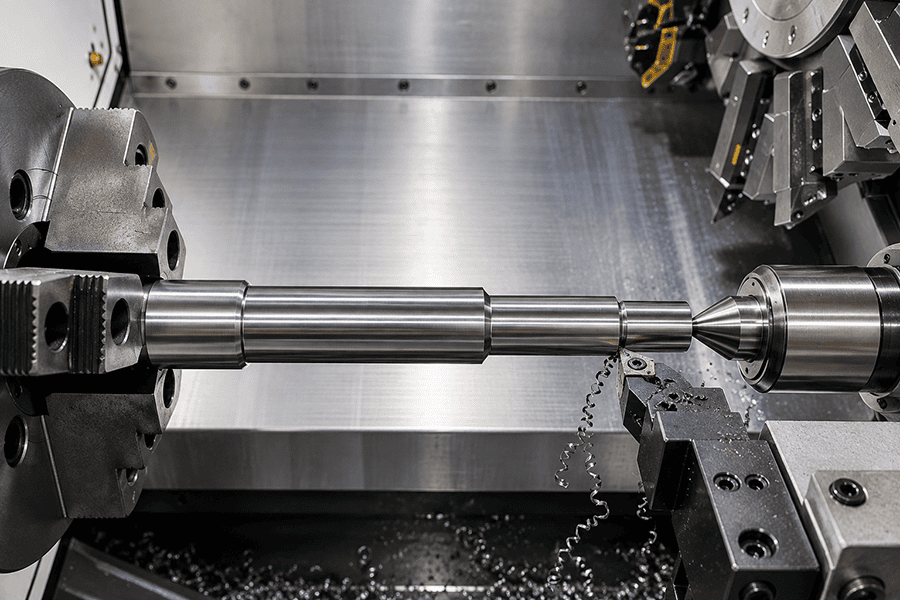
The pilot finish-turning trial produced journal taper up to 0.021 mm with intermittent chatter and chip wrapping. Tailstock support, a fresh CVD-coated finishing insert, a 0.15 mm radial finish pass, 0.10 mm/rev journal feed, and a programmed chip-break retract reduced journal taper to 0.007 mm or less. These are internal process values from this part, not universal 1045 cutting recommendations.
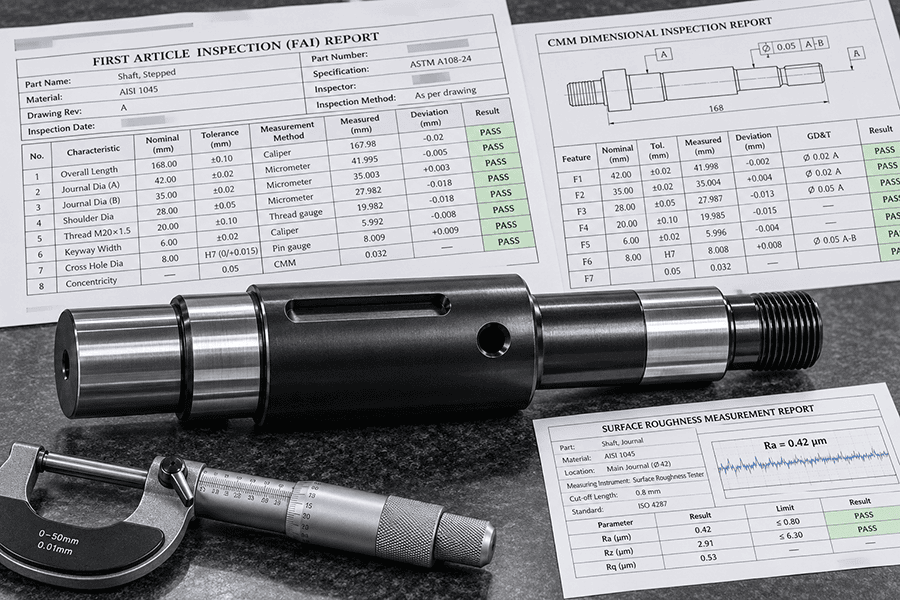
| CTQ | Requirement | FAI result | Inspection |
| Bearing journal | Ø25 h6, 25.000 / 0.000 to -0.013 mm; total runout ≤0.020 mm | 24.993 to 24.997 mm; runout 0.012 mm | 0.001 mm micrometer + CMM |
| Cross-hole | Ø8 H7, 8.000 to 8.015 mm; true position Ø0.050 mm to A|B | 8.009 mm; position Ø0.031 mm | Air gauge + CMM |
| Keyway | 6.000 +0.030/0.000 mm; symmetry 0.040 mm | 6.018 mm; symmetry error 0.022 mm | Blade micrometer/gauge blocks + CMM |
| Journal roughness | Ra ≤0.8 µm | Ra 0.48 to 0.63 µm across five sampled parts | Contact profilometer, 0.8 mm cutoff |
After the process correction, the average machine cycle was 14.8 min/part versus 16.9 min/part in the pilot. The clarified cold-finished condition raised raw-stock cost by $0.74/part versus the initial hot-rolled quote, but reduced machining time by 2.1 min/part and eliminated scale-removal handling. The project recorded a net manufacturing cost reduction of $1.86/part. These figures apply only to this 320-piece lot.
6. Selection Scenarios: Shafts, Gears, Corrosion, Wear, and Volume
Application labels help only when they identify the requirement that changes the material. Steel for shafts is often driven by straightness, journal wear, runout, and heat-treatment need. Steel for gears is more likely to be driven by hardenability, tooth loading, final hardness, and post-heat-treatment finishing.
For thin walls, deep pockets, or datum-sensitive features, the CNC DFM design guidelines help separate material choice from geometry-driven cost and distortion risk.
| Part scenario | Material direction | What must be controlled |
| Precision shaft | 1018 or 1045 when carbon steel meets the load; 4140 when hardenability or a defined Q&T condition is required | Straightness, delivery condition, hardness, journal finish, runout. |
| Gear or drive component | Alloy steel when the heat-treatment route and section performance justify it | Final hardness, machining before/after heat treatment, finishing allowance, inspection. |
| Corrosion-exposed part | Stainless steel grades selected against the actual medium and service condition | Do not use “stainless” as a complete callout; define grade, condition, finish, and any passivation requirement. |
| Wear-related part | Wear resistant steel or hardenable stainless when wear and hardness drive function | Separate machining condition from final hardened condition. |
| Low-volume build | Use an available, well-defined grade and stock form that minimizes total route risk | Material minimums, setup, heat treatment, certification, FAI, and finish can dominate raw stock price. |
In low-volume CNC production, the cheapest raw stock is not automatically the lowest-cost route because setup, inspection, heat-treatment minimums, and material consistency can dominate a short or medium batch.
7. CNC Steel RFQ Checklist
A complete RFQ gives the supplier enough information to buy the right stock, plan the process, and define acceptance without guessing. Use the following checklist for carbon steel, alloy steel, stainless steel, or tool steel parts.
| RFQ field | What to define |
| Material identity | Exact grade/type plus UNS, SAE, or AISI designation where applicable. |
| Product specification | Applicable standard and edition, such as ASTM A108-24 or ASTM A276/A276M-25. |
| Product form | Round, flat, hex, square, shape, or other defined stock form. |
| Starting size and length | State when stock size affects cleanup, workholding, material yield, or quote. |
| Delivery condition | Cold-finished, annealed, stress relieved, Q&T, hardened, or other applicable state. |
| Hardness / mechanical property | Specify only when it affects acceptance; define the required range or property. |
| Raw-stock requirements | Size, straightness, roundness, surface condition, or tolerance level when functionally relevant. |
| Heat-treatment route | Before machining, after roughing, prehardened, local hardening, or other defined sequence. |
| MTR / traceability | State whether certification, heat/lot identity, chemistry, or reported mechanical results are required. |
| Finished drawing | Released revision with dimensions, GD&T, threads, hole fits, keyways, and surface finish. |
| CTQs | Identify the few features that control fit, motion, sealing, alignment, or function. |
| Inspection | FAI, CMM, hardness, profilometer, gauges, sampling, or final report as required. |
| Finishing | Black oxide, passivation, plating, coating, protective oil, or none; define acceptance state if dimensions can change. |
| Quantity | Prototype, pilot, low-volume, or repeat production. |
When the drawing is ready, EPOC CRAFTER’s CNC machining capabilities provide the process context for turning, milling, inspection, and low-volume production. The useful handoff is the complete material and drawing package, not a note that says only “4140 steel” or “stainless steel.”
8. Frequently Asked Questions
8.1 What Is Steel, and What Are Steel Grades?
Steel is an iron-based material family whose behavior is controlled by carbon, alloying elements, processing, and condition. Steel grades identify a defined chemistry or grade designation, but the grade is not the complete purchase specification. For CNC work, pair the grade with product form, condition, hardness or mechanical-property requirement when needed, and the applicable stock standard.
8.2 What Is the Best Steel for Machining?
There is no single best steel for machining. 1018 or 1045 may suit general carbon steel machining; 4140 may be justified when hardenability or a defined heat-treated condition matters; stainless may be required by corrosion exposure. Choose the grade against load, service environment, heat treatment, geometry, tolerance, inspection, and quantity.
8.3 What Is the Best Stainless Steel for Machining?
There is no universal best stainless steel for machining. 303 stainless steel is relevant when free-machining behavior is a primary requirement, but 304 or 316 may be required by the service environment or product specification. Stainless steel machinability should not override corrosion, mechanical, or compliance requirements.
8.4 1018 vs 1045: Which Fits a CNC Part?
Use 1018 when low carbon steel properties are adequate and deep hardening is unnecessary. Use 1045 when the part needs more carbon-driven strength or wear capability without moving to an alloy steel route. The delivered condition still matters, so 1018 vs 1045 is not a substitute for a complete stock callout.
8.5 304 vs 316 Stainless Steel, and 316 vs 316L: What Changes?
In the supplied ASTM A276/A276M-25 data, 316 adds 2.00 to 3.00% Mo, while 316L also limits carbon to 0.030% maximum. 304 vs 316 stainless steel is therefore primarily a chemistry and service-environment decision, while 316 vs 316L adds the low-carbon requirement. Neither comparison creates a universal CNC cutting-speed rule.
8.6 Hot Rolled vs Cold Rolled Steel: Which Is Better for CNC?
Neither is always better. Hot rolled vs cold rolled steel should be decided by starting tolerance, straightness, surface condition, scale, machining allowance, availability, and total cost. For near-net shafts, cold finished steel can reduce cleanup and setup variation. For parts that remove most of the stock, a tighter starting condition may not repay its premium.
Release the Material Callout Before You Release the Quote
A grade name gets you into the right material family. A production-ready steel specification adds the product standard, stock form, condition, hardness or mechanical-property requirement where needed, certification, and the drawing that controls the finished part. That is the information a supplier can quote, machine, and inspect without guessing.
Ready to Quote Your CNC Prototype?
Upload your STEP file and get a DFM review + quote within 12 hours.
No tooling cost. Minimum 1 part.