

Dewey Wu General Manager & senior mechanical engineer at EPOC CRAFTER, 15 years in design engineering, quality, and metallurgy. Hands-on across CNC machining, metalwork, sheet metal, and prototyping (subtractive + 3D printing).
Annealing changes a metal’s condition through controlled heating, holding, and cooling. The exact annealing process depends on alloy, starting condition, and the property you need next. For CNC work, the first decision is whether you need a softening heat treatment, such as full annealing or process annealing, or a separate stress relief heat treatment intended to reduce residual stress with limited change to the existing metallurgical condition.
SAE AMS2759G treats annealing, subcritical annealing, normalizing, hardening, and stress relieving as different operations. SAE AMS2759/11B is the current steel stress relief specification, while SAE AMS2770R covers heat treatment of wrought aluminum alloy parts. A drawing or purchase order therefore needs the alloy, current condition, required process, final condition, and applicable heat treatment specification. A generic note such as “anneal per AMS2759” does not define a complete cycle.
For the broader sequencing decision, the published EPOC CRAFTER guide on heat treatment before or after CNC machining explains where AMS2759G ends and the machining process plan begins.
1. What Annealing Changes in Metal
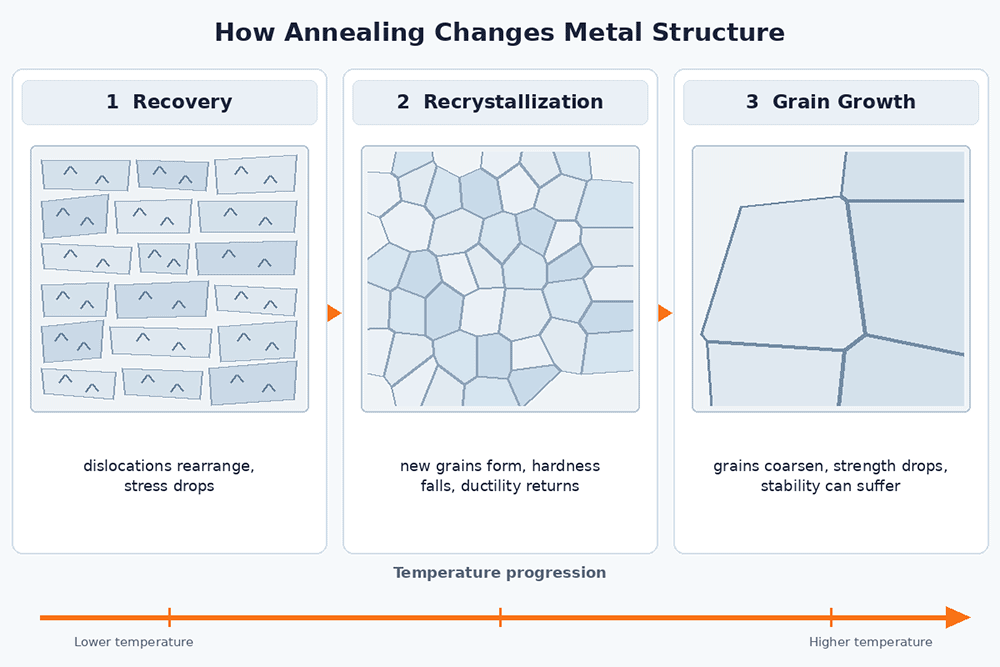
A practical annealing definition is controlled thermal processing used to soften material, restore ductility, alter microstructure, or prepare a part for a later manufacturing step. How does annealing work? Heating gives the microstructure enough mobility for recovery and, when the cycle reaches the required condition for that alloy, recrystallization. Further exposure can permit grain growth. The effect of annealing therefore depends on temperature, annealing time, prior cold work, alloy chemistry, and cooling.
For cold work annealing or work hardening annealing, the manufacturing objective is usually to recover formability or machinability lost during deformation. Recovery lowers stored strain energy before new grains form. Recrystallization annealing replaces deformed grains with new strain free grains. Excessive thermal exposure can coarsen the grain structure, which is why a grain structure annealing discussion is incomplete without the actual alloy and condition.
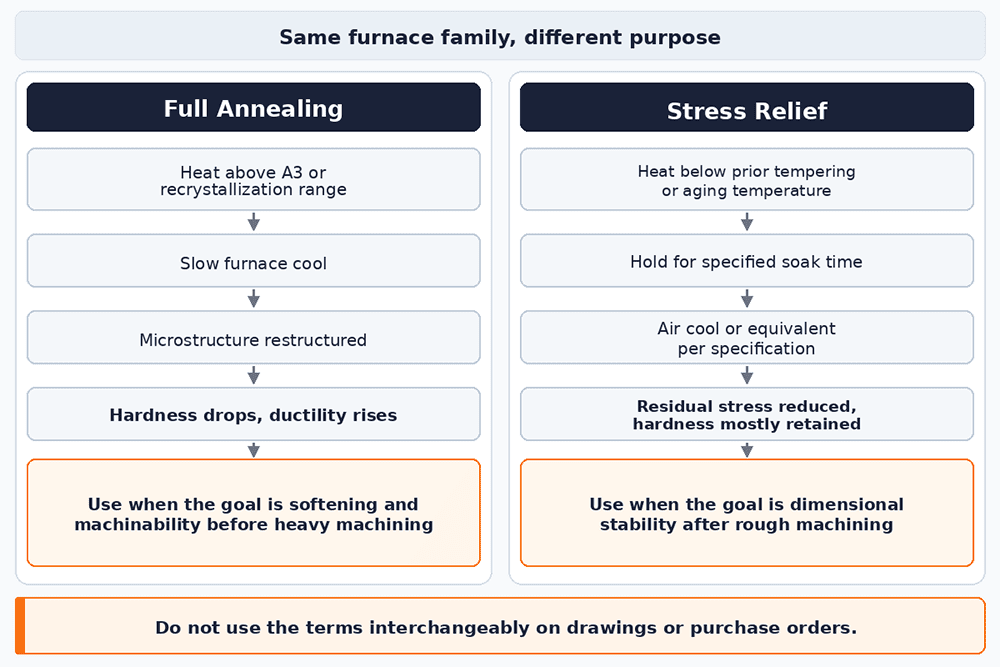
Annealing hardness usually moves downward when the treatment is intended to soften the material, while annealing ductility moves upward. That statement does not make every low temperature stress relief cycle an anneal. Under AMS2759G and AMS2759/11B, thermal stress relief is a separate operation for steel parts.
2. Types of Annealing and the Production Problem Each One Solves
Different types of heat treatment solve different manufacturing problems. Full annealing targets substantial softening and a changed metallurgical condition. Process annealing and subcritical annealing are used below a transformation range when full softening is not required. Isothermal annealing controls transformation through a hold at an intermediate temperature. Bright annealing uses a controlled atmosphere to limit surface oxidation, while vacuum annealing uses a vacuum environment when surface chemistry or contamination control matters. Solution annealing is a different treatment family used to dissolve phases or precipitates before the required cooling or aging route.
The terms are not interchangeable. A heat treater needs the exact process name and governing specification, not a broad request for an annealing heat treatment. An annealing furnace also needs the required pyrometry, atmosphere, load arrangement, and soak logic for the specification in use.
| Term | Manufacturing intent | Decision boundary |
| Full annealing | Softening and metallurgical reset before later forming or machining | Use the alloy specific specification for the cycle. AMS2759G does not give one universal steel annealing temperature. |
| Process annealing / subcritical annealing | Restore ductility or reduce work hardening without a full transformation route | Do not assume it is equivalent to AMS2759/11B stress relief. |
| Isothermal annealing | Control transformation through an intermediate temperature hold | Cycle is alloy specific. |
| Bright annealing | Limit oxidation during the selected annealing cycle | Atmosphere control is part of the process definition. |
| Vacuum annealing | Limit oxidation or contamination when the material and specification permit vacuum processing | Vacuum equipment does not replace the material specific temperature and time requirements. |
| Solution annealing | Place alloying constituents back into solution before the required cooling or aging route | Do not substitute solution treatment data for a softening anneal or stress relief. |
Material searches need the same boundary. Annealing steel, annealing carbon steel, annealing 4140, and annealing tool steel all require the steel grade and its current condition before a cycle can be selected. Annealing aluminum and annealing 6061 must follow the wrought aluminum rules when AMS2770R applies. Annealing stainless steel may mean solution treatment or stress relief, which are not the same operation. Annealing copper, annealing brass, annealing titanium, and annealing cast iron require their own material specifications; the steel and wrought aluminum values in this article must not be transferred to those materials.
The same rule applies to application searches such as annealing wire, annealing sheet metal, annealing welding, and post weld stress relief. Product form and manufacturing history change the specification path. A wire drawing route, a formed sheet, and a welded assembly should not inherit a CNC steel cycle simply because all three involve heat treatment metals.
3. Annealing vs Stress Relieving, Tempering, Normalizing, and Quenching
Annealing vs stress relieving is the distinction that matters most for this article. AMS2759G lists the operations separately, and AMS2759/11B defines thermal stress relief for steel parts as a treatment used to reduce residual stresses, improve dimensional stability, and decrease warpage during subsequent machining. It does not define stress relief as full annealing, and it does not claim complete removal of residual stress.
| Comparison | Annealing side | Other treatment side | Drawing / RFQ implication |
| Stress relief vs annealing | Softening or microstructural change may be the objective | Stress relief targets residual stress reduction while retaining the required prior condition | Name the exact operation and the applicable specification. |
| Annealing vs tempering | Annealing moves material toward a softer or more ductile condition | Tempering follows hardening and adjusts hardness and toughness | Do not use the terms as substitutes. |
| Normalizing vs annealing | Annealing uses the cycle specified for the alloy and target condition | Normalizing is a separate steel heat treatment category under AMS2759G | The applicable slash specification and material requirement control the cycle. |
| Annealing vs quenching | Annealing may include slow or controlled cooling when required by the material specification | Quenching is a rapid cooling step used in hardening or solution treatment routes | Cooling method must come from the governing specification. |
Hardening and tempering should also stay separate from annealing. For a quenched and tempered steel part, AMS2759/11B restricts the stress relief temperature relative to the prior tempering temperature. For precipitation hardened or maraging steel in an age hardened condition, the stress relief temperature is restricted relative to the prior aging temperature. That is why a stress relief temperature cannot be copied from a generic chart.
4. Annealing Temperature and Time: Steel and Wrought Aluminum
There is no universal annealing temperature steel shops can apply to every grade. AMS2759G is a general requirements document. The applicable slash specification, material requirement, and purchase order set the actual steel cycle. AMS2759/11B does provide stress relief temperature limits by material class and condition, and those values are set points.
| Steel material and condition | AMS2759/11B stress relief temperature rule |
| Carbon or low alloy steel, annealed or normalized | 537°C to 677°C |
| Carbon or low alloy steel, quenched and tempered | At least 28°C below the prior tempering temperature |
| Carbon or low alloy steel, post nitrided | 163°C to 427°C, and at least 56°C below the nitriding temperature |
| Tool steel, unhardened | 537°C to 677°C |
| Tool steel, quenched and tempered | At least 28°C below the prior tempering temperature |
| PH corrosion resistant or maraging steel, age hardened | At least 55°C below the aging temperature |
| Austenitic corrosion resistant steel, Cycle 1 | 899°C. Maximum stress relief; not for dimensional stabilization |
| Austenitic corrosion resistant steel, Cycle 2 | 371°C. May be used to improve dimensional stability |
| Martensitic corrosion resistant steel, quenched and tempered | At least 28°C below the prior tempering temperature |
Annealing time and stress relief soak time are not universal either. Under AMS2759/11B, minimum soak depends on temperature, sensor method, and the heaviest section. With a working sensor, the minimum is 2 h at or below 650°F and 1 h above 650°F. With a load sensor, the minimum is 1 h at or below 650°F and 0.5 h above 650°F. Those minimums apply through 25.4 mm thickness; each additional 12.7 mm adds 0.5 h.
4.1 Annealing Aluminum Under AMS2770R
AMS2770R covers wrought aluminum alloy parts and distinguishes full annealing from partial annealing. For 6061, 2024, 7075, and the other listed wrought alloys, the annealing cycle comes from Table 8 and its notes. The specification also draws a hard boundary around already solution treated or aged parts: Table 8 partial annealing temperatures must not be used to relieve residual stress in parts already in states such as T4, T6, or T7 when the treatment would change the target temper properties.
| Alloy family | Full annealing under AMS2770R | Partial annealing / stress relief boundary |
| 1100 and 5052 | 332°C to 349°C, minimum 0.5 h, air cool | Same listed temperature range and minimum time where applicable |
| 3003 | 382°C to 410°C, minimum 0.5 h, air cool | No separate partial annealing line in Table 8 |
| 2000 series | 399°C to 427°C, minimum 1 h, controlled furnace cooling per Table 8 notes | 332°C to 349°C, minimum 0.5 h, but not for already solution treated or aged parts when used to relieve residual stress |
| 6000 series, including 6061 | 399°C to 427°C, minimum 1 h, controlled furnace cooling per Table 8 notes | 332°C to 349°C, minimum 0.5 h, with the same restriction on already treated or aged parts |
| 7000 series, including 7075 | 399°C to 427°C, minimum 2 h, controlled furnace cooling per Table 8 notes | 332°C to 349°C, minimum 2 h, with the same restriction on already treated or aged parts |
For thickness above 13 mm, AMS2770R Table 8 adds 0.5 h for each additional 13 mm or fraction. Furnace cooling, air cooling, and any other cooling rate annealing requirement must follow the applicable table notes rather than a generic shop rule.

5. Where Annealing Fits Before and After Machining
The useful manufacturing question is where the heat treatment process belongs in the CNC route. Annealing before machining can lower hardness or restore ductility when the incoming condition is too hard or too heavily cold worked for efficient roughing. Heat treatment before machining is therefore a material condition decision, not a universal first step.
For grade selection around this decision, the published 4140 vs 1018 vs 1045 steel guide separates stock condition, hardness, and machining implications instead of treating the grade name as a complete material state.
5.1 Between Rough Machining and Finish Machining
For parts that move after heavy stock removal, stress relief between roughing and finishing can be the most useful route. Roughing changes the stress balance inside the blank. Once the clamps are released, residual stress can show up as machining distortion or machining warpage. A properly specified stress relief steel cycle allows more of that movement to occur before the final datums and critical features are cut.
AMS2759/11B supports the reason for this sequence, but it does not prescribe a CNC machining allowance, a re datum method, or a guaranteed final flatness. Those are engineering decisions. For dimensional stability machining, leave only the stock that your geometry and measured first batch movement justify, then re establish the datum structure before the final cut.
This is also where tight tolerance machining matters. Heat treatment distortion must be evaluated against the final acceptance condition for flatness, parallelism, position, or size, not against a vague requirement to “hold tolerance.”
5.2 EPOC CRAFTER Case: 4140 Fixture Base
A 24 piece batch of AISI 4140 automation fixture bases measured 320 × 180 × 38 mm. Incoming stock was quenched and tempered to 28 to 32 HRC. The drawing required datum A flatness of 0.05 mm and opposite face parallelism of 0.06 mm, with a 5.0 mm pocket floor over a 240 × 110 mm pocket. After rough machining and unclamping, maximum bow across the 285 mm datum span reached 0.17 mm.
The documented intermediate treatment was a subcritical stress relief at a 565°C set temperature. Soak time was 2.0 h after the load reached set temperature. Parts were furnace cooled to 315°C, then still air cooled to room temperature. After stress relief, datum A was skimmed by 0.20 to 0.30 mm, datums B and C were re established, and the remaining features were finish machined.
| Measurement | Before stress relief | After stress relief and finish machining |
| Bow / flatness across 285 mm datum span | 0.17 mm maximum bow after rough machining | 0.028 mm flatness on datum A |
| Parallelism | Not measured in rough state | 0.041 mm |
| Hardness | 29.4 HRC average; range 29.0 to 29.8 HRC | 29.0 HRC average; range 28.6 to 29.4 HRC |
| Datum face surface finish | Not measured in rough state | Ra 0.9 to 1.1 μm |
| Warpage rejection | 4 of 24 in the prior comparable run without intermediate stress relief | 0 of 24 in this run |
These are batch results, not universal performance claims. The case form does not state the original tempering temperature, so the 565°C cycle must be checked against the actual prior tempering record before anyone claims compliance with the AMS2759/11B requirement for quenched and tempered steel. The measurable result from this run is narrower: final flatness was 0.028 mm, hardness changed from 29.4 to 29.0 HRC on average, and all 24 parts passed final dimensional inspection.a

5.3 Stress Relief After Machining
Stress relief after machining can be appropriate when a later grinding, EDM, plating, or chemical process is the real final sizing or service critical step. The risk is that a thermal cycle after final CNC dimensions may move the part. Any stress relief after machining therefore needs a defined final acceptance state and a plan for features that may require re inspection or post treatment sizing.
Use the published tolerances and GD&T standards resource to keep flatness, parallelism, position, and size requirements tied to the actual inspection method.
6. Verification, Furnace Control, and Heat Treatment Certification
Hardness testing after heat treatment is only one part of verification. AMS2759G points to ASTM A370, E10, E18, E384, and E110 as applicable methods, with the actual hardness requirement coming from the slash specification or purchase order. For specified intermediate operations such as annealing or normalizing, Table 2 uses one part per batch as the usual inspection frequency. Final thermal operations generally require every part unless an authorized statistical sampling plan applies.
Surface condition also matters. Steel parts heated above 677°C require the surface contamination controls and evaluation described by AMS2759G. Type 1 and Type 2 classification depends on how much material will be removed after heat treatment. The 0.51 mm threshold is a surface control classification, not a recommended machining allowance.
Furnace control is part of the specification chain. AMS2759G ties steel heat treatment equipment to AMS2750 and requires Class 5 or better furnaces for annealing, subcritical annealing, normalizing, hardening austenitizing, solution treatment, and stress relieving unless a detailed specification says otherwise. Soak start depends on the sensor configuration, which is why annealing cycle records should identify the actual measurement basis instead of listing only the furnace set point.
Heat treatment certification should trace the load to the order, part identification, alloy, condition, process control number, and applicable specification. AMS2759G requires production, test, and inspection records to be retained for at least five years unless the purchaser requires a different period. For outsourced heat treatment CNC parts, the machining supplier and heat treater need the same revision of the drawing and purchase order.
For parts that combine thermal processing with multiple setups, use the DFM design guidelines to review wall thickness, feature access, stock condition, and datum strategy before the first roughing operation.
The CNC machining services page describes the machining and inspection route when heat treatment is one operation inside a wider manufacturing plan.
7. Specification Mistakes That Cause Scrap or Rework
The first mistake is writing stress relief annealing as though it were a single standardized process. Stress relief vs annealing has to be resolved before the furnace cycle is released. AMS2759/11B covers steel stress relief, not a complete steel annealing schedule.
The second mistake is applying a single temperature to every steel. Carbon and low alloy steel, tool steel, precipitation hardening steel, austenitic stainless, and martensitic stainless have different rules, and the starting condition changes those rules again. A universal 600°C stress relief temperature is not supported by AMS2759/11B.
The third mistake is treating partial annealing as a repair route for an already aged aluminum part. AMS2770R does not let a 6061 T6 or 7075 T6 part use the Table 8 partial annealing route simply to remove residual stress when that heat exposure changes the required temper properties.
The fourth mistake is assuming the furnace can guarantee zero movement. Standards require process control and part support, but they do not publish a universal distortion allowance or a guaranteed final flatness. The machining plan still has to account for heat treatment distortion, measurement uncertainty, and the feature that actually controls function.
For material selection before this point, the CNC machining materials guide helps separate grade, stock condition, machinability, and total part cost.
8. Frequently Asked Questions
What is annealing, and why is annealing done?
Annealing is controlled heating, holding, and cooling used to change a material condition, commonly to soften metal, restore ductility, or prepare it for another manufacturing step. The purpose of annealing must be defined by alloy and starting condition. A request to “anneal metal” without those details is not a complete process instruction.
Does annealing increase hardness?
A softening anneal is not selected to increase hardness. Full annealing normally moves the material toward a softer condition. A separate stress relief cycle may leave hardness nearly unchanged when the specification and prior condition require the treatment to stay below the temperature that would alter the existing temper or age hardened state.
Does annealing reduce strength?
A full softening anneal can reduce strength because the metallurgical condition changes. Do not transfer that statement to every stress relief heat treatment. AMS2759/11B controls stress relief by steel family and prior condition specifically to reduce residual stress without treating the operation as full annealing.
What is the difference between annealing and tempering?
The difference between annealing and tempering is process position and objective. Annealing is used to establish a softer or more ductile condition when that is the required state. Tempering follows hardening and adjusts the hardened condition. That is why annealing vs tempering cannot be decided from temperature alone.
What is the difference between annealing and normalizing?
The difference between annealing and normalizing is defined by the specified steel heat treatment route, not by a generic cooling slogan. AMS2759G treats them as separate operations and sends the actual process variables to the applicable detailed specification.
Can 6061 be annealed after machining to remove residual stress?
Annealing 6061 is covered by AMS2770R when the specification applies, but an already solution treated or aged part cannot simply use the Table 8 partial annealing temperature to remove residual stress if that heat exposure changes the required temper properties. For a 6061 T6 CNC part, the heat treatment route has to be planned around the final temper, geometry, and dimensional acceptance state.
For an RFQ, send the material grade and condition, drawing revision, required final hardness or temper, applicable heat treatment specification, critical datums and tolerances, and the inspection state in which the part must pass. Those inputs let the machining and heat treatment routes be reviewed together before stock is cut.
Ready to Quote Your CNC Prototype?
Upload your STEP file and get a DFM review + quote within 12 hours.
No tooling cost. Minimum 1 part.