

Dewey Wu General Manager & senior mechanical engineer at EPOC CRAFTER, 15 years in design engineering, quality, and metallurgy. Hands-on across CNC machining, metalwork, sheet metal, and prototyping (subtractive + 3D printing).
Stainless steel is a family of corrosion resistant steels defined by chemistry, not a single alloy or surface appearance. ISO 15510:2014 defines stainless steel as steel containing at least about 10.5% chromium by mass and no more than about 1.2% carbon. That definition explains what is stainless steel at the material family level, but a CNC part still needs a specific grade, product form, supply condition and product specification. The stainless steel grades most often discussed for machined parts include 303, 304, 304L, 316, 316L, 410, 416, 420, 430 and precipitation hardening grades such as 17-4 PH. This guide connects stainless steel types, stainless steel composition and stainless steel properties to machining, corrosion, finishing, MTR verification and RFQ decisions, with one measured 316L production case used only within its documented conditions.
1. What Is Stainless Steel and What Makes Stainless Steel Stainless?
What makes stainless steel stainless is its chromium based passive behavior. Chromium in stainless steel supports formation of a thin chromium rich oxide surface when the environment allows passivation. That passive condition improves corrosion resistance, but it does not make every stainless steel grade immune to rust or pitting. Nickel, molybdenum, carbon, sulfur, nitrogen and other alloying elements change the stainless steel chemical composition and the behavior of individual grades.
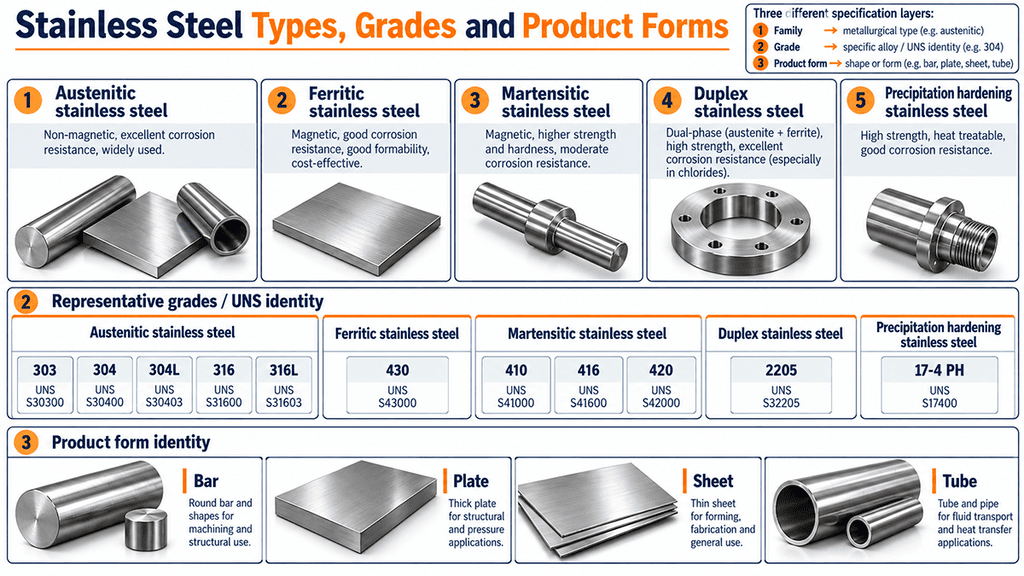
ISO 15510:2014 is useful for stainless steel classification, wrought grade identification and international composition comparison. It does not replace the product specification for a stainless steel bar, plate, sheet, tube or finished CNC part. When you buy raw material, the grade or UNS designation still has to be paired with the correct product form, delivery condition, dimensions and certification requirements.
ASTM A276/A276M-25 shows the product form boundary clearly. It covers hot finished and cold finished stainless steel bars plus specified hot rolled or extruded shapes. It should not be used automatically for plate or tube simply because the material is 304 stainless steel or 316 stainless steel.
2. Stainless Steel Types and Grades for Machined Parts
What are the grades of stainless steel that matter for machined parts? The main types of stainless steel and stainless steel material grades do not share one machining or corrosion profile. Austenitic stainless steel covers common 300 series stainless steel grades such as 304, 304L, 316 and 316L. Ferritic stainless steel and martensitic stainless steel sit within the broad 400 series stainless steel market language, while duplex stainless steel and precipitation hardening stainless steel have their own composition and condition logic.
2.1 304, 304L, 316 and 316L Stainless Steel
ASTM A276/A276M-25 separates 304, 304L, 316 and 316L by Type and UNS designation. The stainless steel carbon content is one key difference: 304 and 316 allow up to 0.08% carbon, while 304L and 316L limit carbon to 0.030%. The stainless steel nickel content also changes by grade, and 316 or 316L includes 2.00 to 3.00% molybdenum in the cited bar specification.
| Material grade | UNS | C max | Cr | Ni | Mo | Decision meaning |
| 304 stainless steel | S30400 | 0.08% | 18.0 to 20.0% | 8.0 to 11.0% | Not specified in cited A276 chemistry | General austenitic choice when service exposure does not require the molybdenum bearing 316 family. |
| 304L stainless steel | S30403 | 0.030% | 18.0 to 20.0% | 8.0 to 12.0% | Not specified in cited A276 chemistry | Choose the L grade when the lower carbon chemistry is part of the drawing or welding related requirement. |
| 316 stainless steel | S31600 | 0.08% | 16.0 to 18.0% | 10.0 to 14.0% | 2.00 to 3.00% | Use when the service environment justifies a molybdenum bearing austenitic grade and the non L grade is acceptable. |
| 316L stainless steel | S31603 | 0.030% | 16.0 to 18.0% | 10.0 to 14.0% | 2.00 to 3.00% | Use when the service environment points to the 316 family and the lower carbon designation is required. |
Source note: ASTM A276/A276M-25, Table 1 chemistry for stainless steel bars and shapes. The values are specification limits for those product forms, not a universal material table for every plate, sheet or tube.
The published 316 vs 316L stainless steel guide examines the carbon distinction without treating the L suffix as a machinability rating.
2.2 303 and 416 Free Machining Stainless Steel
Free machining stainless steel is a separate product choice, not a machining condition applied to 304 or 410. ASTM A582/A582M-22 covers free machining stainless steel bar grades including 303 stainless steel, UNS S30300, and 416 stainless steel, UNS S41600. In the reviewed chemistry, common sulfur modified grades such as 303 and 416 require at least 0.15% sulfur.
That chemistry is why a 303 vs 304 stainless steel decision is not just a feeds and speeds question. 303 is selected when chip breaking and machining productivity are primary requirements and the service environment allows the trade. Likewise, 303 vs 316 stainless steel should be decided from both machining demand and corrosion exposure, not from a generic machinability score.
2.3 410, 420, 430 and 17-4 PH
410 stainless steel and 420 stainless steel are martensitic grades whose mechanical requirements depend strongly on condition. 430 stainless steel is ferritic and should not be treated as a low cost substitute for every 300 series application. 17-4 stainless steel, commonly written as 17-4 PH stainless steel, is a precipitation hardening grade and requires explicit heat treatment condition control.
One standard boundary matters in procurement: the reviewed ASTM A276/A276M-25 Table 1 does not list UNS S17400. That edition should not be cited as the bar purchasing basis for 17-4 PH.
2.4 Common Grade Comparison Questions
| Search or design question | What the standards support | Decision use |
| 304 vs 316 stainless steel | The cited A276 chemistry adds 2.00 to 3.00% Mo to 316 or 316L, while 304 or 304L does not carry that Mo requirement. | Use the service environment to decide whether the 316 family is justified. |
| 316 vs 304 stainless steel | Same chemistry distinction viewed from the opposite selection direction. | Do not upgrade by habit. Check chlorides, chemicals, cleaning and exposure first. |
| 316 vs 316L | Maximum carbon changes from 0.08% to 0.030% in the cited bar specification. | The L grade is a chemistry callout, not an easier machining version. |
| 304 vs 304L | Maximum carbon changes from 0.08% to 0.030%. | Select the L grade only when the lower carbon requirement is relevant to the product. |
| 304 vs 430 stainless steel | Austenitic and ferritic families have different composition and property logic. | Do not substitute on appearance or price alone. |
| 303 vs 304 stainless steel | A582 free machining chemistry is different from conventional 304 chemistry. | Use 303 when machining productivity matters and the service requirements permit it. |
| 304 vs 316L | This comparison changes both alloy family chemistry and carbon designation. | Separate the Mo question from the L grade question. |
| What is the difference between 304 and 316 stainless steel? | For the cited bar chemistry, Mo is the clearest specification difference relevant to corrosion selection. | Check the actual product standard and exposure before approving a substitution. |
3. Stainless Steel Properties: Density, Hardness and Tensile Strength
Stainless steel properties only become useful when they are tied to a grade, product form and condition. Properties of stainless steel taken from a generic web chart can be wrong for your purchase if the chart mixes plate, bar, annealed stock and cold worked stock. The stainless steel material properties below are therefore separated by source and condition.
3.1 Stainless Steel Density and Mechanical Properties
| Property | Verified example | Source boundary | Why it matters |
| Stainless steel density | 304 and 304L: 7.9 g/cm³ at 20°C. 316 and 316L: 8.0 g/cm³ at 20°C. | Outokumpu Core and Supra manufacturer datasheets. These are physical property data for the named product ranges. | Use density for mass and inertia estimates. Do not assume every stainless grade has one universal density. |
| Stainless steel tensile strength | 304 and 316 Condition A hot finished bar: 515 MPa minimum. 304L and 316L: 485 MPa minimum. | ASTM A276/A276M-25 bar requirements. | Use only when the product form and condition match the cited specification. |
| Yield strength | 304 and 316 Condition A hot finished bar: 205 MPa minimum. 304L and 316L: 170 MPa minimum. | ASTM A276/A276M-25 bar requirements. | Do not copy the number into a plate or finished part design without checking the governing product specification. |
| Stainless steel hardness | Condition dependent. A276 uses different requirements for martensitic grades and A582 uses Brinell hardness for free machining bar acceptance. | ASTM A276/A276M-25 and ASTM A582/A582M-22. | Hardness is not one generic stainless steel value. Confirm grade and supply condition before planning cutting or heat treatment. |
Cold finishing can also change stainless steel mechanical properties. Under ASTM A276/A276M-25, Condition A 304 or 316 cold finished bar at 12.70 mm or below has minimum tensile and yield requirements of 620 MPa and 310 MPa, while the cited hot finished minimums are 515 MPa and 205 MPa. Those are specification minima, not universal stainless steel strength values.
The stainless steel properties resource helps compare grade families before the drawing is finalized.
4. CNC Machining Stainless Steel: Work Hardening, Heat and Chip Control
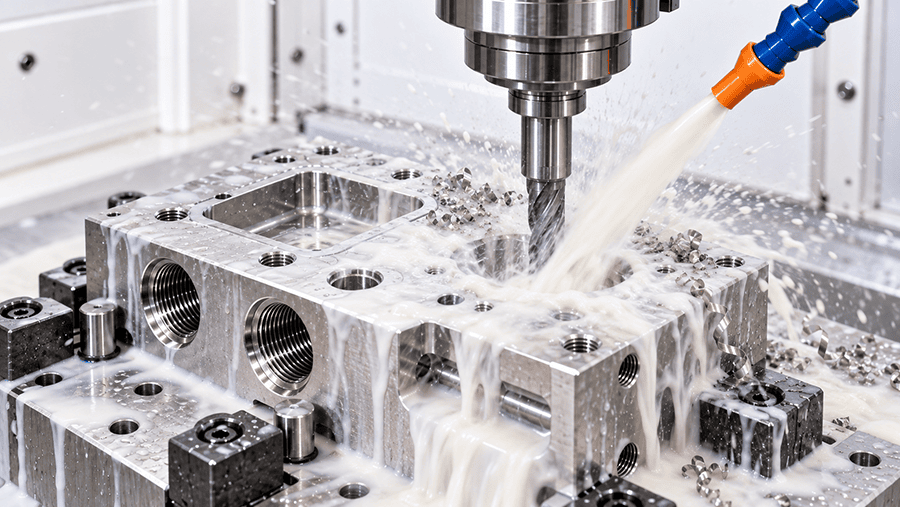
CNC machining stainless steel becomes difficult when the process lets the cutting edge rub, recut chips, lose rigidity or accumulate heat. Stainless steel machining is therefore a feature and process problem as much as a grade problem. A CNC stainless steel part with a shallow open pocket is not equivalent to one with a long reach bore, intersecting passages and a controlled sealing surface.
4.1 Work Hardening Stainless Steel
Work hardening stainless steel during cutting is different from buying material in a strain hardened supply condition. ASTM A276 Condition S describes a supplied condition created by relatively light cold work. Stainless steel work hardening at the cutting zone develops locally from deformation and rubbing. A standard such as A276 does not give a universal feed, speed or toolpath that prevents it.
Machining 304 stainless steel and machining 316 stainless steel both require attention to edge engagement, chip evacuation, coolant access and dwell. 304 stainless steel machinability and 316 stainless steel machinability should be judged from the actual feature and condition, not a single rating. Stainless steel cutting becomes more sensitive to local hardening during stainless steel drilling, stainless steel turning and stainless steel milling when the tool repeatedly returns to the same heat affected or rubbed surface.
4.2 Measured 316L Manifold Case
EPOC CRAFTER machined a 48 piece low volume batch of 316L fluid control manifolds from solution annealed ASTM A240/A240M-24a plate. The finished part measured 118.00 × 76.00 × 24.00 mm. Critical requirements included an Ø12.000 +0.018/0.000 mm spool bore, Ø0.050 mm true position to datums A, B and C, 0.030 mm sealing face flatness, and Ra ≤0.8 µm on the spool bore and sealing face.
During the initial process trial, the Ø12 bore showed rising spindle load and size drift when the reamer dwelled at the bore entrance. Deep drilling and side port machining produced long stringy chips and visible chip recutting. The process also showed localized heat, progressive flank wear, light reamer edge micro chipping, light material adhesion and burrs at intersecting holes.
The released process removed the dwell, increased feed through the affected zone, added through coolant, shortened effective tool overhang, replaced the worn reamer, added a dedicated light sealing face finish pass and standardized cross hole deburring. Across the batch, the spool bore measured Ø12.006 to Ø12.014 mm. Sealing face flatness measured 0.012 to 0.024 mm, true position measured Ø0.021 to Ø0.039 mm, sealing face roughness measured Ra 0.42 to 0.68 µm and spool bore roughness measured Ra 0.36 to 0.61 µm. All 48 parts passed final inspection. Two parts required burr rework and there was no scrap.
This case is evidence for one geometry and one process route, not a universal 316 stainless steel machinability claim. It shows why machinability of stainless steel should be reviewed at the feature level. The stable result depended on dwell control, coolant delivery, overhang, tool condition and feature specific finishing.
The published 316L CNC machining case provides a separate example in which residual stress and long cantilever geometry control the process.
4.3 Stainless Steel for Machining Is a Grade Plus Geometry Decision
The best stainless steel for machining is not one universal grade. Free machining stainless steel such as 303 or 416 can reduce chip control problems when the service requirements allow those grades, but geometry can still dominate the quote. A deep bore, thin wall, long tool reach or demanding surface can add more risk than a simple change in alloy family.
The CNC DFM guidelines help identify tool access, wall thickness, corner and inspection risks in stainless steel part designs before the RFQ reaches the shop.
EPOC CRAFTER’s CNC machining stainless steel parts capability page defines the manufacturing route after the material and CTQs are fixed.
5. Stainless Steel Corrosion Resistance: Why Does Stainless Steel Rust?
Stainless steel corrosion resistance is high compared with many plain carbon steels, but stainless steel is not corrosion proof. Does stainless steel rust? Yes, under the wrong combination of alloy, surface condition and environment. Can stainless steel rust even when the MTR chemistry is correct? Yes. Contaminant iron, heat tint, crevices, chlorides and unsuitable cleaning history can all change the finished surface behavior.
Why does stainless steel rust in chloride service? The answer depends on more than bulk chromium. The cited ASTM A276 chemistry gives 316 and 316L 2.00 to 3.00% molybdenum, which is one reason 316 stainless steel corrosion resistance is considered for more demanding chloride exposure than 304. That does not create a service life guarantee, and 304 stainless steel corrosion resistance can still be fully adequate in environments that do not justify the 316 family.
Stainless steel pitting corrosion and stainless steel chloride corrosion are service environment questions. ASTM A967 passivation verification does not provide a universal corrosion rate, chloride concentration limit, pitting resistance number or field life. The corrosion resistance of stainless steel therefore has to be separated into alloy selection, surface condition and the actual exposure.
6. Stainless Steel Pickling, Passivation and Surface Finish
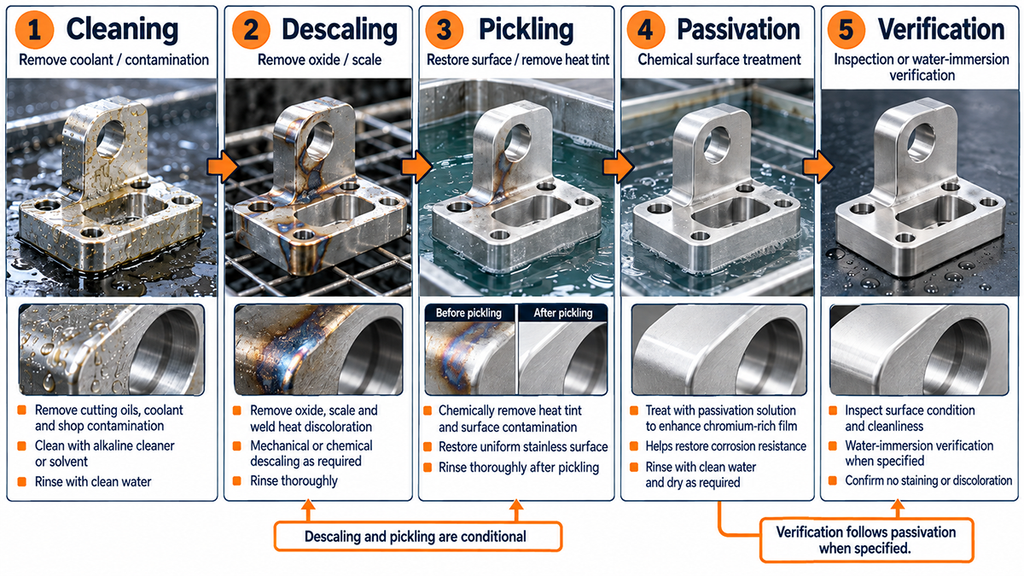
Stainless steel cleaning, stainless steel pickling, passivation of stainless steel and stainless steel polishing are different operations. Stainless steel finishing should specify which operation is required. Combining them under one stainless steel surface treatment note creates ambiguity because each step solves a different surface problem.
| Surface condition | Operation | Purpose | Decision boundary |
| Oil, coolant, shop dirt | Stainless steel cleaning | Remove process contamination before later treatment or inspection. | Cleaning does not prove long term corrosion resistance. |
| Oxide scale or heat affected surface | Descaling or stainless steel pickling where required | Remove oxide scale or affected surface material. | Pickling can change a machined surface, so protect CTQs and verify dimensions where needed. |
| Contaminant iron after fabrication or machining | Stainless steel passivation | Apply the specified chemical treatment and verify treatment effectiveness. | Passivation does not repair burrs, scratches, dents or an out of tolerance surface. |
| Cosmetic or functional texture | Stainless steel polishing or another stainless steel surface finish | Change texture, appearance or roughness when the drawing requires it. | A cosmetic finish is not automatically a passivation treatment. |
6.1 Pickling and Passivation Are Not the Same Process
ASTM A380/A380M-25 is the broader practice for cleaning, descaling, pickling and passivation related procedures. Pickling stainless steel is therefore a surface restoration decision, not a synonym for passivation. ASTM A967/A967M-25 is narrower and covers chemical passivation treatments, rinsing, optional post cleaning treatments and verification. That is the practical passivation vs pickling boundary for machined parts.
Passivating stainless steel under A967 can use nitric, citric or other qualified chemical or electrochemical treatments. A drawing that only says passivate per ASTM A967 may still leave treatment and test selection to the supplier unless the purchase order defines them. What is stainless steel passivation in procurement terms? It is a specified chemical treatment plus an appropriate verification requirement, not a generic instruction to make the part more corrosion resistant.
Why passivate stainless steel after machining? One reason is to control contaminant iron or other anodic surface contamination introduced by tooling, handling or fabrication. Verification confirms the selected treatment requirement; it does not predict years of field life.
6.2 Finishing Route on the 316L Manifold
The manifold case used alkaline ultrasonic cleaning, potable water rinse, DI water final rinse and filtered air drying. Descaling and pickling were not required. The project specified Citric 2 passivation to ASTM A967/A967M-24, followed by visual cleanliness inspection and a water immersion verification test.
The project used the 2024 edition because that was the production requirement. The current article discusses ASTM A967/A967M-25 separately. The verification passed with no staining, rusting or visible free iron indication after the required exposure, and the post treatment dimensional recheck found no CTQ shift greater than 0.004 mm.
EPOC CRAFTER’s surface finishing services include stainless steel passivation and other finishing processes that can be specified after the drawing defines the required surface condition.
7. Stainless Steel Bar, Plate and Stock: Raw Material and MTR Verification
When an RFQ calls for stainless steel bar, stainless steel round bar or stainless steel bar stock, the grade name is only one part of the purchase definition. You still need the product specification, condition, finish, dimensions and certification. The same rule applies to stainless steel stock supplied as plate, sheet or another product form.
ASTM A276/A276M-25 purchase information for bars and shapes includes material name, shape, condition, finish, dimensions, cross section, Type or UNS designation, and the ASTM designation and year. Applicable general requirements are incorporated through ASTM A484/A484M. A 304 stainless steel bar or 316 stainless steel bar should therefore be purchased against the bar specification, while a plate project needs the correct plate specification.
Free machining bar needs the same discipline. A 303 stainless steel bar or 416 stainless steel bar falls under the free machining bar specification when that is the intended product. The 316L manifold case used plate under ASTM A240/A240M-24a, so applying A276 simply because the alloy was 316L would have been the wrong product standard.
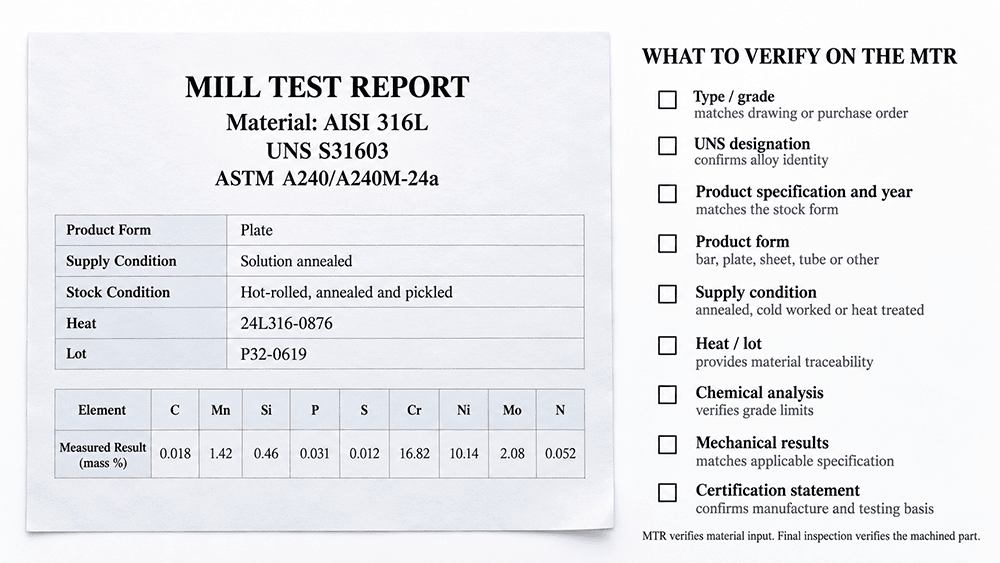
7.1 What to Verify on the MTR
| MTR field | Check | Decision impact |
| Type or grade | Matches the drawing or purchase order. | Prevents a familiar trade name from replacing the exact alloy callout. |
| UNS designation | Matches the intended alloy identity. | Useful when Type names or international cross references could be ambiguous. |
| Product specification and year | Matches bar, plate or other stock form and the contract requirement. | Confirms that chemistry and mechanical acceptance come from the correct product standard. |
| Heat and lot | Traceable to the supplied stock. | Connects the certificate to the material actually used on the job. |
| Chemical analysis | Meets the applicable grade limits. | Confirms alloy identity such as Cr, Ni, Mo and carbon limits. |
| Mechanical results and condition | Match the applicable specification and supply state. | Prevents annealed, cold worked or heat treated stock from being treated as equivalent. |
| Certification statement | Confirms manufacture and testing to the specification. | Material certification does not replace finished part inspection or passivation verification. |
The manifold MTR recorded 316L, UNS S31603, ASTM A240/A240M-24a, Heat 24L316-0876 and Lot P32-0619. Reported chemistry included Cr 16.82%, Ni 10.14%, Mo 2.08% and C 0.018%. Final part inspection remained separate and used a bridge CMM, air gauge or bore gauge, contact profilometer and thread plug gauges.
8. Which Stainless Steel Is Best for Machining and Application Selection?
Which stainless steel is best depends on what the finished part must do. For stainless steel for machining where cycle stability and chip control dominate, 303 or 416 may be candidates. For chloride bearing fluid service, the 316 family may be more relevant. For martensitic or precipitation hardening grades, supply condition and heat treatment can dominate both machining and final properties.
| Candidate | Why it may fit | Do not choose it until you check |
| 303 stainless steel | Free machining austenitic bar when chip control and throughput are primary. | Corrosion exposure, welding, finishing and product form. |
| 304 or 304L stainless steel | General austenitic family for many fabricated and machined parts. | Whether the service environment requires Mo, and whether the L grade is actually required. |
| 316 or 316L stainless steel | Mo bearing austenitic family for more demanding chloride or chemical exposure. | Product form, exact service conditions, machining geometry and post machining treatment. |
| 416 stainless steel | Free machining martensitic bar when machinability and martensitic properties fit the design. | Condition, hardness, corrosion demand and heat treatment route. |
| 410 or 420 stainless steel | Martensitic choices when condition dependent strength or hardness matters. | Incoming and final heat treatment condition. |
| 430 stainless steel | Ferritic stainless option for applications that fit its property set. | Do not substitute for 304 only on price or appearance. |
| 17-4 PH stainless steel | Precipitation hardening choice when higher strength is part of the design. | Correct product specification and explicit condition. |
Stainless steel applications and stainless steel uses also need precise language. Food grade stainless steel and medical grade stainless steel are application labels, not single universal material grades. When a project specifies stainless steel for food industry equipment, stainless steel for marine applications or a medical device, the drawing still needs the exact grade, product specification, condition, finish and applicable regulatory or customer requirements.
The CNC machining materials guide helps compare stainless steel with aluminum, plastics and other material families before the material is finalized on the drawing.
9. FAQ
9.1 Does Stainless Steel Rust?
Yes. Stainless steel can rust or stain when the surface is contaminated, the passive condition is disrupted, or the environment exceeds the selected grade’s resistance. The engineering question is not simply whether stainless steel rust can occur, but why does stainless steel rust in the actual exposure and whether alloy selection, surface treatment or geometry needs to change.
9.2 Is Stainless Steel Hard to Machine?
It can be, especially when rubbing, heat, poor chip evacuation or long tool reach destabilize the cut. Modern tooling does not remove those constraints, but a stable process keeps the edge cutting instead of dwelling and verifies the feature with the correct inspection method.
9.3 Does Stainless Steel Work Harden?
Yes, but supplied strain hardening and machining induced work hardening are different. Austenitic grades such as 304 and 316 can harden locally during deformation, while ASTM A276 Condition S is a defined material supply condition. The process plan should not treat those as the same thing.
9.4 What Is Stainless Steel Passivation?
Stainless steel passivation is a chemical treatment used to control contaminant iron or other anodic surface contamination and to meet a defined verification requirement. It is not the same as polishing, pickling, deburring or a service life test.
9.5 Which Stainless Steel Is Best for Machining?
There is no universal best grade. Free machining grades such as 303 and 416 can be strong choices when machining productivity dominates and the service requirements allow them. 304, 316, martensitic and precipitation hardening grades may be better choices when corrosion, welding, strength or heat treatment controls the design.
Before You Release the RFQ
| Check | Release condition |
| Material identity | Exact Type or grade and UNS designation are stated where needed. |
| Raw stock | Product form, governing material specification, condition and required certification are defined. |
| Machining CTQs | Critical dimensions, GD&T and Ra requirements are explicit and measurable. |
| Surface treatment | Cleaning, pickling, passivation, polishing or other finishing is called out only when required, with acceptance criteria where needed. |
| Evidence | MTR, dimensional inspection, roughness data and passivation verification are separated rather than treated as one certificate. |
Release the quote only after those five items agree with the service environment and the actual geometry. That prevents a broad stainless steel material grade from carrying requirements that belong in the drawing, product specification or finishing note.
Ready to Quote Your CNC Prototype?
Upload your STEP file and get a DFM review + quote within 12 hours.
No tooling cost. Minimum 1 part.