

Dewey Wu General Manager & senior mechanical engineer at EPOC CRAFTER, 15 years in design engineering, quality, and metallurgy. Hands-on across CNC machining, metalwork, sheet metal, and prototyping (subtractive + 3D printing).
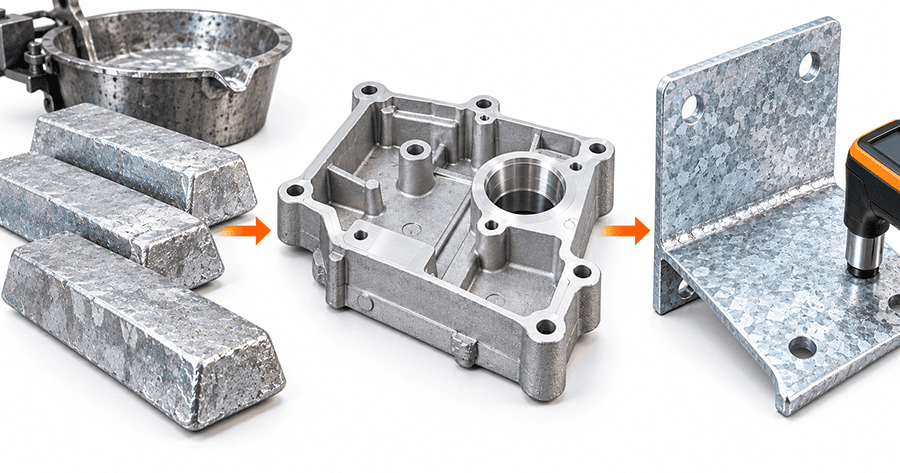
Zinc is a metallic element, Zn, with atomic number 30, but in manufacturing the word can mean three different things: zinc metal or a zinc alloy used as the part, zinc alloy feedstock used to make a casting, or a zinc coating applied to steel. Those products are not interchangeable. ASTM B86-23 governs specified zinc and zinc-aluminum castings, ISO 301:2006 governs zinc-alloy casting feedstock, and ISO 1461:2022 or ASTM A123/A123M-24 govern batch hot dip galvanizing on fabricated iron and steel. For an RFQ, the practical question is not only what is zinc. It is which zinc material or coating you are buying, what process makes it, and what requirement controls acceptance.
1. What Is Zinc?
Zinc metal is a bluish-white metallic element with the symbol Zn. PubChem lists a density of 7.134 g/cm³ and a melting point of 419.53°C for elemental zinc. These values answer what is zinc made of at the elemental level, but they do not define the properties of a finished Zamak or ZA casting.
For engineering work, the useful types of zinc are easier to separate by product form. A zinc material can be elemental zinc, a zinc alloy, casting feedstock, or a coating on another metal. The main zinc applications in this article are cast components, secondary machining of castings, and corrosion protection on iron and steel. That scope is more useful to a mechanical engineer or buyer than a general list of zinc uses.
| Product form | Primary standard | What it controls | Decision meaning |
| Zinc alloy ingot or liquid feedstock | ISO 301:2006 | Designation, chemistry, marking, traceability | Use for incoming casting material identity, not finished-part performance. |
| Zinc or ZA casting | ASTM B86-23 | Alloy identity, chemistry, casting acceptance framework | Use with the drawing or PO for dimensions, soundness, finish, and pressure tightness. |
| Hot dip galvanized iron or steel | ISO 1461:2022 or ASTM A123/A123M-24 | Coating acceptance on applicable fabricated iron and steel products | Use for zinc coating requirements, not Zamak or ZA alloy requirements. |
2. Zinc Physical Properties That Matter in Manufacturing
The properties of zinc only help a design decision when the material condition is clear. Zinc density, zinc melting point, and zinc electrical conductivity describe elemental zinc unless a source states a specific alloy and condition. The same rule applies to zinc hardness and other zinc mechanical properties.
| Property | Verified elemental zinc value | Engineering use |
| Density | 7.134 g/cm³ | Use for mass estimates and material comparisons, not as a Zamak alloy value. |
| Melting point | 419.53°C | Explains the low melting temperature of zinc metal, but is not a die-casting machine setpoint. |
| Thermal conductivity | about 115 W/m·K at 298.2 K in NIST reference data | Use pure-zinc data only when the design actually uses elemental zinc. |
For broader zinc material properties and grade selection, use the actual alloy or product form rather than copying a pure-zinc value into a casting calculation.
2.1 Zinc Alloy Properties Need a Test Condition
ASTM B86-23 makes chemistry mandatory for the specified casting alloy, but tensile or impact properties are not default acceptance requirements unless the contract, purchase order, or drawing says so. Appendix X2 reports typical test-specimen data. It does not set a guaranteed minimum for every production casting. A separately cast test bar, a specimen cut from a production casting, and the local behavior of the finished part are different evidence.
This is why a search for zinc tensile strength or zinc hardness needs an alloy and test basis. For ZA alloys, ASTM B86 also separates typical property data by casting method. A die-cast value should not be transferred to a sand-cast ZA part.
3. Zinc Alloys: Zamak and ZA
A zinc alloy is not one material. ASTM B86-23 identifies Zamak 3, Zamak 5, Zamak 7, Zamak 2, ZA-8, ZA-12, ZA-27, and ACuZinc 5 as distinct compositions. Zamak is a traditional zinc-aluminum-magnesium-copper family name. The ZA series is a zinc aluminum alloy family with higher aluminum contents.
3.1 What Is Zamak?
A Zamak alloy is a zinc-base casting alloy, but the grade still matters. Zamak 3 and Zamak 5 share the ASTM B86 aluminum range of 3.7 to 4.3%, while Zamak 5 contains 0.7 to 1.2% copper and Zamak 3 limits copper to 0.10% maximum. A drawing that only says “Zamak” leaves the material identity incomplete.
| ASTM B86 alloy | UNS | Al, % | Mg, % | Cu, % |
| Alloy 3 / Zamak 3 | Z33525 | 3.7 to 4.3 | 0.020 to 0.060 | 0.10 max |
| Alloy 5 / Zamak 5 | Z35533 | 3.7 to 4.3 | 0.030 to 0.080 | 0.7 to 1.2 |
| ZA-8 | Z35638 | 8.0 to 8.8 | 0.010 to 0.030 | 0.8 to 1.3 |
| ZA-12 | Z35633 | 10.5 to 11.5 | 0.010 to 0.030 | 0.5 to 1.2 |
| ZA-27 | Z35841 | 25.0 to 28.0 | 0.010 to 0.020 | 2.0 to 2.5 |
4. Zinc Die Casting: Material, Porosity, and Acceptance
Zinc die casting begins with material identity, then moves to the drawing. ISO 301:2006 controls zinc-alloy feedstock supplied as ingot or liquid metal for casting. ASTM B86-23 controls specified zinc and ZA castings. Neither standard is a complete zinc die casting design guide.
For zinc alloy die casting, a clearer callout is “ASTM B86-23 Alloy 3, UNS Z33525” rather than “zinc alloy.” The same logic applies to zinc die cast parts made from ZA grades. ASTM B86 does not publish one universal zinc die casting tolerance or porosity percentage. Drawing or PO requirements control specified dimensions, while unspecified die-casting tolerances are referred to NADCA. Internal soundness and pressure tightness are project requirements when they matter.
EPOC CRAFTER’s metal casting defects and machining guide shows why near-net casting geometry and final machined acceptance need separate controls.
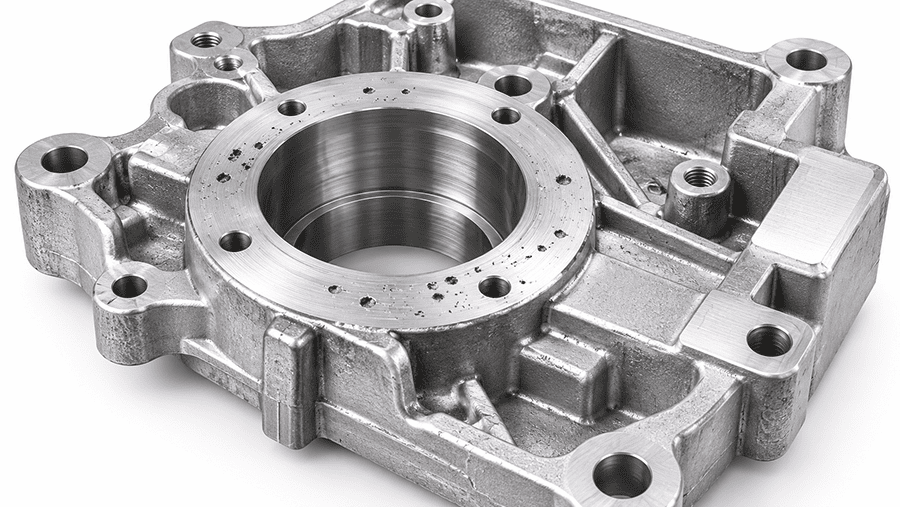
Die cast zinc can be a good manufacturing route for complex geometry, but “zinc die cast” does not mean every surface is finished to the same requirement. Zamak die casting, zinc casting, and other zinc die casting alloys still need explicit CTQs for bores, threads, datums, sealing faces, and pressure boundaries.
5. Zinc CNC Machining After Casting
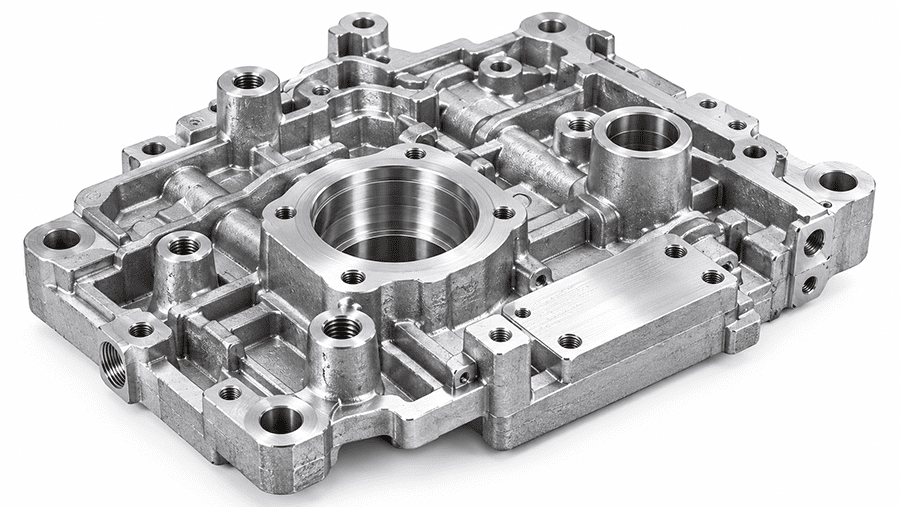
Zinc CNC machining is a secondary operation, not a requirement created by ASTM B86. The standard does not specify cutting speed, feed, tool grade, coolant, machining allowance, minimum wall after machining, or an allowable amount of porosity exposed by a cut.
Machining zinc castings makes sense when the function needs tighter size, position, thread quality, or surface texture than the agreed as-cast condition. Typical CTQs include bearing bores, threaded holes, sealing lands, mating faces, and datum pads. Machining can also expose subsurface discontinuities, so the drawing should identify critical regions instead of using a vague “no porosity” note.
For these features, zinc CNC machining capabilities should be paired with CNC tolerance and inspection standards so the machining and verification method match the CTQ.
Search phrases such as machining zinc, zinc machining, and zinc alloy machining all point to the same decision: define the alloy, feature, tolerance, surface requirement, fixturing constraint, and inspection method before selecting a cutting process.
6. What Is Galvanizing? Hot Dip Galvanizing and Zinc Coating
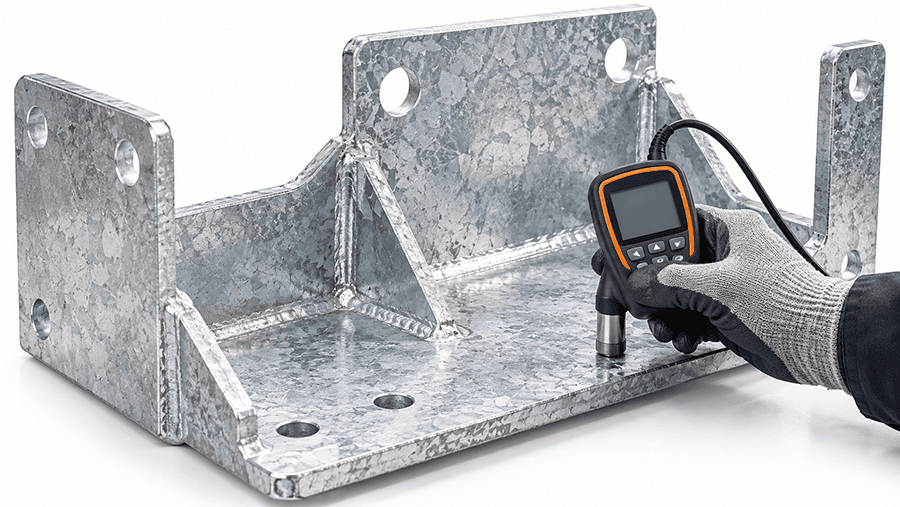
What is galvanizing in this context? It is a corrosion-protection process applied to iron or steel, not a method of making a Zamak part. In the hot dip galvanizing process, a fabricated iron or steel article is immersed in zinc melt to form a zinc or zinc-iron coating. ISO 1461:2022 and ASTM A123/A123M-24 are separate acceptance systems for applicable batch hot dip galvanized steel products.
A zinc coating thickness is an acceptance requirement, not a guaranteed service-life clock. ASTM A123/A123M-24 uses material category, measured steel thickness, and coating grade. ISO 1461 uses local thickness, mean thickness, reference area, and control-sample concepts. The two standards should not be treated as identical tables.
The distinction between zinc plating and surface finishing and batch hot dip galvanizing matters on threads, bearing seats, electrical contacts, and other precision interfaces.
Hot dip galvanized steel, zinc coated steel, and galvanized coating requirements also depend on the product form. Certain threaded or centrifuged hardware can fall under ASTM A153/A153M rather than A123/A123M. A note that only says “zinc galvanizing” or “galvanized per ASTM” is therefore incomplete.
For sheet and fabricated-product context, galvanized steel material selection helps separate substrate selection from the coating requirement.
6.1 Galvanized vs Zinc Plated
Galvanized vs zinc plated is not a cosmetic wording choice. Hot dip galvanizing uses immersion in molten zinc. Zinc electroplating uses an electrochemical deposition process. The zinc plating vs galvanizing decision changes coating build, fit allowance, applicable standard, repair method, and inspection. The drawing should name the process that the function requires.
7. Does Zinc Rust? Zinc Corrosion and Zinc Oxidation
Does zinc rust? Zinc corrodes, but the corrosion products are different from the red iron oxides normally called rust on steel. Zinc oxidation can form adherent corrosion products, and persistent moisture can produce visible white corrosion products often called zinc rust or white rust.
Does zinc corrode fast enough to matter? It depends on the environment, alloy, surface condition, moisture, contaminants, and whether zinc is the bulk material or a sacrificial coating. Zinc corrosion resistance is therefore not one universal number. The same point applies to galvanized steel corrosion resistance: coating thickness helps, but exposure conditions still control service life.
Is zinc corrosion resistant? In many atmospheric applications, yes, but not without limits. Marine exposure, trapped moisture, coating damage, and galvanic couples can change the corrosion rate. A zinc oxide layer is part of the surface response, not proof that the material is corrosion proof.
8. How to Specify Zinc in an RFQ or Drawing
A useful RFQ separates material identity, process route, functional CTQs, and inspection. That prevents one vague material note from being asked to control chemistry, porosity, machining, coating thickness, and corrosion life.
| RFQ item | Zinc or ZA casting | Galvanized steel |
| Material / standard | ASTM B86-23 plus alloy and UNS where applicable | Base steel grade plus ISO 1461:2022, ASTM A123/A123M-24, or the product-specific standard |
| Critical features | Individual dimensions, GD&T, machined CTQs | Threads, fits, masked surfaces, drainage and venting where relevant |
| Internal / coating acceptance | Soundness or pressure tightness only where functional | Applicable coating thickness, appearance, repair, and inspection criteria |
| Inspection | CMM, gauges, pressure test, radiography, sectioning as required | Coating-thickness measurement, visual inspection, and required conformity documentation |
Before release, DFM design rules for coated and machined features can be used to check whether machining, masking, venting, drainage, and inspection are defined at the right stage.
9. Zinc Compared With Other Metals
Zinc vs aluminum, zinc vs stainless steel, zinc vs brass, and Zamak vs aluminum are different comparisons because the manufacturing route changes with the material. A Zamak die casting should not be compared with “aluminum” as if all aluminum products had one process or property set. The alternative may be an aluminum die casting, machined 6061, an extrusion, or sheet metal.
For a weight-sensitive part, aluminum usually deserves attention because zinc density is higher. For a corrosion-critical part, stainless steel may remove the need for a sacrificial zinc coating. For turned fittings or electrical hardware, brass may be a more relevant comparator. Zinc alloy vs aluminum should therefore be decided from part function, geometry, quantity, finish, inspection, and service environment rather than a generic winner.
10. FAQ
10.1 What Is Zinc Alloy?
A zinc alloy is a zinc-base metal with controlled additions such as aluminum, magnesium, or copper. For casting procurement, “zinc alloy” is incomplete unless the grade or designation is identified.
10.2 What Is Zamak?
Zamak is a family of zinc casting alloys, not one single composition. ASTM B86 identifies Zamak 3, Zamak 5, Zamak 7, and Zamak 2 as separate alloy identities.
10.3 What Is Zinc Die Casting?
Zinc die casting injects molten zinc alloy into a metal die to produce a near-net-shape casting. Material identity still needs to be separated from drawing tolerances, internal soundness, and any secondary-machined CTQs.
10.4 Does Zinc Rust?
Zinc corrodes and can develop white corrosion products, especially when moisture remains on the surface. That is different from red iron oxide on bare steel.
10.5 What Is Galvanizing?
Galvanizing applies a zinc-based protective coating to iron or steel. Batch hot dip galvanizing is different from zinc electroplating and from making the part itself from a zinc alloy.
10.6 Is Zinc Corrosion Resistant?
Zinc provides useful corrosion resistance in many environments, but the result depends on exposure, alloy or coating condition, moisture, and galvanic contact. Saltwater or trapped moisture can be much more severe than dry indoor service.
For a zinc drawing or RFQ, name the product form first. Then specify the alloy or base steel, the process, the CTQs, and the acceptance method. That sequence keeps zinc alloy chemistry, die-casting quality, CNC machining, and galvanizing requirements from being mixed into one ambiguous note.
Ready to Quote Your CNC Prototype?
Upload your STEP file and get a DFM review + quote within 12 hours.
No tooling cost. Minimum 1 part.