

Dewey Wu General Manager & senior mechanical engineer at EPOC CRAFTER, 15 years in design engineering, quality, and metallurgy. Hands-on across CNC machining, metalwork, sheet metal, and prototyping (subtractive + 3D printing).
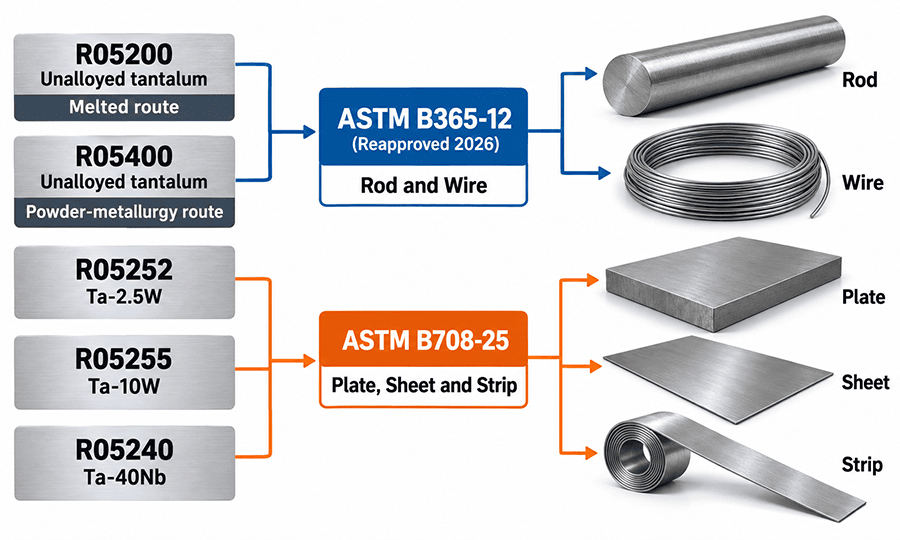
Tantalum machining starts with the material callout, not the cutter. A drawing that says only “tantalum” does not define the UNS grade, mill product, condition, or acceptance basis. ASTM B365-12 (Reapproved 2026) covers tantalum rod and wire, while ASTM B708-25 covers tantalum plate, sheet, and strip. In a 36-piece EPOC CRAFTER R05200 valve-seat job, the decisive machining issues were adhesion, built-up edge, long ductile chips, surface tearing, and clamp-induced ovality. For teams machining tantalum, this article connects tantalum properties and uses to grade selection, inspection, and RFQ controls. In CNC machining tantalum, the material identity and setup need to be fixed before feeds and speeds are treated as transferable data.
1. What Is Tantalum? Properties and Uses That Matter in Machining
Tantalum is a dense, ductile refractory metal, symbol Ta, atomic number 73. The Royal Society of Chemistry lists a tantalum melting point of 3017°C and a tantalum density of 16.4 g/cm³ at 20°C. If the search starts with “what is tantalum,” those are useful identifiers, but a tantalum material callout still needs a grade and condition.
| Property | Verified basis | Decision use |
| Tantalum density | 16.4 g/cm³ at 20°C | Mass, fixturing load and material-cost calculations use actual volume and density. |
| Tantalum melting point | 3017°C | Confirms refractory-metal status; it is not a CNC cutting temperature or service limit. |
| Tantalum hardness | No B365 hardness acceptance table | Do not label a supplier hardness value as an ASTM B365 requirement. |
| Tantalum tensile strength / tantalum yield strength | Grade, form and condition dependent under ASTM material tables | Use the table for the exact UNS, product form, size and condition. |
| Tantalum ductility / corrosion behavior | USGS describes tantalum as ductile and highly resistant to acid corrosion | Relevant to chip behavior and chemical-service selection; corrosion life still needs medium-specific data. |
Tantalum thermal conductivity and tantalum electrical conductivity matter in electronics and thermal designs, but exact design values need a grade-specific source. Searches for tantalum heat resistance or tantalum refractory metal applications also need service-specific temperature data.
Tantalum uses span chemical processing, heat exchangers, electronics, medical implants, and high-temperature hardware. These tantalum applications are driven by different service requirements. The CNC machining materials guide is a closer comparison point when tantalum is being weighed against common CNC alloys.
Tantalum chemical resistance is a major reason to consider the metal for wetted chemical equipment. Tantalum medical implants, tantalum biomedical applications, and broader tantalum medical applications need a separate material-compliance path. Tantalum capacitors remain an important electronic use, but capacitor design is outside this article.
2. Tantalum Grades and Stock Forms
Material identity comes before machinability. ASTM B365-12 (Reapproved 2026) and ASTM B708-25 both cover five tantalum alloy or unalloyed material identities, but they apply to different mill products. R05200 is melted unalloyed tantalum. R05400 is powder-metallurgy consolidated unalloyed tantalum. “Pure tantalum” is incomplete as a purchase callout.
| UNS | Common description | Verified identity / composition point | Purchase implication |
| R05200 | Unalloyed tantalum | Melted route | B365 rod/wire; B708 plate/sheet/strip |
| R05400 | Unalloyed tantalum | Powder-metallurgy consolidation | B365 rod/wire; B708 plate/sheet/strip |
| R05252 | Ta-2.5W | W 2.0 to 3.5 mass % under B365 | Do not use the nominal 2.5% as the acceptance range |
| R05255 | Ta-10W | W 9.0 to 11.0 mass % under B365 | Do not use the nominal 10% as the acceptance range |
| R05240 | Ta-40Nb | Nb 35.0 to 42.0 mass % under B365 | Tantalum niobium alloy; use UNS plus governing specification |
The tantalum tungsten alloy grades are R05252 and R05255. The shorthand Ta 2.5W, Ta 10W, and Ta 40Nb does not replace the UNS designation or acceptance range. R05240 is the tantalum niobium alloy in this standard set.
For stock form, B365 covers tantalum rod and tantalum wire. B708 covers tantalum plate, tantalum sheet, and tantalum strip. Some tantalum suppliers market “tantalum bar,” but the governing ASTM product terminology still matters. A tantalum supplier quote should state grade, standard, form, condition, dimensions, and certification. The EPOC CRAFTER case used R05200 tantalum in annealed rod form.
3. Why Tantalum Is Difficult to Machine
Tantalum machinability is often misunderstood because the metal is not difficult for the same reason as hardened steel or tungsten. In the EPOC CRAFTER case, annealed R05200 produced adhesion and built-up edge during finishing. Long ribbon chips wrapped around the bore tool, and material pickup on the rake face left smeared marks on the sealing face. The phrase tantalum work hardening appears in search queries, but the observed failure on this job was dominated by adhesion, rubbing, and loss of edge sharpness.
| Case stage | Recorded EPOC CRAFTER shop-floor data | Observed result / decision |
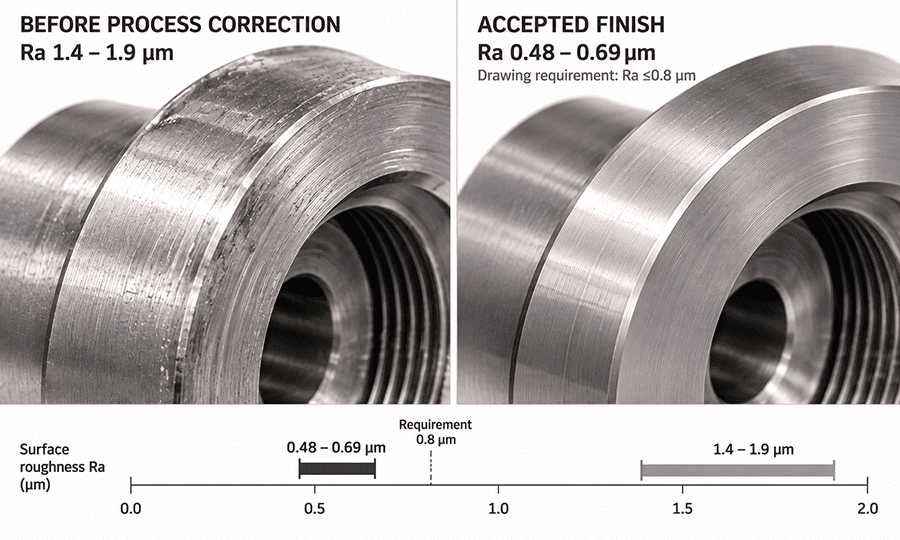
| Initial finish | 30 m/min; 0.035 mm/rev; 0.05 mm radial DOC; 6% coolant | Ra 1.4 to 1.9 µm on sealing face; drag marks and smearing |
| Stable finish | 20 m/min; 0.060 mm/rev; 0.15 mm radial DOC; 9% coolant | Ra 0.48 to 0.69 µm; sharp polished positive-rake carbide edge |
| Fixturing change | Chuck pressure 1.2 MPa to 0.55 MPa; soft jaws recut to about 80% contact | Initial 0.018 to 0.026 mm OD ovality after release no longer showed measurable permanent movement |
The case does not create a universal tantalum cutting recipe. It shows why a very light polishing cut can fail when the edge rubs or carries adhered material. The sealing-face requirement belongs on the drawing, and the CNC surface roughness chart gives the adjacent Ra terminology and process context.
4. Turning, Drilling, Milling and Threading
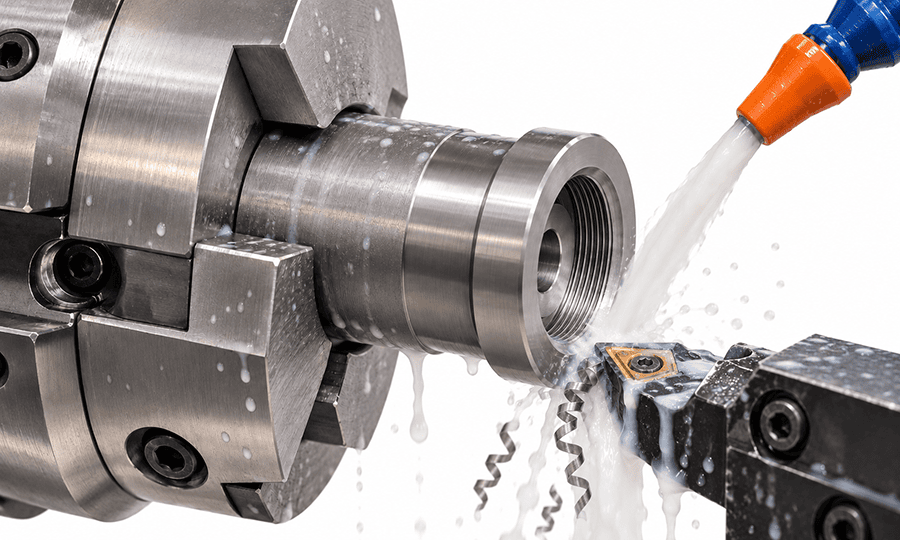
The documented route used tantalum turning, drilling, boring, and internal threading on a two-axis CNC turning center. Rough turning ran at 24 to 28 m/min and 0.12 mm/rev. Finish turning ran at 18 to 22 m/min and 0.06 mm/rev. The Ø8 mm through bore was drilled at 18 m/min and 0.07 mm/rev. The M20×1.5 thread used a full-profile carbide insert at 10 to 12 m/min. These are case values for annealed R05200, not universal feeds and speeds.
Tantalum drilling needs a cutting edge that stays engaged, with chip evacuation and coolant at the cutting zone. The case drill completed all 36 parts without replacement. Tantalum milling was not used on this job, so no EPOC CRAFTER milling speed or feed is claimed. Tantalum cutting tools, tool overhang, coolant delivery, chip load, and finish allowance should be evaluated as one process.
Tantalum fabrication can also include tantalum forming, tantalum welding, grinding, and secondary finishing. ASTM B365 and B708 do not prescribe those process parameters. Geometry, tool access, and clamping can be reviewed against the CNC DFM design guidelines before the RFQ is released.
5. Corrosion, Chemical and Medical Boundaries
Tantalum corrosion resistance can justify the material in aggressive chemical service, but the material certificate does not establish equipment life. ASTM B365 and B708 define mill products; they do not supply a universal tantalum corrosion rate, pressure rating, service temperature, welding procedure, or design life.
The EPOC CRAFTER case used annealed R05200 rod for a corrosion-resistant metering-valve seat that isolated wetted metal surfaces from concentrated acid service. That is evidence for the recorded application, not a claim that R05200 fits every acid, concentration, or temperature. Searches for tantalum chemical processing, tantalum chemical applications, tantalum chemical equipment, and tantalum heat exchanger design should lead to medium-specific corrosion data before material release.
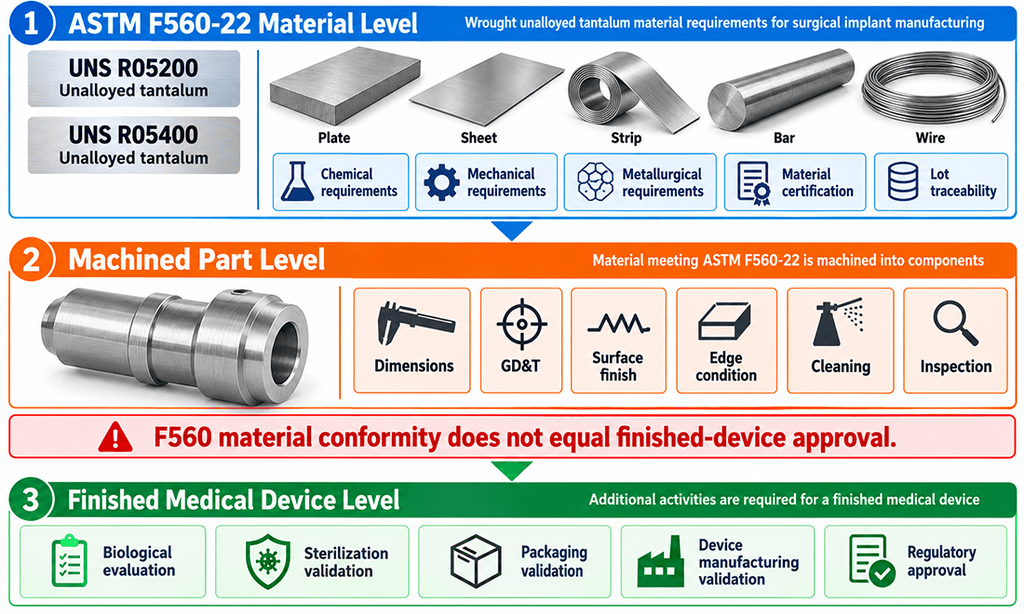
Medical use has a separate boundary. ASTM F560-22 covers wrought unalloyed R05200 and R05400 used to manufacture surgical implants. It does not turn B365 or B708 material into medical grade tantalum, and it does not cover Ta-2.5W, Ta-10W, or Ta-40Nb as F560 implant materials. “Implant grade tantalum” should resolve to a real grade and specification. Tantalum implants, including tantalum orthopedic implants, still need device-level controls such as those described on EPOC CRAFTER’s medical device CNC manufacturing page.
ASTM F560 material conformity does not certify the finished implant, sterilization, packaging, final dimensions, or regulatory approval. The FDA recognizes ASTM F560-22 as a consensus material standard, which does not change that material-level scope.
6. Tantalum RFQ and Inspection Checklist
Before releasing a tantalum CNC machining RFQ, connect the material certificate to the drawing and inspection plan. The 36-piece valve-seat case specified R05200, ASTM B365, annealed rod, heat T26-0417, lot 26-TA-083, and Ø38.10 × 76 mm cut blanks. The drawing controlled the finished part separately: Ø31.80 mm OD, Ø8.00 mm bore, ±0.015 mm on both features, 0.025 mm total runout, 0.020 mm sealing-face flatness, and Ra ≤0.8 µm on the sealing face.
| RFQ block | Specify | Decision value |
| Material identity | UNS grade, ASTM specification, stock form, condition | Prevents “pure tantalum” or “tantalum alloy” from becoming an ambiguous purchase callout |
| Traceability | Heat/lot and required MTR fields | Connects certified stock to the production lot |
| CTQ dimensions | Feature size, GD&T, thread and surface texture | Separates finished-part acceptance from mill-product tolerances |
| Inspection | Gauge or method where acceptance depends on method | Aligns supplier and customer verification |
| Quantity and documentation | Batch size, reports, cleaning and application requirements | Lets the quote include tooling, inspection and paperwork before release |
The case inspection matched each CTQ: micrometer on the OD, air gauge on the bore, V-block and 0.001 mm indicator for runout, optical flat for flatness, contact profilometer for roughness, and GO/NO-GO plug gauge for the M20×1.5 thread. Feature-level acceptance belongs on the drawing; the CNC drawing tolerance guide explains how to separate individual CTQs from general tolerances.
The final batch had 36 accepted parts, no rejects, and two parts reworked during process development and accepted after refinish and reinspection. That separation is the RFQ rule: material grade and MTR prove the stock; drawing and inspection prove the finished part.
7. Cost and Material Comparisons
Tantalum price is only one input to tantalum cost. The quote also moves with grade, tantalum stock form, buy-to-finished volume, tool-edge consumption, setup, inspection, documentation, and quantity. In the case, machining time was 42 minutes per part and cleaning plus inspection added 9 minutes. The finish turning edge was controlled at 6 parts per edge; the roughing edge reached 18 parts per edge.
| Element | Density | Melting point | Selection boundary |
| Tantalum | 16.4 g/cm³ | 3017°C | Corrosion-driven, refractory and specialized medical/electronic use; machining behavior in this article is based on R05200 case data |
| Tungsten | 19.3 g/cm³ | 3414°C | Higher density and melting point; do not transfer tantalum machining assumptions |
| Titanium | 4.506 g/cm³ | 1670°C | Much lower density; different strength-to-weight and machining problem |
Tantalum metal price should not be published as a fixed number without a supplier, form, quantity, and date. The same caution applies to searches such as tantalum vs tungsten, tantalum vs titanium, tantalum vs platinum, tantalum vs stainless steel, or tantalum vs niobium. Tantalum and niobium are related refractory metals, but they use different material standards and process assumptions.
For tantalum aerospace applications, tantalum industrial applications, and other tantalum high temperature applications, the RFQ logic still applies, but service-specific design data must come from the relevant specification or validated source.
8. FAQ
8.1 Is tantalum difficult to machine?
Yes. On the R05200 case, adhesion, built-up edge, long chips, surface tearing, and clamp distortion controlled the process. The case values above describe one annealed R05200 route, not a universal recipe.
8.2 What is the difference between R05200 and R05400 tantalum?
Both are unalloyed tantalum grades. R05200 is melted; R05400 is powder-metallurgy consolidated. State the UNS grade, standard, form, and condition on the purchase order.
8.3 Which specification applies to tantalum rod, wire, plate, sheet, and strip?
ASTM B365-12 (Reapproved 2026) covers rod and wire; ASTM B708-25 covers plate, sheet, and strip. ASTM F560-22 is a separate surgical-implant material specification for unalloyed tantalum.
8.4 Is tantalum biocompatible, and does ASTM F560 approve the finished implant?
ASTM F560-22 covers R05200 and R05400 raw material used to manufacture surgical implants. It does not approve the finished device; biological evaluation, sterilization, packaging, dimensional acceptance, and regulatory approval remain separate.
Ready to Quote Your CNC Prototype?
Upload your STEP file and get a DFM review + quote within 12 hours.
No tooling cost. Minimum 1 part.